Quiz · Hard
Calculation and reasoning questions on HHI, Cournot, Bertrand, payoff matrices, kinked demand, price discrimination and antitrust history.
Four firms hold market shares of 40, 30, 20 and 10 percent. What is the HHI?
10,000
3,000
100
1,000
1,600 + 900 + 400 + 100 = 3,000. The 100 is the CR4 (as a percent), not the HHI.
In a Cournot duopoly with P = 100 - Q and MC = 10, what is each firm's output?
30
22.5
90
45
Best response: Q1 = (90 - Q2)/2. Symmetric: Q = 30 each. 45 is the monopoly output, and 90 is the competitive one.
In the same Cournot duopoly, what is the market price?
$30
$40
$10
$55
Total Q = 60, P = 100 - 60 = 40. The $55 is the monopoly price, and $10 is the Bertrand price.
Two firms producing identical goods with the same constant MC compete on price (Bertrand). The equilibrium price is...
halfway between MC and the monopoly price
the monopoly price
above MC but below the monopoly price
equal to marginal cost
Any price above MC invites undercutting, so both firms price at MC.
In this payoff matrix, what is the Nash equilibrium?
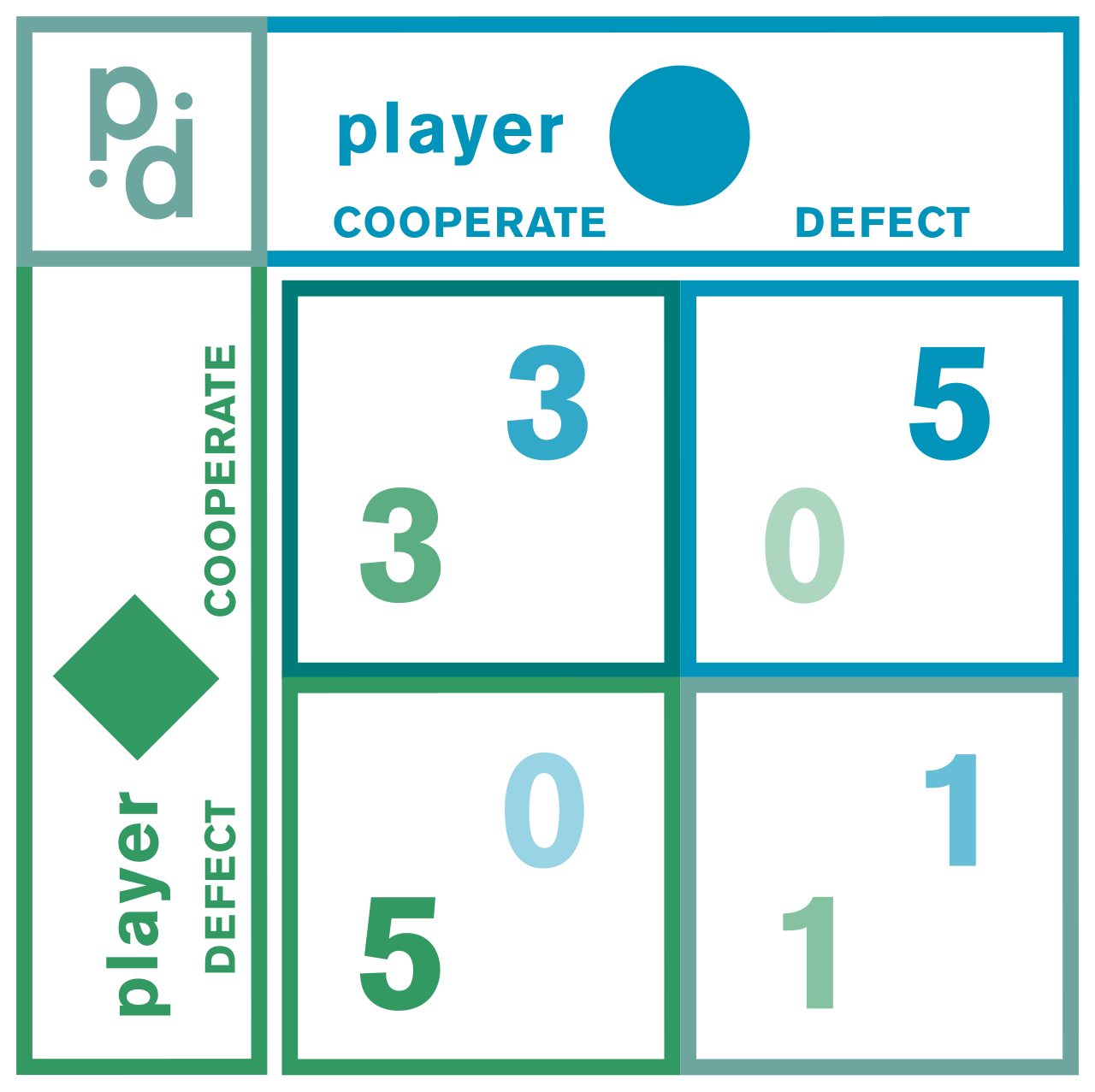
Row defects and column cooperates, giving (5, 0)
There is no Nash equilibrium
Both cooperate, giving (3, 3)
Both defect, giving (1, 1)
Defecting is a dominant strategy for each player. Mutual cooperation would be better for both, but isn't stable.
Image: Christopher X Jon Jensen and Greg Riestenberg, CC BY-SA 3.0, via Wikimedia Commons.
Which feature distinguishes the kinked demand curve model?
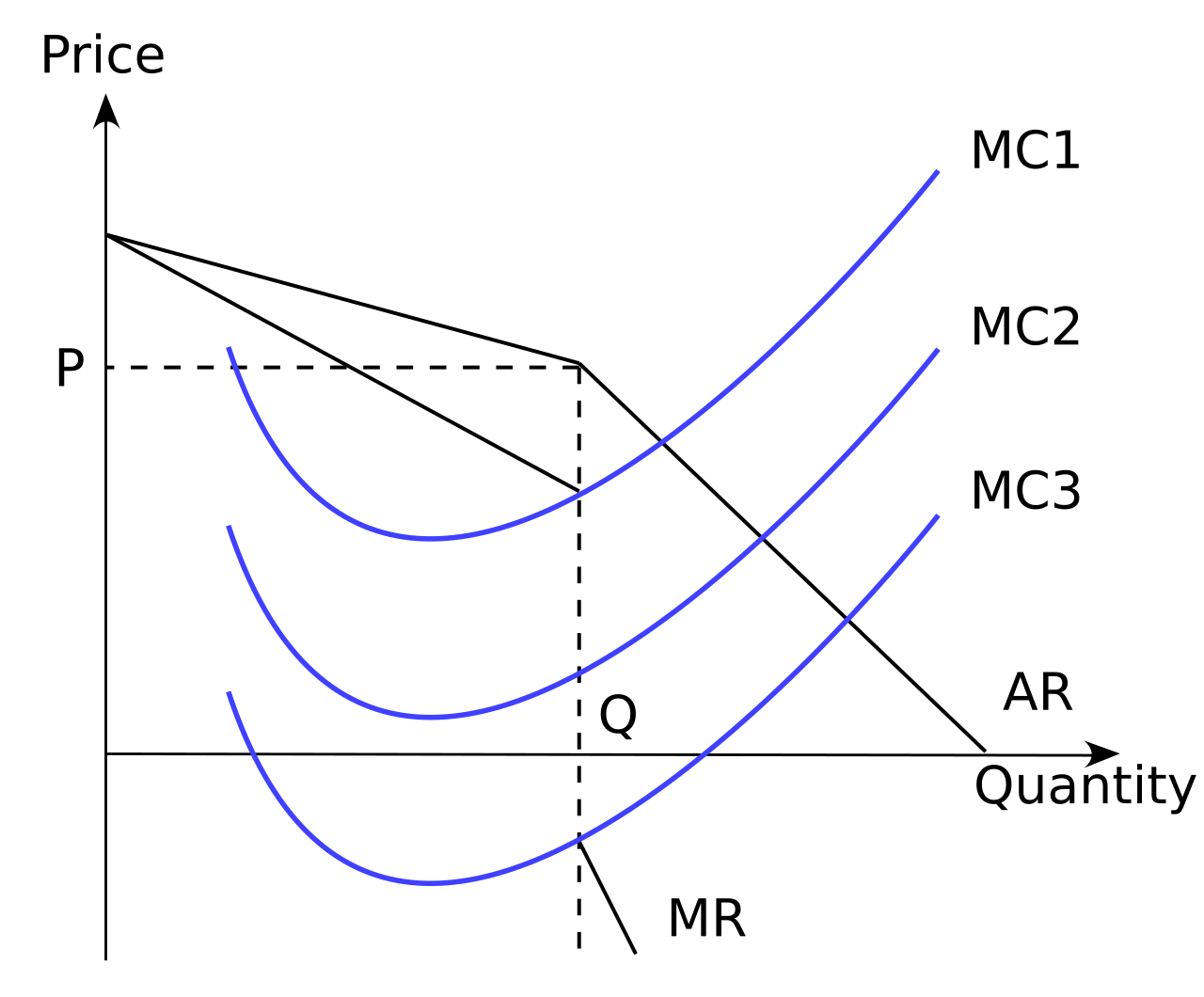
Rivals never react to price changes
Rivals match price cuts but not price increases
Firms choose quantities simultaneously
Rivals match price increases but not price cuts
This makes demand elastic above the kink and inelastic below it, so prices are sticky.
Image: Sheitan (English Wikipedia) and Jarry1250, CC BY-SA 3.0, via Wikimedia Commons.
In the kinked demand model, why can marginal cost change without changing price?
Marginal revenue is constant
Demand is perfectly elastic
Fixed costs don't matter
Marginal revenue has a vertical gap at the kinked quantity
If MC passes through the gap, the profit-maximizing output stays the same.
A monopolist faces P = 100 - 2Q and MC = 20. What is the deadweight loss compared with competition?
1,600
400
200
800
Competitive Q = 40, monopoly Q = 20 and P = 60. DWL = 1/2 x (60 - 20) x (40 - 20) = 400.
The Lerner index for a firm with |PED| = 4 is...
0.75
4
0.25
1
L = 1/|E| = 1/4. A firm with more inelastic demand has a larger markup.
A monopolist is operating where demand is inelastic. What should it do?
Lower price
Keep price and quantity
Raise price, because revenue rises and costs fall
Raise output
On the inelastic range, MR is negative, so a smaller output raises revenue and lowers cost.
An industry has ten firms with equal 10% shares. A merger of two of them changes the HHI from 1,000 to...
2,000
1,400
1,100
1,200
The merged firm has 20%, so HHI = 400 + 8 x 100 = 1,200. A merger raises the HHI by 2 x s1 x s2 = 200.
Which law, passed in 1890, made monopolization and agreements in restraint of trade illegal?
The Sherman Antitrust Act
The Federal Trade Commission Act
The Clayton Act
The Robinson-Patman Act
The Clayton and FTC acts came in 1914.
What was the main outcome of the 1911 Supreme Court case against Standard Oil?
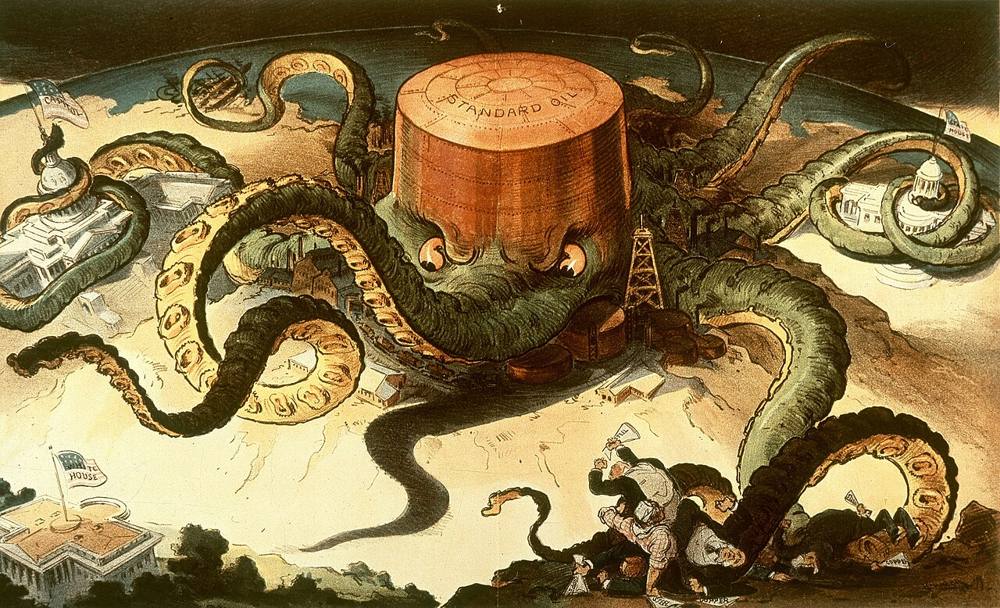
It became a regulated utility
The company was broken into 34 separate firms
It was fined but left intact
It was allowed to merge further
The case applied the Sherman Act to dissolve the trust.
A repeated prisoner's dilemma with no known end can sustain cooperation because...
the payoffs change
defection can be punished in later rounds
each firm has a monopoly
defection is no longer a dominant strategy in any single round
The threat of future retaliation (tit for tat) can outweigh the one-time gain from cheating.
Why do cartels tend to be unstable?
Each member can gain by secretly cheating on its quota
Consumers refuse to buy
The product is homogeneous
Demand is perfectly elastic
The price is above MC, so each firm would like to sell more, and if all cheat the cartel price collapses.
A monopolist price discriminates perfectly. Compared with a single-price monopoly, what happens to output and deadweight loss?
Output is unchanged
Deadweight loss rises
Output rises to the efficient level and deadweight loss disappears
Output falls and deadweight loss rises
Each buyer is charged their maximum willingness to pay, so every unit with value above MC is sold, but all the surplus goes to the monopolist.
A government forces a natural monopoly to price at marginal cost. What is the typical problem?
The firm earns a large profit
Output falls
The firm makes a loss and may need a subsidy
Price rises above average cost
With falling average cost, MC is below ATC, so P = MC doesn't cover total cost.
What would an oligopolist expect after cutting price in the kinked demand model?
Rivals ignore the cut
Rivals match the cut, so sales rise by little
Sales double
Rivals raise price
That is why demand is inelastic below the kink.
For a monopolist with a linear demand curve P = a - bQ, MR has what slope?
The same as demand: -b
Zero
Half as steep: -b/2
Twice as steep as demand: -2b
MR = a - 2bQ. This is why MR cuts the quantity axis at half the demand quantity.
Four firms with equal shares of 25 percent each: which statement is correct?
HHI = 1,000 and CR4 = 100 percent
HHI = 2,500 and CR4 = 25 percent
HHI = 100 and CR4 = 25 percent
HHI = 2,500 and CR4 = 100 percent
HHI = 4 x 25^2 = 2,500, and the top four firms hold all of the market.
