Quiz · Hard
Twenty Level I style questions on the Code and Standards, GIPS, means, dispersion, probability, hypothesis testing and regression.
In a simple regression of Y on X, Cov(X,Y) = 12 and Var(X) = 8. The slope is:
0.67
4.0
96
1.5
Slope = Cov / Var = 12 / 8 = 1.5.
An analyst learns from a company insider that earnings will miss estimates badly, before announcement. The analyst should:
Trade only for clients, not personally
Not act on the information or cause others to act on it
Publish a sell recommendation
Tell a few trusted clients
Material nonpublic information must not be used for trading or passed on. Standard II(A) applies.
Where local law and the CFA Institute Standards conflict, a member must:
Follow the stricter of the two
Always follow local law
Always follow the Standards
Follow the employer's preference
Standard I(A) requires compliance with the more strict requirement.
A portfolio manager receives a lavish gift from a company whose stock she covers. The best action under Standard I(B) is to:
Accept it and tell no one
Accept it and issue a buy rating
Accept it and mention it in a footnote
Decline gifts that could compromise independence and objectivity
Gifts that could impair objectivity should be avoided, and modest items should be disclosed.
A member trades for a personal account before executing a large client order in the same stock. This violates:
Standard V(C), Record Retention
Standard I(C), Misrepresentation
Standard VI(B), Priority of Transactions
Standard IV(B), Additional Compensation
Clients come first, then the employer, then the member. Trading ahead of clients is front-running.
Which standard covers the duty to determine a client's objectives and constraints before recommending investments?
III(B), Fair Dealing
III(C), Suitability
I(D), Misconduct
V(B), Communication
Suitability requires understanding the client's circumstances, typically documented in the IPS.
The investment policy statement lists return and risk objectives. Which items are constraints?
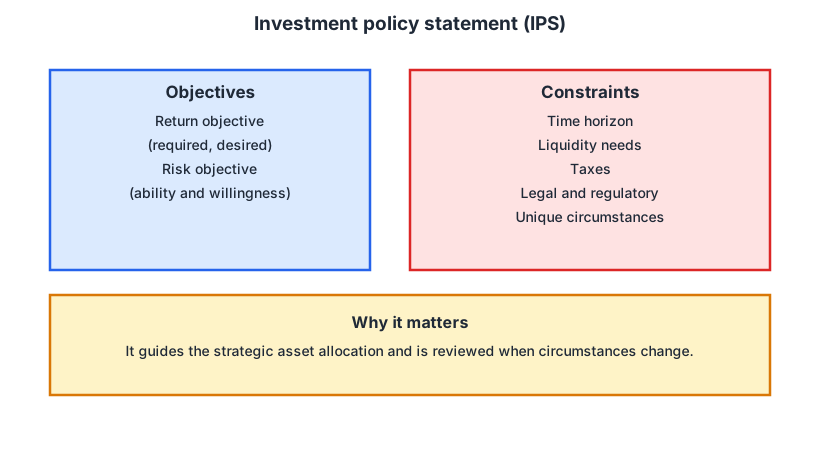
Time horizon, liquidity, taxes, legal and regulatory factors, and unique circumstances
Required return and risk tolerance
Asset allocation and benchmark
Expected return and standard deviation
Objectives are return and risk. The other five categories are constraints.
The recommended minimum retention period for records supporting investment analysis is:
Six months
One year
Permanently
Seven years
Standard V(C) recommends at least seven years, unless regulation requires longer.
GIPS are best described as:
A mandatory SEC rule
A tax standard
Voluntary ethical standards for fair presentation of investment performance
A trading rulebook for exchanges
Firms claim compliance voluntarily, using composites and time-weighted returns.
Returns are +10%, -5% and +15%. The geometric mean is closest to:
6.67%
6.32%
5.00%
7.50%
(1.10 x 0.95 x 1.15)^(1/3) - 1 = 6.32%. The arithmetic mean is 6.67%.
Which is correct about the three means for positive, unequal values?
Arithmetic > geometric > harmonic
Harmonic > geometric > arithmetic
All are equal
Geometric > arithmetic > harmonic
For 2, 4 and 8: arithmetic 4.67, geometric 4.00, harmonic 3.43.
Data: 4, 8, 6, 5, 7. The sample standard deviation is closest to:
1.41
2.50
1.12
1.58
Sample variance = 10 / 4 = 2.5, so s = sqrt(2.5) = 1.58.
According to Chebyshev's inequality, at least what percentage of observations of any distribution lie within 3 standard deviations?
68%
95%
88.9%
99.7%
1 - 1/9 = 0.889. The 99.7% figure holds only for the normal distribution.
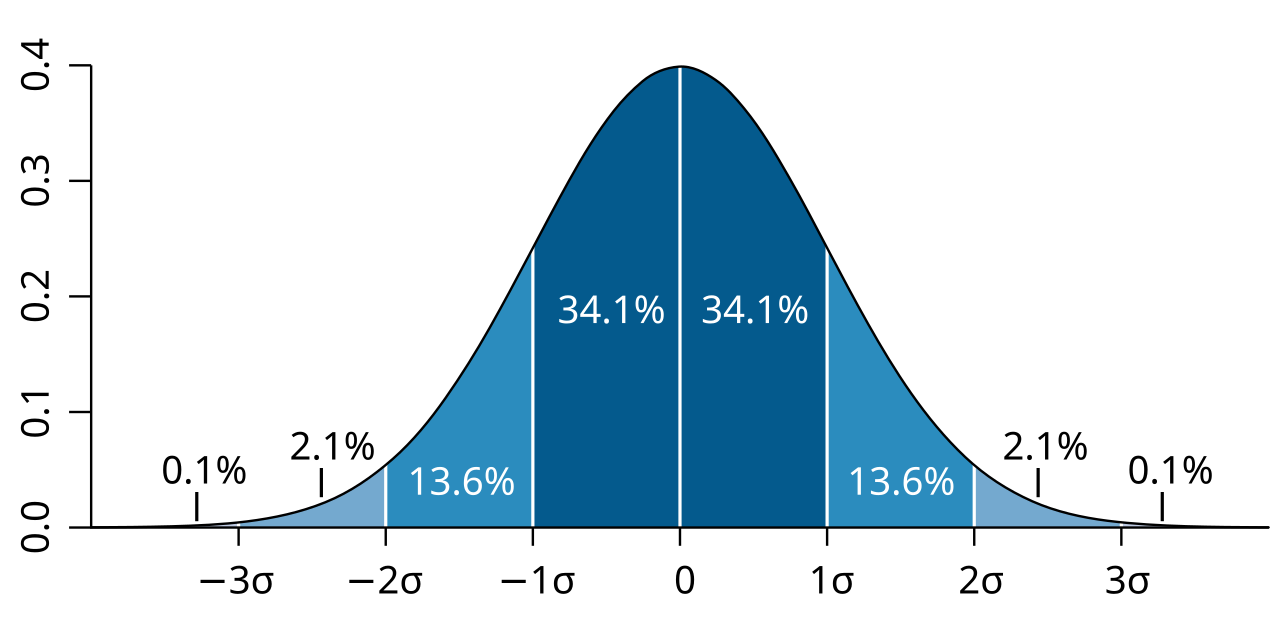
In the normal curve shown, the area between the mean and one standard deviation above it is about:
13.6%
34.1%
47.7%
68.2%
Both sides together give 68.2% within 1 standard deviation.
Image: M. W. Toews, CC BY 2.5, via Wikimedia Commons.
For the right-hand distribution in the diagram, which is correct?
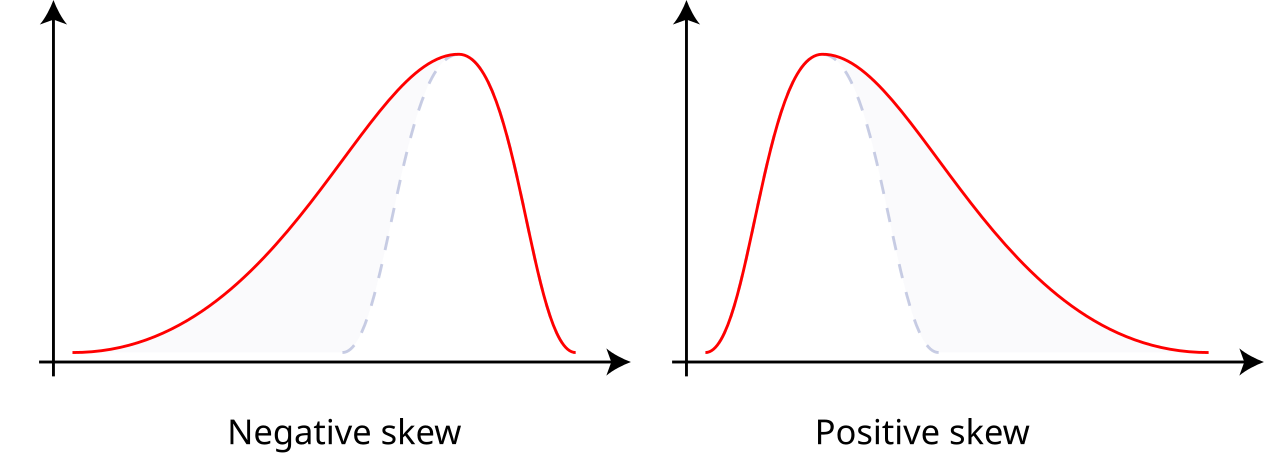
Positively skewed, mean > median > mode
Negatively skewed, mean > median > mode
Symmetric, mean = median
Positively skewed, mean < median < mode
The long right tail pulls the mean above the median and mode.
Image: Rodolfo Hermans (Godot), CC BY-SA 3.0, via Wikimedia Commons.
A disease has 1% prevalence. A test has 95% sensitivity and a 5% false positive rate. The probability of disease given a positive test is closest to:
95%
50%
5%
16%
0.0095 / (0.0095 + 0.0495) = 16.1%. Most positives are false positives because the disease is rare.
A fair coin is tossed 5 times. The probability of exactly 3 heads is:
0.5
0.6
0.3125
0.1563
C(5,3) x (0.5)^5 = 10 / 32 = 0.3125.
A rejection of a true null hypothesis is called:
A Type II error
A Type I error
Statistical power
A p-value
Its probability is alpha, the significance level.
Sample mean 52, hypothesized mean 50, sample standard deviation 8, n = 64. The t-statistic is:
2.0
0.25
1.0
16
t = (52 - 50) / (8 / sqrt(64)) = 2.
Standard IV(C) places which responsibility on supervisors?
Guarantee that no violations occur
Delegate all compliance to subordinates
Make reasonable efforts to prevent and detect violations by those they supervise
Report only violations that become public
Supervisors must have adequate compliance procedures and act when violations are suspected. The standard requires reasonable efforts, not a guarantee.
