Quiz · Medium
Core concepts from intro journalism: the inverted pyramid, source rules, AP style, libel and the First Amendment.
In an inverted pyramid news story, which information comes first?
Background and context in chronological order
The most important and newsworthy facts
The least important details
A quote from the reporter's editor
The structure ranks facts by importance so readers get the essentials immediately and editors can cut from the bottom. Chronological order is typical of narrative features, not hard news.
Which part of the pyramid would an editor cut first to save space?
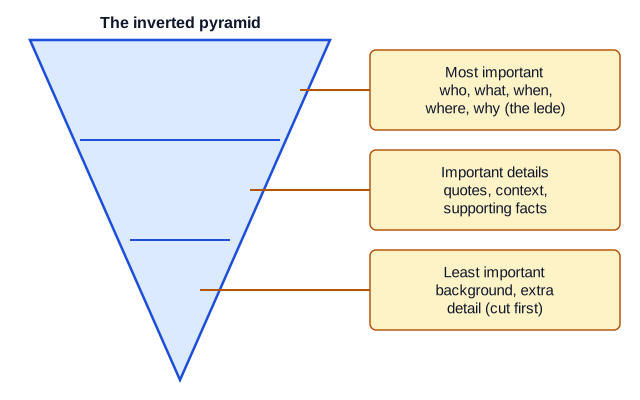
The bottom (least important background)
The top (the lede)
The middle (quotes and context)
The headline
Because details are ranked by importance, trimming from the bottom loses the least. Cutting the lede would remove the news itself.
A reporter agrees to let an official explain a policy but says the official may only be described as 'a senior White House aide'. This is:
On the record
Off the record
A shield-law protection
Information on background
On background means the information can be used with a general description but not the name. On the record would allow naming; off the record traditionally means not for publication.
What is a nut graf?
The first sentence of a hard news story
A quote that is set in large type
A paragraph that explains what the story is about and why it matters now
A short list of corrections
Nut grafs usually appear high in features. A pull quote is the large-type quote; the first sentence of hard news is the lede.
McCombs and Shaw's agenda-setting theory argues that the media mainly influence:
What conclusions people reach on every issue
Only people who already share their politics
The legal definition of news
Which issues the public thinks about
The idea is that media may not tell us what to think, but they tell us what to think about. It does not claim the media dictate opinions.
Which news value explains why a local school fire is covered more heavily than a similar fire overseas?
Prominence
Proximity
Novelty
Conflict
Proximity means closeness (geographic or emotional) to the audience. Prominence would apply if famous people were involved.
Which is the best description of disinformation?
False information deliberately created or shared to deceive
False information shared by mistake
True information shared to harm someone
Opinion pieces on controversial topics
Intent is the dividing line: misinformation is unintentional; malinformation is genuine information used to harm.
Which verb is the most neutral attribution in AP-style news writing?
claimed
admitted
said
blasted
'Said' reports without judgment. 'Claimed' casts doubt, 'admitted' implies guilt and 'blasted' adds opinion.
Which sentence follows AP style on numbers?
The council hired 7 staff and twelve volunteers.
The council hired seven staff and 12 volunteers.
The council hired seven staff and twelve volunteers.
The council hired 7 staff and 12 volunteers.
AP spells out one through nine and uses numerals for 10 and above.
Which case established the 'actual malice' standard for libel suits by public officials?
Near v. Minnesota (1931)
New York Times Co. v. Sullivan (1964)
New York Times Co. v. United States (1971)
Roe v. Wade (1973)
Sullivan requires public officials to prove knowledge of falsity or reckless disregard for truth. Near and the Pentagon Papers case concerned prior restraint.
What does 'prior restraint' mean?
Punishment after a story is published
A government order blocking publication before it happens
A reporter's refusal to name a source
A newsroom rule requiring two sources
US courts treat prior restraint as presumptively unconstitutional. Punishment after publication (e.g. libel) is a different matter.
Truth is generally a complete defense to a libel claim in the United States.
True
False
The plaintiff typically must prove falsity; if the statement is substantially true, there is no libel.
Slander refers to defamatory statements that are written or printed.
True
False
Slander is spoken; written or otherwise fixed defamation is libel.
Which is NOT one of the four principles of the SPJ Code of Ethics?
Seek Truth and Report It
Minimize Harm
Maximize Profit
Be Accountable and Transparent
The fourth principle is 'Act Independently'. Maximizing profit is not an ethical principle in the code.
A newspaper discovers a published story had a factual error in a name and a date. The best response is to:
Quietly edit the online text without telling anyone
Publish a clear correction and fix the online version with a note
Delete the story entirely
Wait to see whether anyone complains
Transparency requires visible corrections. Silent edits and deletions hide the error and erode trust.
Which reporter team broke the Watergate scandal for The Washington Post?
Bob Woodward and Carl Bernstein
Daniel Ellsberg and Neil Sheehan
Ida Tarbell and Upton Sinclair
Walter Cronkite and Edward R. Murrow
Ellsberg leaked the Pentagon Papers; Tarbell and Sinclair were muckrakers; Cronkite and Murrow were broadcasters.
The term 'muckraking' was popularized in the early 1900s for:
Sensational celebrity gossip
Investigative reporting exposing corruption and social ills
Government press releases
Local sports reporting
Roosevelt used it in 1906. Sensational celebrity gossip is closer to yellow journalism, which was circulation-driven exaggeration.
Which pair is the classic example of 1890s yellow journalism rivals?
Joseph Pulitzer's New York World and William Randolph Hearst's New York Journal
The Times and the Guardian
The Chicago Tribune and the Sun-Times
Reuters and the Associated Press
Their circulation war produced sensational headlines. The others are real organizations but not the yellow press rivals.
On a breaking social media video, the first verification step should be to:
Share it quickly so you are first
Trust it if it has many views
Wait for an official press release before looking
Trace the original uploader and check where and when it was filmed
Views and speed do not prove authenticity. Verification means finding the original, checking metadata and geolocating.
