Quiz · Medium
Foundational questions on partial derivatives, gradients, critical points, double and triple integrals, coordinate systems, and divergence, curl and line integrals.
If , then is
Treat x as a constant and differentiate . is .
At a point, the gradient of f points
along the level curve
in the direction of steepest decrease
toward the origin
in the direction of steepest increase of f
is perpendicular to the level curve and points toward increasing f.
Find for at with .
2
6
5
3
; dotting with the unit vector gives 3 (this is just ).
The tangent plane to at is
. The plane must pass through (1,2,5): 2 + 8 − 5 = 5.
For , the origin is
a local maximum
a saddle point
not a critical point
a local minimum
at the origin. and .
At a critical point, . The point is
a local minimum
a saddle point
a local maximum
undetermined
D < 0 always indicates a saddle. Undetermined happens when D = 0.
Maximum of subject to ?
25
10
50
100
By Lagrange multipliers x = y = 5, so the maximum is 25.
Evaluate .
2
1
1/2
4
Inner: . Outer: .
In polar coordinates, equals
A polar patch has sides Δr and rΔθ, so its area is about r Δr Δθ.
The area of the unit disk as an iterated polar integral is
Forgetting the factor r gives 2π; θ must run all the way to 2π.
The volume element in spherical coordinates is
The spherical Jacobian is (φ measured from the +z axis).
Which coordinates are best for the volume inside ?
Cylindrical
Polar only
Spherical
Rectangular only
A ball centered at the origin becomes in spherical coordinates. Cylindrical works but is messier.
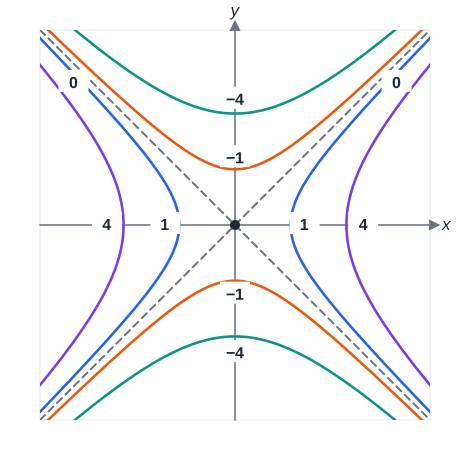
This contour map has hyperbolic level curves and a value of 0 on two crossing lines. What is at the origin?
A local maximum
A local minimum
A saddle point
A plateau
Values are positive along the x-axis and negative along the y-axis: the signature of a saddle (here ).
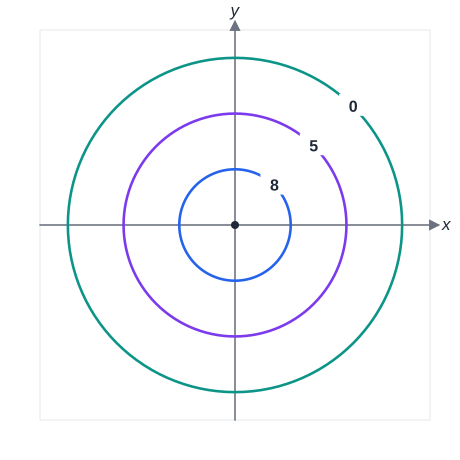
Contours labeled 8, 5, 0 get larger toward the center of these circles. What is at the center?
A local minimum
A local maximum
A saddle point
Nothing special
The function increases toward the center, so it is a peak (here ).
For , is
3
0
. Divergence is a scalar, not a vector.
The curl of is
2
in the z-component. Curl is a vector.
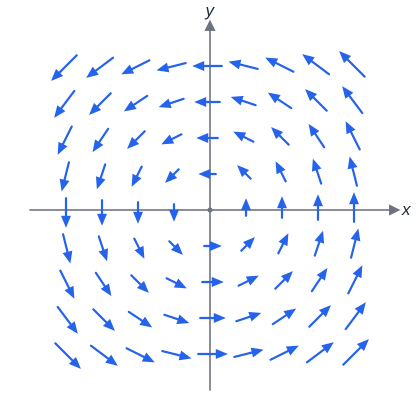
The field in this picture circulates around the origin. What are its divergence and 2D curl?
Divergence 2, curl 0
Divergence 0, curl 0
Divergence 2, curl 2
Divergence 0, curl 2
: and .
Evaluate from (0,0) to (3,4) along any path.
7
5
25
It depends on the path
The field is , so the integral is . Path independence is the point of conservative fields.
Green's theorem requires the curve C to be
any orientation
a straight line
positively oriented (counterclockwise) and simple closed
clockwise
Clockwise orientation gives the negative of the double integral.
Flux of out of the unit sphere is
3
0
Divergence theorem: . The volume alone, , forgets the factor 3.
The integral of f over this Type I region is set up as
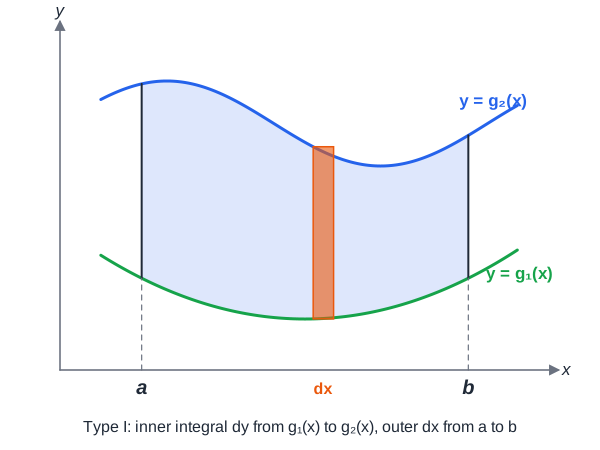
Outer limits are constants a, b; inner limits are the curves bounding the region from below and above.
