Quiz · Easy
Parent graphs, domain and range, function notation, symmetry, composition and inverses. Good first check after a functions unit.
Which graph shows f(x) = |x|?
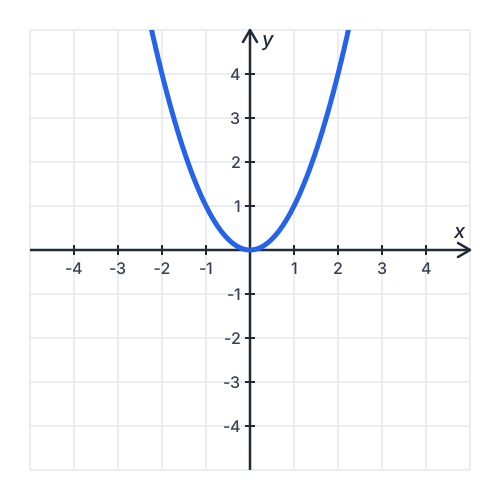
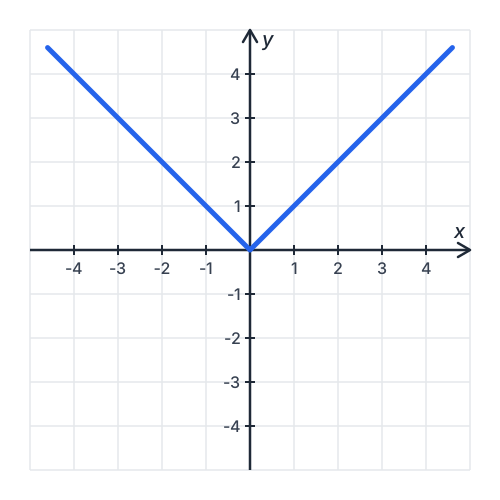
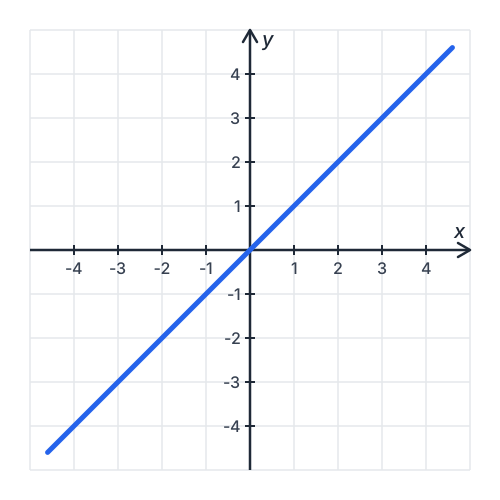
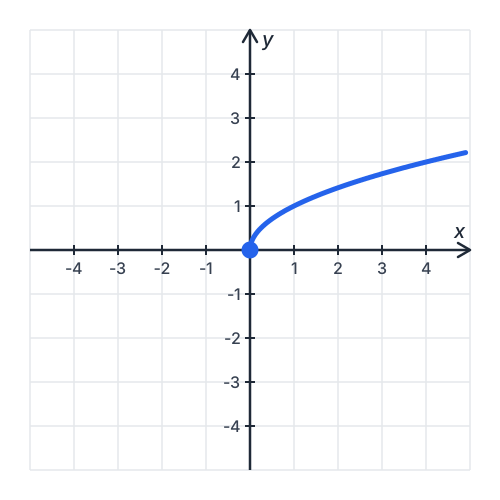
|x| is a V with a sharp corner at the origin. The parabola x² is the tempting choice, but it is rounded at the bottom.
Which graph shows f(x) = √x?
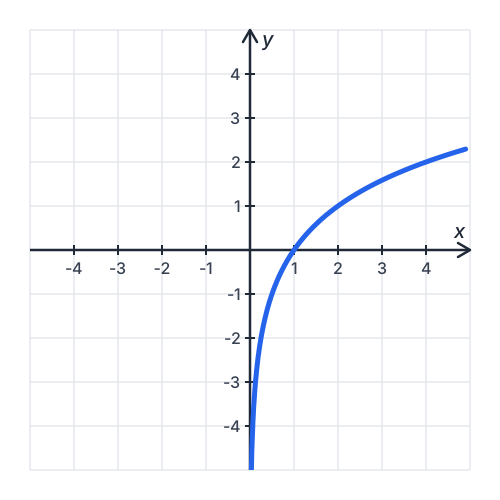
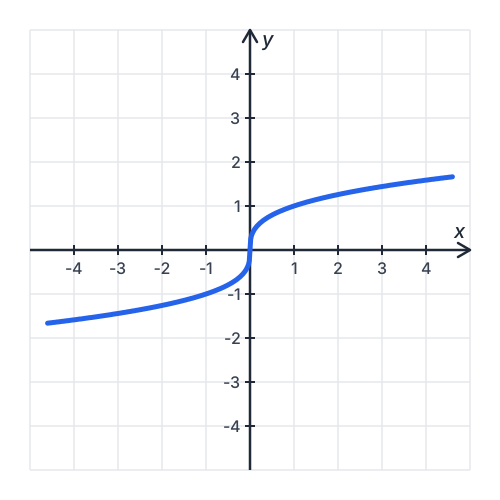
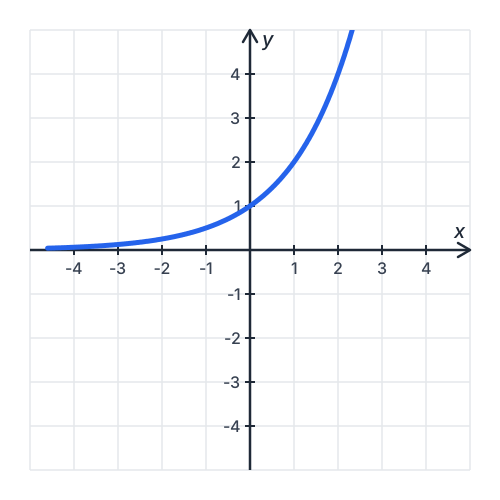
√x starts at the point (0, 0) and is undefined for x < 0. log₂ x looks similar but has a vertical asymptote and passes through (1, 0).
Which graph shows f(x) = 1/x?
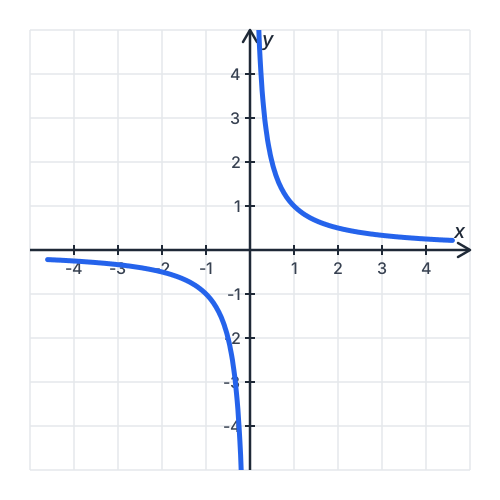
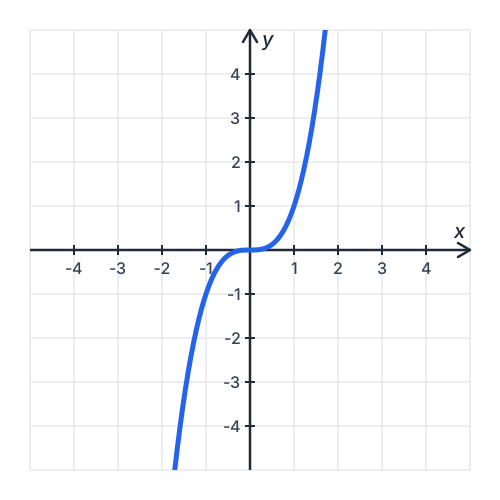
1/x has two branches and asymptotes on both axes. The cubic passes through the origin instead.
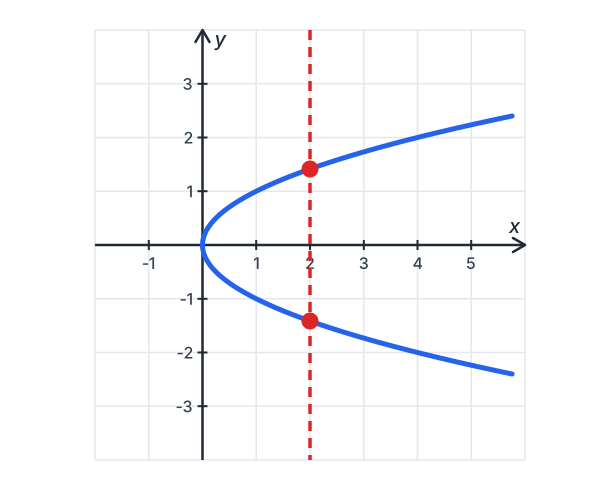
Does this graph represent y as a function of x?
Yes
No
No. The vertical line x = 2 meets the graph twice, so the input 2 has two outputs.
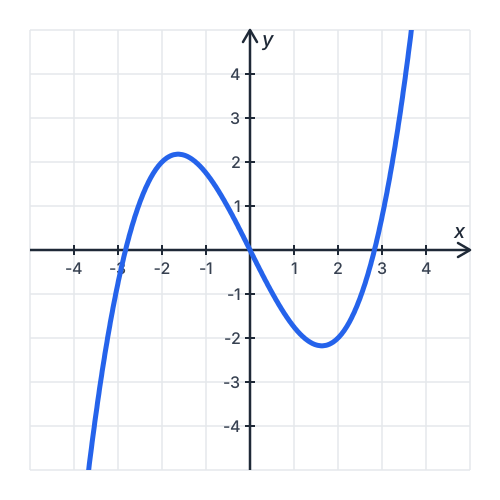
Is the graphed function even, odd, or neither?
Even
Odd
Neither
The graph is symmetric about the origin, so it is odd. It is not a mirror image across the y-axis, so it is not even.
What is the domain of ?
(3, ∞)
[3, ∞)
[−3, ∞)
All real numbers
2x − 6 ≥ 0 gives x ≥ 3. The endpoint is included because √0 = 0 is defined, so (3, ∞) is wrong.
What is the domain of ?
x ≠ −1
x ≠ 2
x ≠ 2 and x ≠ −2
All real numbers
The denominator x² − 4 = (x − 2)(x + 2) is 0 at x = ±2. A zero in the numerator (x = −1) does not restrict the domain.
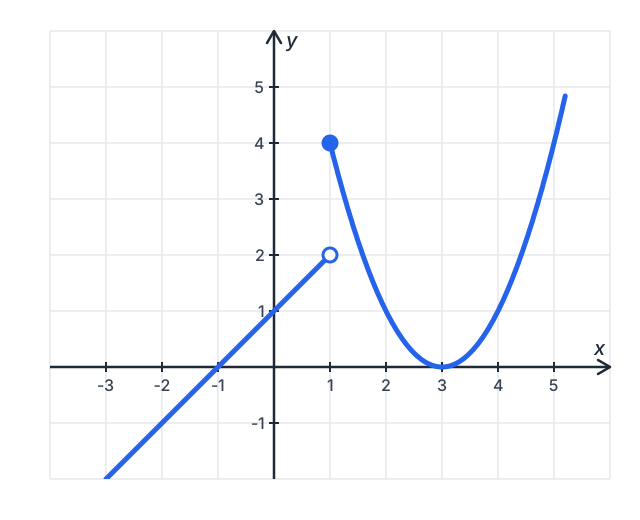
Use the graph. What is f(1)?
2
4
1
f(1) is undefined
The filled dot at (1, 4) is the function value. The open circle at (1, 2) marks a point that is not on the graph.
If , what is ?
10
14
−14
38
3(−2)² − (−2) = 12 + 2 = 14. Getting 10 comes from subtracting 2 instead of subtracting −2.
How does the graph of compare with ?
Shifted 4 units right
Shifted 4 units left
Shifted 4 units up
Shifted 4 units down
Inside the parentheses, + 4 moves the graph left: the vertex is where x + 4 = 0, at x = −4.
Which transformation turns into ?
Reflection across the y-axis
Reflection across the x-axis
Rotation by 180°
Shift down 1 unit
Negating the outputs flips every point (x, y) to (x, −y), a reflection across the x-axis. f(−x) would reflect across the y-axis.
and . What is ?
f∘g means f(g(x)): square the inner expression x + 3. x² + 3 is g∘f.
What is the inverse of ?
Swap and solve: x = (y − 5)/2 ⇒ y = 2x + 5. The reciprocal 2/(x − 5) is a common mix-up with f⁻¹.
The graph of f passes through (2, 7). Which point must lie on the graph of f⁻¹?
(−2, −7)
(7, 2)
(2, 1/7)
(1/2, 7)
An inverse swaps inputs and outputs, so (a, b) on f gives (b, a) on f⁻¹.
State the range of the graphed function.
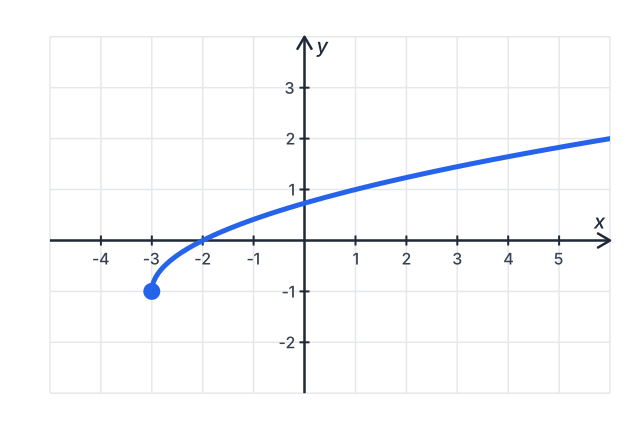
[−3, ∞)
[−1, ∞)
(−1, ∞)
All real numbers
The lowest point is the filled endpoint (−3, −1), and the graph rises without bound. [−3, ∞) is the domain, not the range.
What is the average rate of change of on [0, 2]?
8
4
6
2
(f(2) − f(0))/(2 − 0) = 8/2 = 4. 8 is the change in f, not the rate.
A relation is a function if...
each output comes from exactly one input
each input has exactly one output
its graph passes the horizontal line test
its domain is all real numbers
The defining property is one output per input. One input per output (horizontal line test) describes a one-to-one function.
On which interval is the graphed function decreasing?
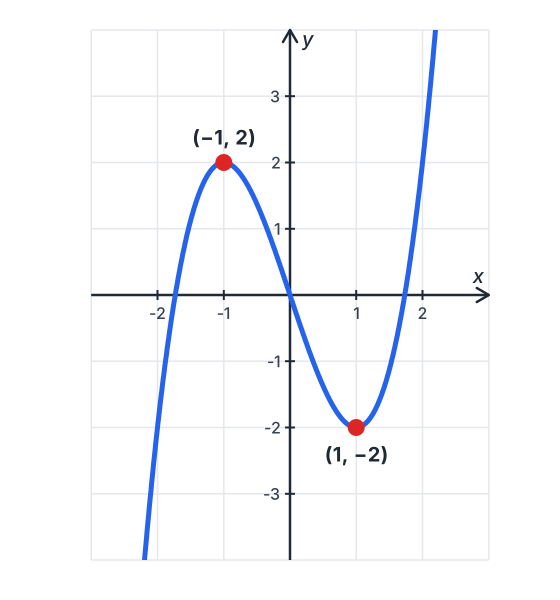
(−2, 2)
(−1, 1)
(−∞, −1)
(1, ∞)
The graph falls from the local max at x = −1 to the local min at x = 1. (−2, 2) uses y-values, a common mix-up.
Which statement about is true?
Its range is all real numbers
It has a vertical asymptote at x = 0
It passes through (0, 1)
It is decreasing
2⁰ = 1, so (0, 1) is on the graph. Its range is (0, ∞) and its asymptote is horizontal (y = 0).
Evaluate .
3
25
1/3
5
5³ = 125, so log₅ 125 = 3.
