Quiz · Medium
Foundational questions on closed-loop transfer functions, second-order specifications, steady-state error, Routh and PID terms.
For negative feedback with forward gain G and feedback H, the closed-loop transfer function is
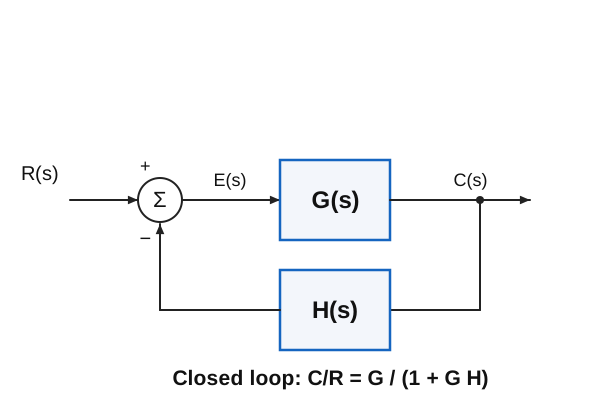
G / (1 + GH)
G / (1 - GH)
GH / (1 + G)
G (1 + H)
Negative feedback subtracts the fed-back signal at the summing junction, giving G / (1 + GH). The 1 - GH form belongs to positive feedback.
A first-order system has a step response that reaches 63.2% of its final value at
t = 0.5 s
t = 2 s
t = 5 s
t = 8 s
The time constant is tau = 2 s (denominator 2s + 1). 8 s is about the 2% settling time (4 tau).
In a second-order system, which damping ratio gives the response with NO overshoot and the fastest rise without it?
zeta = 0
zeta = 0.5
zeta = 1
zeta = 2
Critical damping is the fastest response with no overshoot. zeta = 2 is overdamped (slower), zeta = 0 oscillates forever.
A second-order system has zeta = 0.5. Its percent overshoot is about
5%
50%
30%
16%
%OS = 100 exp(-pi zeta / sqrt(1 - zeta^2)) = 100 exp(-1.81) = 16.3%. 50% is just zeta repeated as a percentage.
Poles at -3 +/- j4 correspond to a damped natural frequency of
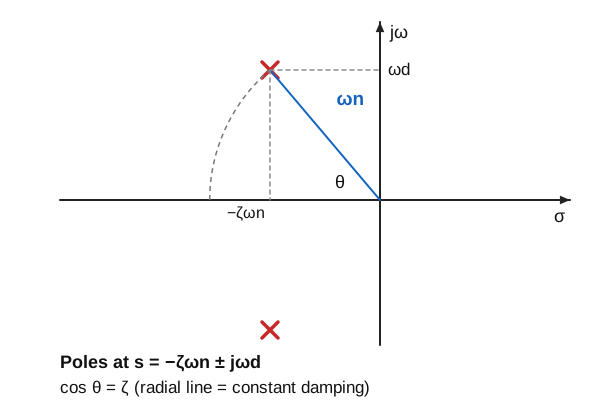
4 rad/s
3 rad/s
5 rad/s
7 rad/s
The imaginary part is omega_d = 4. The natural frequency is the magnitude, 5 rad/s, and the real part 3 equals zeta times omega_n.
For the poles -3 +/- j4, the damping ratio is
0.8
0.6
0.75
0.5
omega_n = 5 and zeta omega_n = 3, so zeta = 0.6. 0.8 is the sine of the pole angle, not the cosine.
The 2% settling time of a system with dominant poles at -2 +/- j5 is about
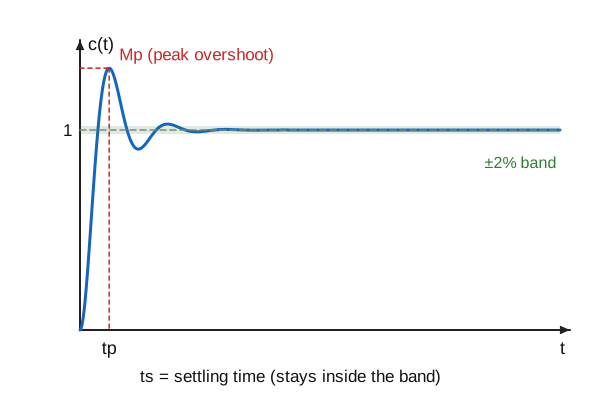
0.5 s
8 s
2 s
1.25 s
ts = 4 / (zeta omega_n) = 4 / 2 = 2 s. Using the imaginary part (5) gives the wrong 0.8 s.
A unity-feedback system has G(s) = 10 / (s(s + 5)). Its system type is
0
2
3
1
There is one pole at the origin, so the type is 1: zero steady-state error to a step, finite error to a ramp.
The system above (G = 10 / (s(s+5))) has steady-state error to a unit ramp of
0.5
0
2
infinity
Kv = lim s G = 10/5 = 2, so e_ss = 1/Kv = 0.5. Infinite error would be a type 0 system.
A characteristic equation has a root in the right half-plane. The system is
marginally stable
unstable
stable but oscillatory
stable only for step inputs
Any right-half-plane closed-loop pole gives a growing exponential mode.
For s^3 + 4s^2 + 5s + 2 = 0, the Routh first column is 1, 4, 4.5, 2. The system is
unstable with 1 RHP root
unstable with 2 RHP roots
stable
marginally stable
No sign changes in the first column means no right-half-plane roots. (Row s^1 is (4*5 - 1*2)/4 = 4.5.)
Which PID term removes steady-state error for a step reference?
Proportional
Derivative
None; feedback cannot remove it
Integral
The integral term keeps increasing the control signal until the error is zero. Proportional action alone leaves a finite error for type 0 plants.
The main drawback of the derivative term is
amplification of high-frequency noise
it causes steady-state error
it reduces damping
it makes the system type higher
Differentiation magnifies fast noise, which is why a filter is added. It increases damping rather than reducing it.
In a root locus plot, branches start at
the open-loop zeros
the open-loop poles
the origin
infinity
At K = 0 the closed-loop poles equal the open-loop poles. They end at zeros or infinity as K grows.
If the gain margin of a minimum-phase system is below 0 dB, the closed loop is unstable.
True
False
A negative gain margin in dB means the loop gain exceeds 1 at the -180 degree frequency, so the closed loop is unstable.
