Quiz · Medium
Twenty-five questions on speed and acceleration, motion graphs, projectiles, Newton's laws, friction, gravity and momentum.
An object moving at constant speed in a circle has zero acceleration.
True
False
The direction of the velocity keeps changing, so the object accelerates toward the center of the circle (centripetal acceleration).
A student runs once around a 400 m track and finishes where she started in 80 s. Which statement is correct?
Her distance is 400 m and her displacement is 0
Her distance and displacement are both 400 m
Her displacement is 400 m
Her average velocity is 5 m/s
Distance is the path length (400 m). Displacement is the change in position: she ended at the start, so it is 0, and so is her average velocity. Her average speed is 5 m/s.
A cyclist accelerates from 2 m/s to 10 m/s in 4 s. What is the acceleration?
8 m/s²
2.5 m/s²
3 m/s²
2 m/s²
a = (v − u)/t = (10 − 2)/4 = 2 m/s². Dividing 10 by 4 ignores the starting speed.
A car starts from rest and accelerates at 4 m/s² for 5 s. How far does it travel?
20 m
50 m
100 m
25 m
s = ½at² = ½ × 4 × 25 = 50 m. The speed reached is 20 m/s, but distance needs the average speed (10 m/s) × 5 s.
An object is dropped from rest. Ignoring air resistance, how fast is it moving after 2 s? (g = 10 m/s²)
10 m/s
20 m/s
5 m/s
40 m/s
v = gt = 10 × 2 = 20 m/s. The speed grows by 10 m/s every second.
Static friction on a block is always equal to μN.
True
False
Static friction adjusts to match the applied force up to a maximum of μ_s N. Only at the point of slipping does it reach that maximum.
On the distance-time graph, what is the object doing between 6 s and 11 s?
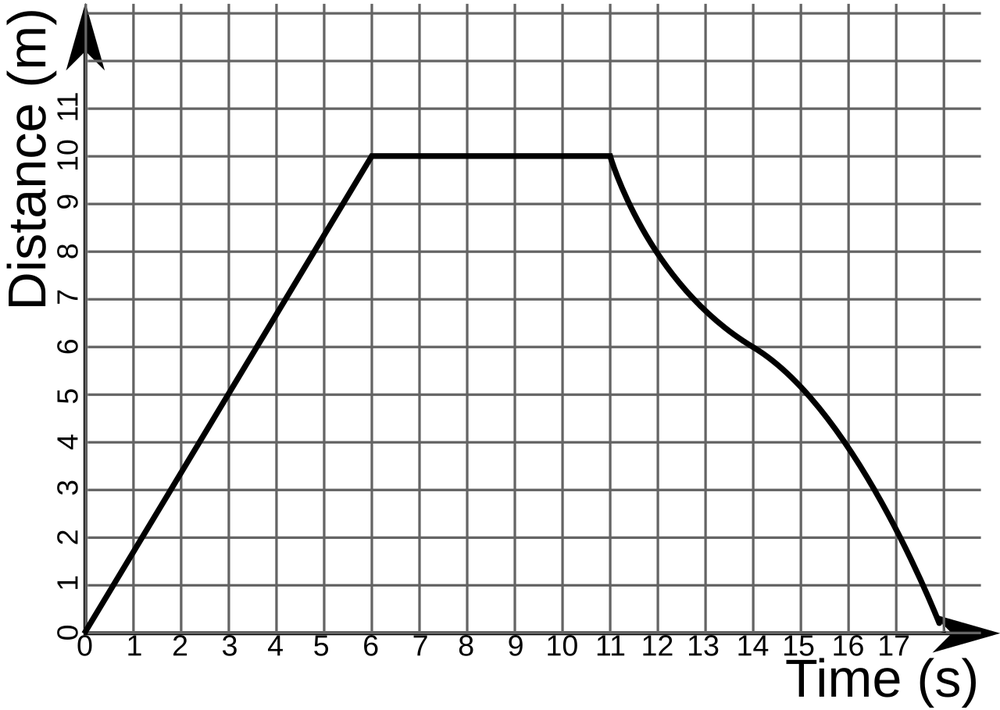
Moving at constant speed
Accelerating
Moving backward
Remaining at rest
A horizontal line on a distance-time graph means the distance is not changing, so the object is stationary (at 10 m).
On the distance-time graph, what is the object's average speed during the first 6 s?
About 1.7 m/s
10 m/s
6 m/s
0 m/s
The slope of a distance-time graph is speed: 10 m ÷ 6 s ≈ 1.7 m/s. 10 m/s confuses the distance with the speed.
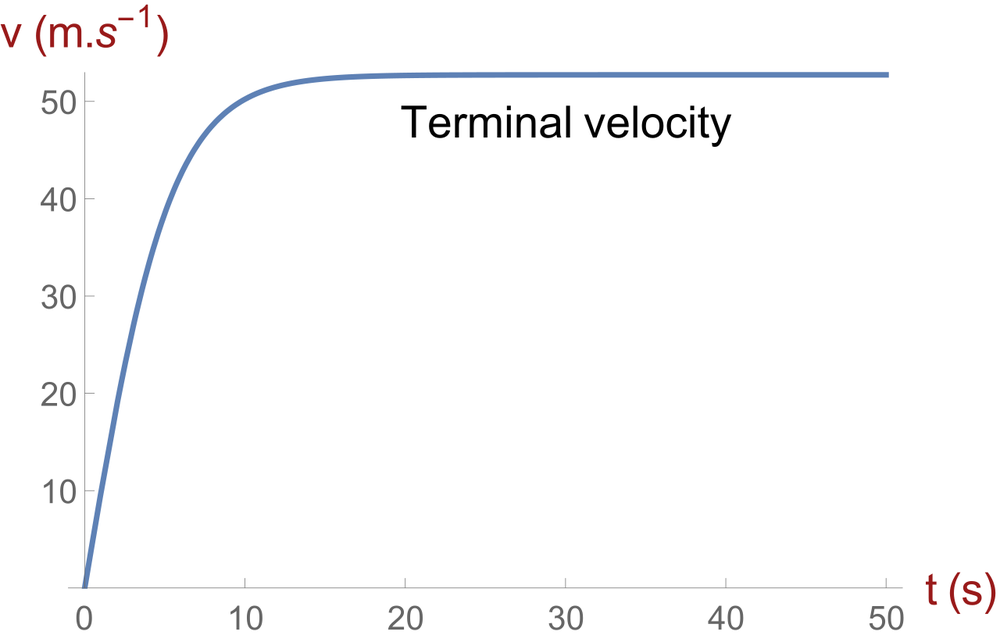
What does the flat part of this skydiver's velocity-time graph indicate?
Gravity has switched off
The skydiver has landed
Drag has become equal to weight, so net force is zero
The skydiver is accelerating at 10 m/s²
At terminal velocity the upward air resistance equals the downward weight. Net force is zero, so acceleration is zero and the speed stays constant. Gravity is still acting.
Image: Spikeylegs, CC BY-SA 4.0, via Wikimedia Commons.
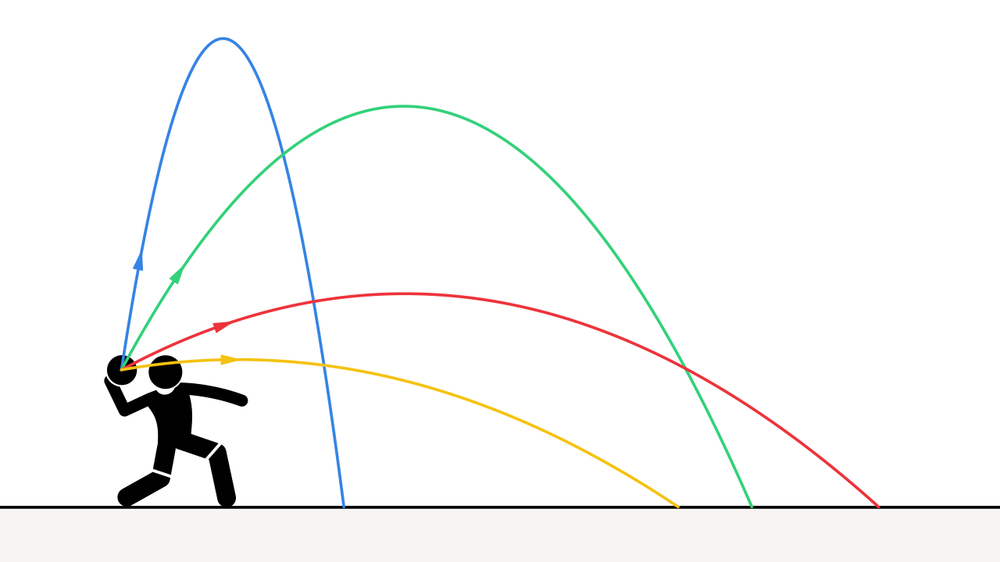
A ball is thrown horizontally from a cliff. If air resistance is ignored, which statement is true?
Both its horizontal and vertical speeds stay constant
Its horizontal speed decreases
Its horizontal speed stays constant while its vertical speed increases
It travels in a straight line
With no horizontal force, horizontal velocity is constant; gravity increases the vertical velocity uniformly. The combination gives a parabola.
Image: MikeRun, CC BY-SA 4.0, via Wikimedia Commons.
At the highest point of a projectile's path, which statement is correct?
Its vertical velocity is zero but its acceleration is still g downward
Its acceleration is zero
Its horizontal velocity is zero
No forces act on it
At the peak the vertical velocity reverses, so it is momentarily zero, but gravity still acts, so the acceleration remains 9.8 m/s² downward.
A 4 kg object is acted on by a net force of 12 N. What is its acceleration?
48 m/s²
0.33 m/s²
8 m/s²
3 m/s²
a = F/m = 12/4 = 3 m/s². Multiplying 12 by 4 mixes up the formula.
A 20 N force pushes a box right and a 5 N friction force acts left. The box has a mass of 3 kg. What is its acceleration?
8.3 m/s² to the right
5 m/s² to the right
6.7 m/s² to the right
1.7 m/s² to the right
Net force = 20 − 5 = 15 N, so a = 15/3 = 5 m/s². Using only the 20 N would give 6.7 m/s², ignoring friction.
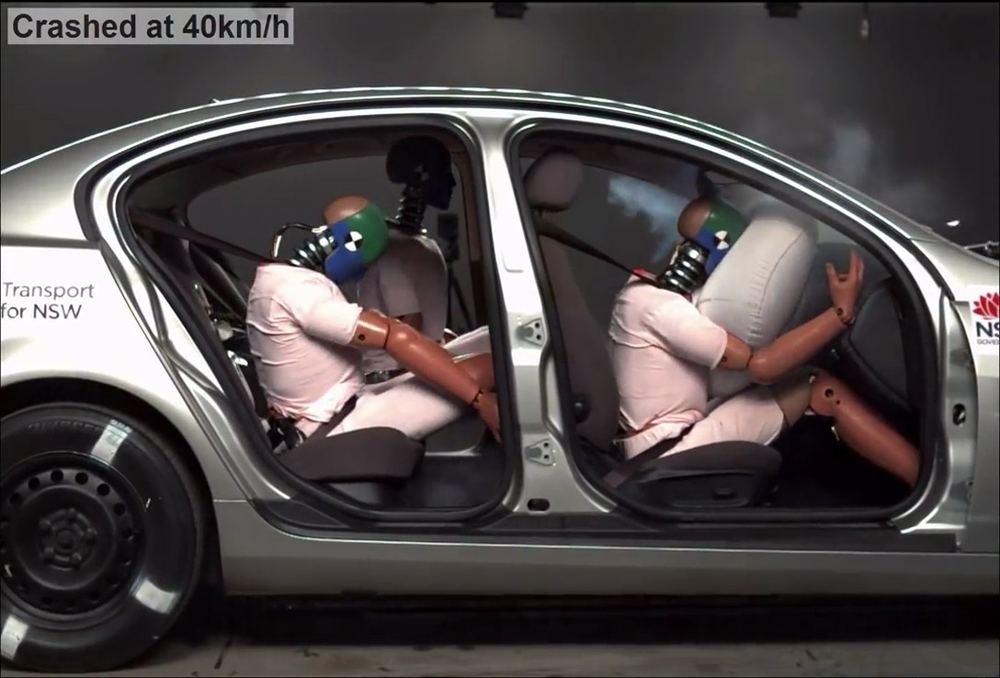
In the crash test, the dummies continue to move forward when the car stops suddenly. Which principle explains this?
Newton's third law
Newton's first law (inertia)
Gravity pulling forward
Friction from the seats
Objects keep their state of motion unless an unbalanced force acts. The car is stopped by the crash but the dummies keep moving until the belts and airbags apply a force.
Image: Transport for NSW, CC BY-SA 4.0, via Wikimedia Commons.
Why do airbags reduce injuries in a collision?
They reduce the passenger's momentum change
They make the car heavier
They increase the time over which the passenger stops, reducing the average force
They remove the passenger's inertia
The change in momentum is fixed by the passenger's mass and speed. Since F = Δp/Δt, a longer stopping time means a smaller force.
In a rocket launch, what is the force that pushes the rocket upward?

The exhaust pushing against the ground
Air pressure below the rocket
Gravity of the Moon
The reaction to the force with which the rocket pushes exhaust gas downward
Newton's third law: the rocket pushes gas down and the gas pushes the rocket up with an equal and opposite force. Rockets work in a vacuum, so they do not push against the air or ground.
A book rests on a table. The weight of the book and the normal force from the table are equal and opposite. Are they an action-reaction pair?
No, because they act on the same object
Yes, because they are equal and opposite
Yes, because they are both vertical
No, because one is a contact force
Action-reaction pairs act on different objects. The weight (Earth pulling on the book) pairs with the book pulling on the Earth, and the normal force pairs with the book pushing on the table.
A 60 kg person is on the Moon where g = 1.6 m/s². What are the person's mass and weight?
Mass 10 kg, weight 96 N
Mass 60 kg, weight 588 N
Mass 60 kg, weight 96 N
Mass 96 kg, weight 60 N
Mass is unchanged (60 kg). Weight = mg = 60 × 1.6 = 96 N. On Earth it would be about 588 N.
A 5 kg box slides on a rough floor with μ = 0.2. What is the friction force? (g = 10 m/s²)
1 N
25 N
10 N
50 N
f = μN = 0.2 × (5 × 10) = 10 N. Forgetting to convert the mass to a normal force gives 1 N.
What does the force labeled F_H in the incline diagram represent?
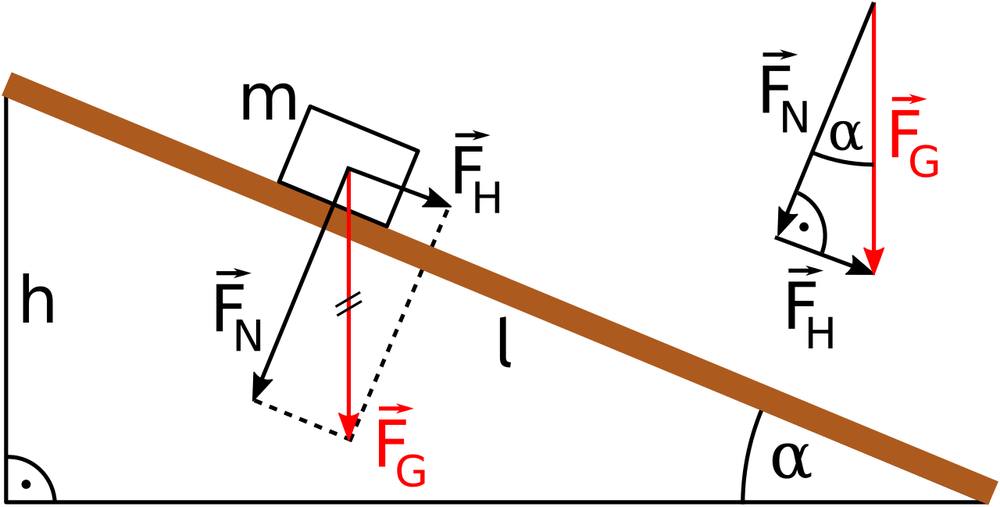
The component of the weight parallel to the slope
The friction force
The normal force
The force of the person pushing the block
The weight F_G is split into two components: F_H along the slope, which tends to make the block slide down, and F_N perpendicular to the slope.
In the free-body diagram of the block on a ramp, which arrow is the weight?
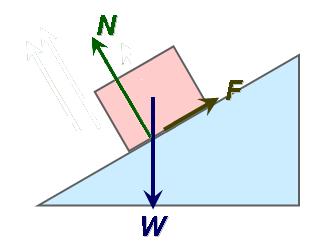
N, the arrow perpendicular to the ramp
F, the arrow up the slope
None of them; weight is not a force
W, the arrow pointing straight down
Weight always acts straight down toward the center of the Earth, whatever the angle of the slope. N is perpendicular to the surface and F is the friction force opposing sliding.
The distance between two planets is doubled. What happens to the gravitational force between them?
It is halved
It becomes one quarter as strong
It doubles
It stays the same
Gravity follows an inverse-square law: F ∝ 1/r². Doubling r divides F by 2² = 4.
What is the momentum of a 0.5 kg ball moving at 8 m/s?
16 kg·m/s
4 kg·m/s
4 N
0.0625 kg·m/s
p = mv = 0.5 × 8 = 4 kg·m/s. Squaring the speed (16) is the kinetic energy mistake.
A 2 kg cart moving at 3 m/s collides and sticks to a stationary 1 kg cart. What is their combined speed?
3 m/s
1 m/s
1.5 m/s
2 m/s
Momentum is conserved: 2 × 3 = 6 = (2 + 1) × v, so v = 2 m/s.
In a Newton's cradle, when one ball swings in, one ball swings out at the other end. Which quantity is being conserved?
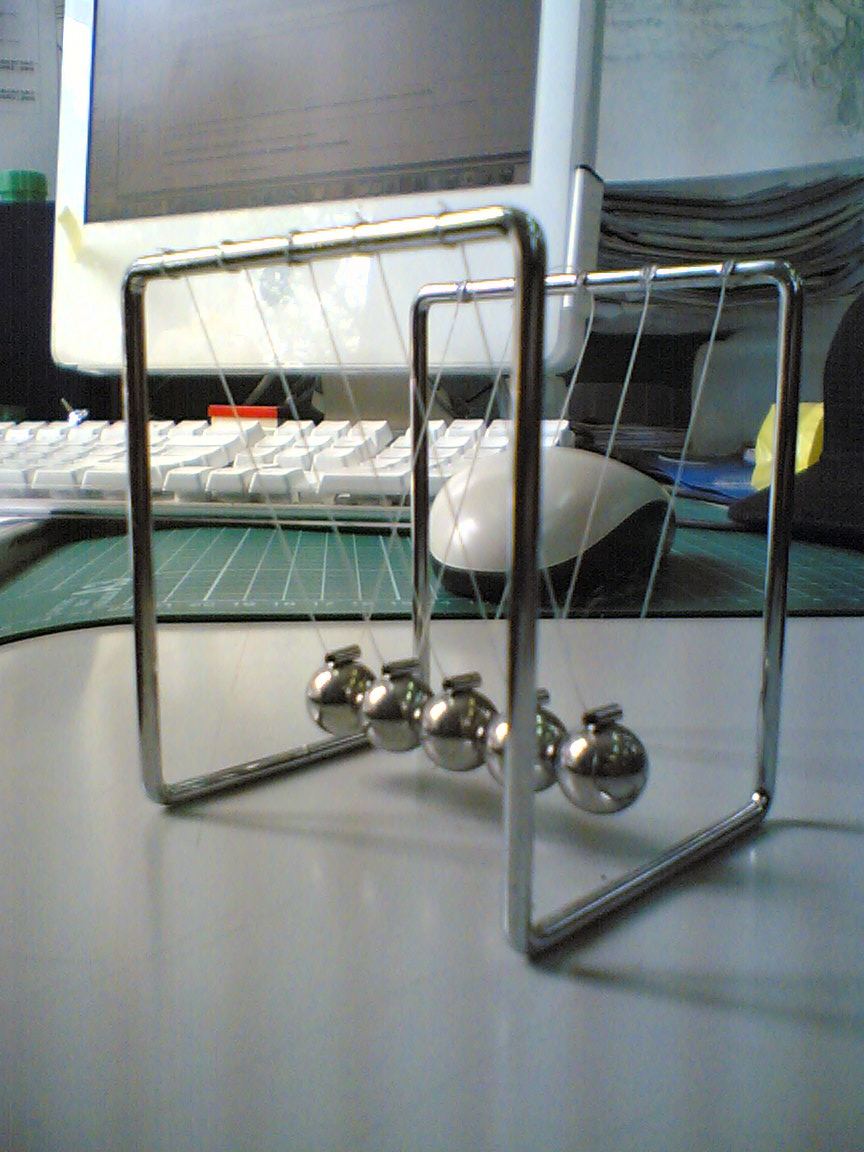
Momentum (and, approximately, kinetic energy)
Only mass
Only friction
Weight
The collisions are nearly elastic, so both momentum and kinetic energy are conserved, and one ball leaves with the incoming momentum.
