Quiz · Medium
Energy systems, VO2 max, training principles and basic nutrition.
Which energy system is dominant in a 100 m sprint?
Beta oxidation
Oxidative
Anaerobic glycolysis
Phosphagen (ATP-PCr)
The first roughly 10 seconds of maximal effort rely on stored ATP and phosphocreatine.
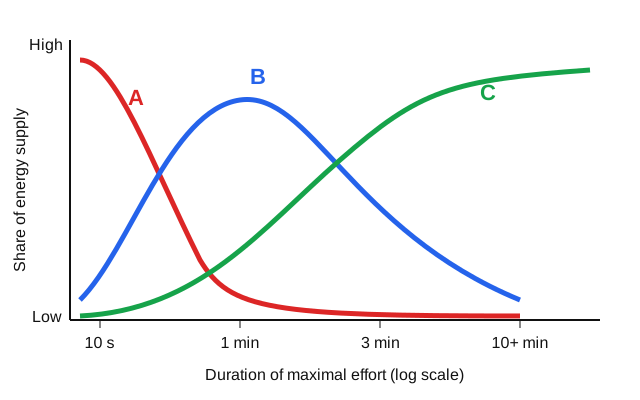
In the chart, which curve is the oxidative system?
None of them
A
B
C
Curve C rises gradually and dominates in long-duration events. A is phosphagen; B is anaerobic glycolysis.
Which statement about lactate is most accurate?
It is a fuel and glycolysis product that does not cause DOMS
It is produced only without oxygen present anywhere in the body
It stays in the muscle for 24 hours
It causes delayed-onset muscle soreness
Lactate is cleared within roughly an hour and is a fuel; DOMS arises from muscle damage.
VO2 max is best defined as:
The highest heart rate possible
The maximum rate of oxygen the body can use during exercise
The amount of oxygen in a breath
Resting oxygen consumption
Measured in mL per kg per minute; it reflects aerobic capacity.
Cardiac output equals:
Heart rate x stroke volume
Heart rate / stroke volume
Stroke volume x blood pressure
Blood volume x heart rate
Q = HR x SV. Training increases maximal stroke volume.
Which fibers are fast-twitch with high fatigue resistance relative to IIx?
Type IIa
Type IIx
Type III
Type I
Type IIa fibers are fast but oxidative. Type I is slow; IIx is the least fatigue-resistant.
Early strength gains in a novice are mainly due to:
Hypertrophy
Neural adaptations
Hyperplasia
Increased tendon length
Better recruitment and synchronization come before significant muscle growth.
Which principle says a body adapts specifically to the type of demand imposed?
Specificity
Progression
Overload
Reversibility
SAID: Specific Adaptations to Imposed Demands. Overload is about intensity beyond normal.
What does the 'T' in FITT stand for?
Time
Tempo
Technique
Training
FITT: Frequency, Intensity, Time, Type.
An RER of about 0.7 indicates the body is using mostly which fuel?
Mostly protein
Mixed 50:50
Mostly carbohydrate
Mostly fat
RER of 0.7 indicates fat oxidation; 1.0 indicates carbohydrate.
True or false: Maximum heart rate increases with endurance training.
True
False
False. Max HR stays about the same (it depends on age); stroke volume and a-vO2 difference rise.
Which BMI value is classified as overweight in adults?
22
27
31
18
25 to 29.9 is overweight; 30 and above is obese.
Tapering refers to:
Increasing volume before competition
Reducing training volume before competition while keeping intensity
Training only at low intensity all season
Stopping all training for months
The taper sheds fatigue while keeping fitness.
How many kilocalories does 1 gram of fat provide?
4
7
9
12
Fat gives 9 kcal/g; carbohydrate and protein give 4.
Which sequence correctly orders heat illness from least to most severe?
Exhaustion, cramps, stroke
Cramps, stroke, exhaustion
Heat stroke, heat exhaustion, cramps
Cramps, heat exhaustion, heat stroke
Heat stroke is a medical emergency.
The recommended aerobic exercise amount for adults is at least:
600 minutes per week
30 minutes per month
75 minutes per week of moderate
150 minutes per week of moderate
150 minutes of moderate (or 75 vigorous) per week, plus strength work.
The 'A' in SMART goals commonly stands for:
Aggressive
Achievable
Active
Applied
Specific, Measurable, Achievable, Relevant, Time-bound.
