Quiz · Medium
Foundational questions on vision, hearing, touch, pain, taste, smell and psychophysics, including diagram-label questions on the eye, ear, visual pathway and skin receptors.
Which structure is marked A in the diagram?
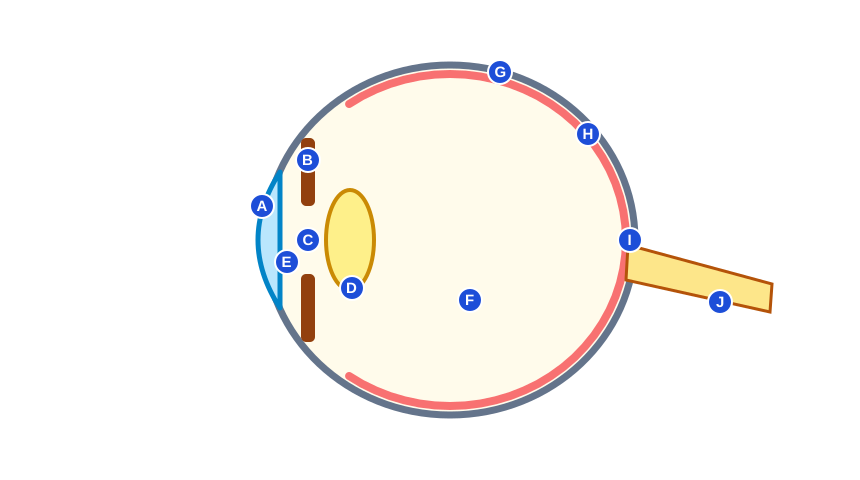
Cornea
Iris
Lens
Sclera
The cornea is the clear front surface and provides most of the eye's focusing power. The sclera is the white, opaque outer coat.
Which structure is marked I in the diagram?
Ciliary body
Pupil
Optic disc
Fovea
The fovea has only cones and the highest acuity. The optic disc is the blind spot.
Which structure is marked H in the diagram?
Vitreous humor
Sclera
Retina
Iris
The retina contains the photoreceptors, bipolar cells and ganglion cells.
Which structure is marked B in the diagram?
Cornea
Iris
Retina
Lens
The iris is the pigmented diaphragm that adjusts pupil size.
Which structure is marked I in the diagram?
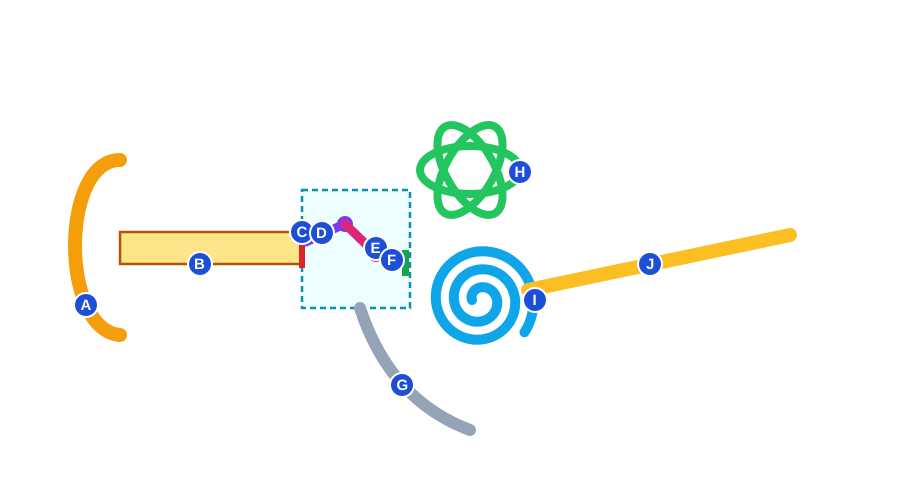
Semicircular canals
Cochlea
Eustachian tube
Eardrum
The cochlea contains the organ of Corti. The semicircular canals sense head rotation.
Which structure is marked D in the diagram?
Malleus
Cochlea
Stapes
Incus
The malleus is attached to the eardrum; then comes the incus and then the stapes.
Which structure is marked H in the diagram?
Eustachian tube
Ear canal
Cochlea
Semicircular canals
They detect angular acceleration of the head.
Which structure is marked D in the diagram?
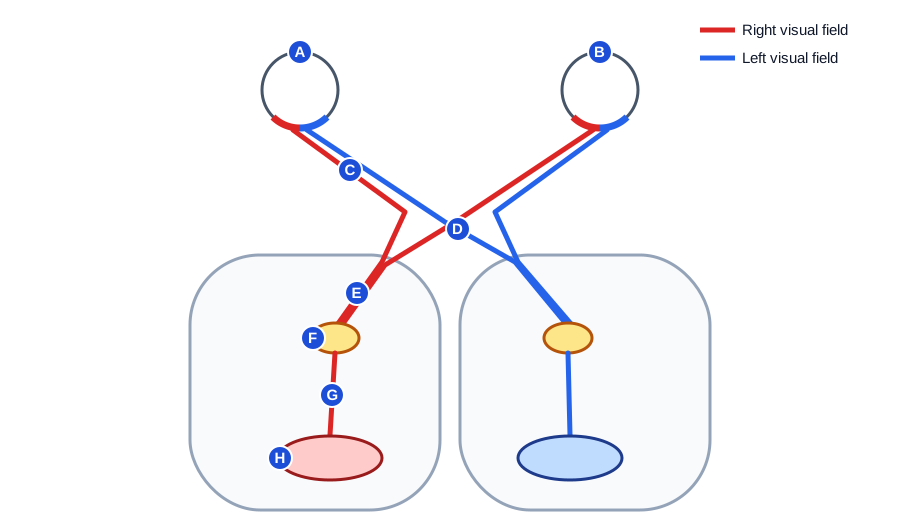
Optic tract
Optic radiation
Optic chiasm
LGN
Nasal retinal fibers cross at the chiasm. The optic tract is behind it.
Which structure is marked F in the diagram?
Optic chiasm
Superior colliculus
Lateral geniculate nucleus
Primary visual cortex
The LGN of the thalamus relays visual information to V1.
Which structure is marked E in the diagram?
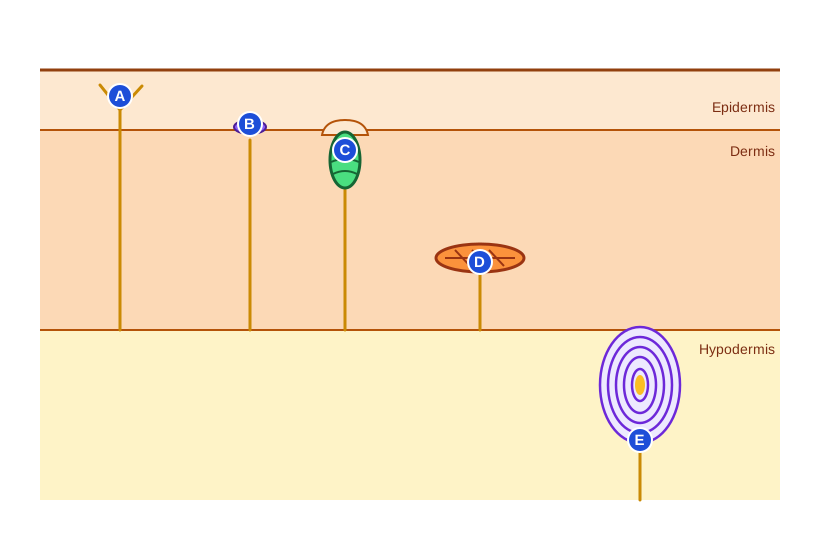
Merkel disc
Pacinian corpuscle
Meissner corpuscle
Free nerve ending
Pacinian corpuscles are deep, onion-like and detect vibration.
Which photoreceptor is most responsible for color vision and high acuity?
Cones
Rods
Horizontal cells
Ganglion cells
Cones function in bright light and are concentrated in the fovea. Rods are more sensitive but colorless.
What happens to a rod photoreceptor when light strikes it?
It depolarizes and releases more glutamate
It releases GABA
It fires an action potential
It hyperpolarizes and releases less glutamate
Light closes cGMP-gated cation channels, shutting off the dark current.
A lesion of the right optic tract produces which visual defect?
Blindness in the right eye
Bitemporal hemianopia
Right homonymous hemianopia
Left homonymous hemianopia
The right optic tract carries the left visual field from both eyes.
A pituitary tumor compressing the optic chiasm typically causes...
Monocular blindness
Left homonymous hemianopia
Bitemporal hemianopia
Binasal hemianopia
Crossing nasal-retina fibers (temporal fields) are the ones pressed on.
In myopia, where does the image focus?
On the fovea
In front of the retina
Behind the retina
On the optic disc
Myopia is corrected with concave lenses. In hyperopia the image falls behind the retina.
What is the main structure that transforms sound pressure waves into neural signals?
Hair cells of the organ of Corti
Semicircular canals
Stapes
Tympanic membrane
The eardrum and ossicles only transmit vibration.
High-frequency sounds maximally vibrate which part of the basilar membrane?
The base (near the oval window)
The apex
All regions equally
The middle only
The base is stiff and narrow; the apex is wide and floppy and responds to low frequencies.
Interaural time differences are mainly used to localize...
Only sounds from above
Only moving sounds
High-frequency sounds
Low-frequency sounds
High frequencies are localized by interaural level differences, due to the head's acoustic shadow.
A man has hearing loss in the right ear. Weber's tone lateralizes to the right ear. Rinne is negative (bone louder than air) on the right. What is the diagnosis?
Left sensorineural hearing loss
Normal hearing
Right conductive hearing loss
Right sensorineural hearing loss
In conductive loss Weber lateralizes to the affected ear and Rinne shows bone > air.
Which receptor type adapts slowly and signals sustained pressure and texture?
Meissner corpuscle
Merkel disc
Free nerve ending
Pacinian corpuscle
Meissner and Pacinian corpuscles are rapidly adapting.
Which fibers carry the fast, sharp 'first' pain?
C fibers
A-delta fibers
A-beta fibers
A-alpha fibers
A-delta fibers are thinly myelinated. C fibers carry slow, dull pain.
According to the gate control theory, rubbing a bumped elbow reduces pain because...
Large touch fibers inhibit pain transmission in the dorsal horn
It increases opioid receptors
It destroys pain fibers
It blocks the thalamus
A-beta activity excites inhibitory interneurons that block C-fiber input.
Which cranial nerve carries taste from the anterior two-thirds of the tongue?
Vagus nerve (X)
Glossopharyngeal nerve (IX)
Trigeminal nerve (V)
Facial nerve (VII), via the chorda tympani
IX carries taste from the posterior third. The trigeminal nerve carries general sensation from the front of the tongue.
Which sense reaches the cortex without first passing through the thalamus?
Vision
Taste
Smell
Hearing
Olfactory signals go from the olfactory bulb to the piriform cortex and amygdala; this strongly links smell to memory and emotion.
Weber's law states that...
The JND is a constant amount
Detection depends only on the criterion
The just-noticeable difference is a constant fraction of the stimulus intensity
Perception grows linearly with intensity
It means that heavier weights need larger increments to be noticeably heavier.
True or false: different regions of the tongue are dedicated to different tastes.
True
False
The tongue map is a myth. Taste receptors for all five tastes are found across the tongue.
True or false: the retina is 'inverted', so light passes through other retinal layers before reaching the photoreceptors.
True
False
Rods and cones lie at the back of the retina, next to the pigment epithelium.
