Quiz · Hard
Numerical problems on magnetic fields, circular motion in B, Faraday and Lenz, transformers, RC circuits and real batteries.
A proton (m = 1.67×10⁻²⁷ kg) enters a 0.10 T field perpendicular to it at 1.0×10⁶ m/s. What is the radius of its circular path?
1.0 cm
10 cm
1.0 m
20 cm
m. A deuteron (double mass) would give 20 cm.
What is the magnetic field 5.0 cm from a long straight wire carrying 10 A? (μ₀ = 4π×10⁻⁷ T·m/A)
40 μT
4.0 μT
0.40 mT
25 μT
T = 40 μT.
A long solenoid has 1000 turns per metre and carries 2.0 A. What is the magnetic field inside?
0.25 mT
25 mT
2.0 mT
2.5 mT
T.
A 100-turn coil experiences a flux change of 0.020 Wb in 0.50 s. What is the magnitude of the induced emf?
0.040 V
0.0040 V
4.0 V
200 V
V. Forgetting N gives 0.040 V.
A 0.50 m metal rod moves at 4.0 m/s perpendicular to a 0.30 T field and perpendicular to its own length. What emf is induced between its ends?
0.15 V
0.60 V
2.4 V
6.0 V
V.
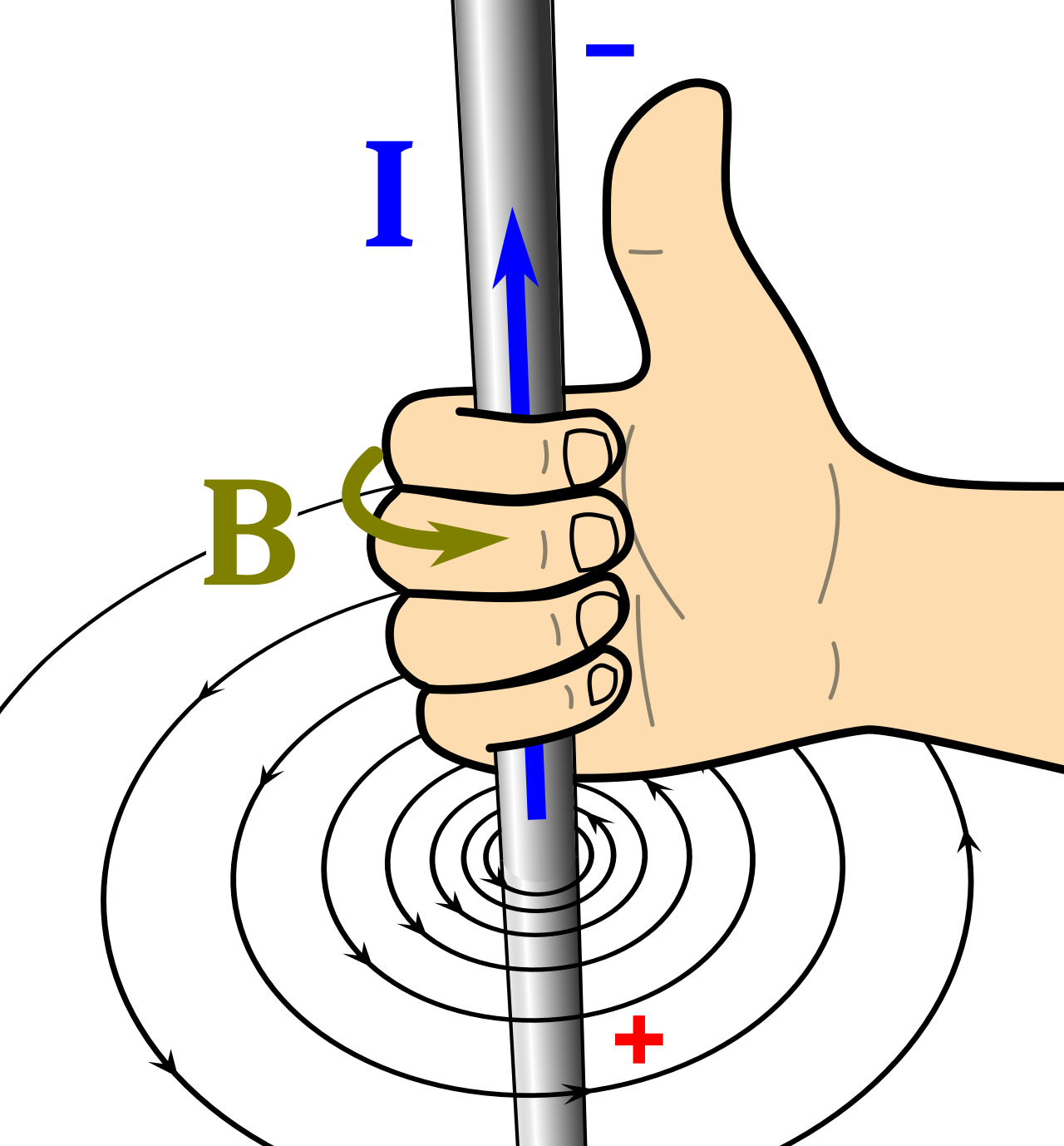
In the right-hand-rule diagram, current flows upward in the wire. Looking down from above, in which sense does the magnetic field circulate?
Clockwise
Radially outward
Counterclockwise
Parallel to the wire
Thumb up (current), fingers curl counterclockwise when viewed from above. Field lines around a straight wire are circles; they are never radial or parallel to the current. Image: MikeRun, CC BY-SA 4.0, via Wikimedia Commons.
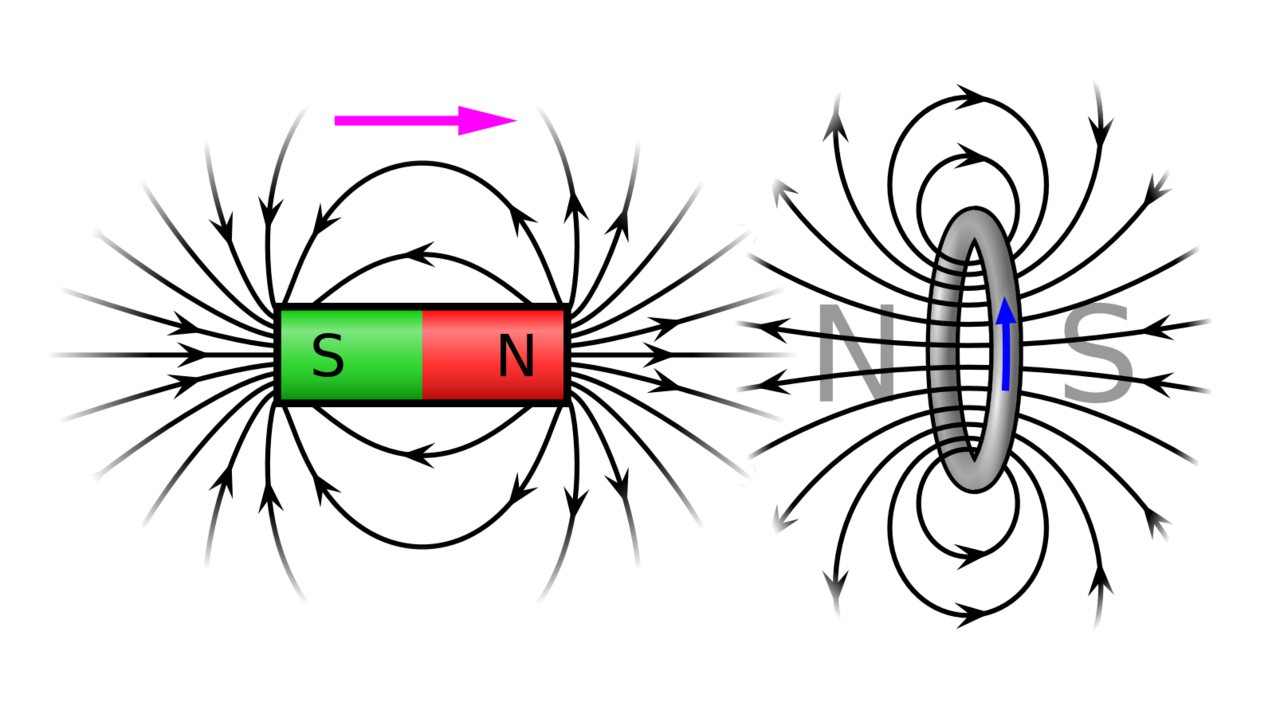
The north pole of a bar magnet is pushed toward a conducting loop. Which statement about the induced current is correct?
It creates a north pole on the side of the loop facing the magnet, which repels the magnet
It creates a south pole facing the magnet, which attracts it
No current is induced because the magnet is not touching the loop
It creates a field in the same direction as the magnet's field
Lenz's law: the induced current opposes the increase in flux, so the loop's field must point against the magnet's field on the near side (north facing north: repulsion). Otherwise energy would not be conserved. Image: MikeRun, CC BY-SA 4.0, via Wikimedia Commons.
An ideal transformer steps 120 V down to 12 V and the secondary delivers 0.50 A. What is the current in the primary?
5.0 A
0.50 A
0.0050 A
0.050 A
: → A. Step-down transformers draw less current on the primary side.
What is the rms voltage of an AC source whose peak voltage is 170 V?
170 V
240 V
120 V
85 V
V.
A 10 kΩ resistor charges a 100 μF capacitor from a 9.0 V battery. What is the capacitor voltage 2.0 s after the switch is closed?
5.7 V
7.8 V
9.0 V
4.5 V
s, so V. 5.7 V is the voltage at one time constant.
A battery has emf 12 V and internal resistance 0.50 Ω. When it delivers 2.0 A, what is the voltage across its terminals?
11 V
12 V
13 V
1.0 V
V. The terminal voltage is lower than the emf while current is drawn.
A 60 W and a 100 W bulb, both rated for 120 V, are connected in series across a 120 V supply. Which statement is true?
The 100 W bulb is brighter
Both are equally bright
Neither lights
The 60 W bulb is brighter
is larger for the 60 W bulb (240 Ω vs. 144 Ω). With the same current, is higher for the larger resistance.
A copper wire is drawn out to twice its original length at constant volume. How does its resistance change?
It doubles
It is unchanged
It increases by a factor of 4
It halves
Length doubles and cross-sectional area halves, so increases by 2 × 2 = 4.
Two long parallel wires carry currents in the same direction. What is the force between them?
Repulsive
Attractive
Zero
Zero if the currents are equal
Each wire's field exerts a force on the other that pulls them together for parallel currents (opposite currents repel): .
In a velocity selector, E = 2000 V/m and B = 0.010 T are perpendicular to each other and to the beam. What speed passes straight through?
2.0×10⁵ m/s
2.0×10⁷ m/s
20 m/s
5.0×10⁻⁶ m/s
gives m/s.
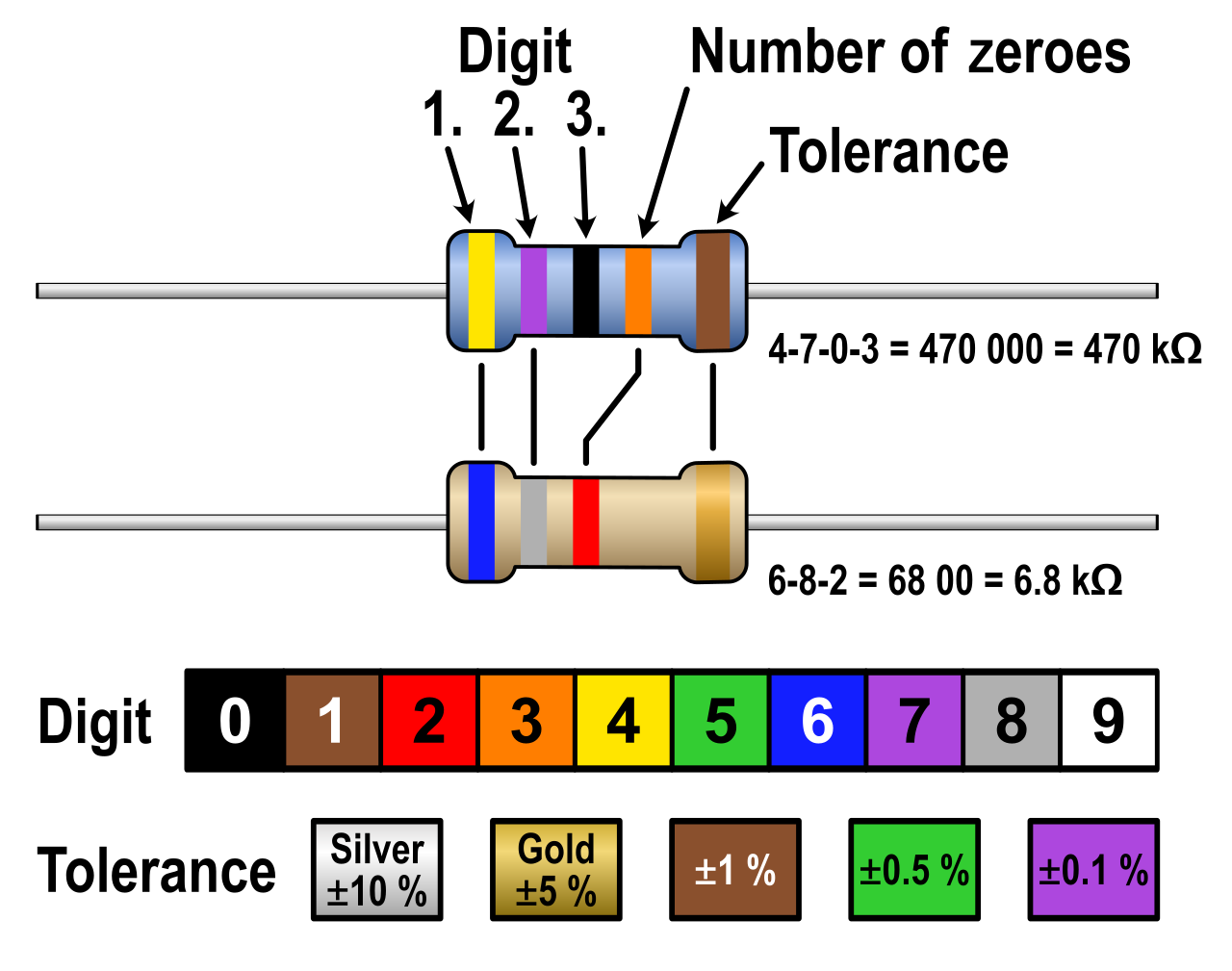
A resistor has colour bands yellow, violet, orange, gold. What is its value, using the standard colour code chart?
470 Ω ± 5%
4.7 kΩ ± 10%
43 kΩ ± 5%
47 kΩ ± 5%
Yellow = 4, violet = 7, orange = 3 (so × 10³), gold = ±5%. Reading orange as 3 zeros (not the digit 3 after 47) is the usual slip. Image: Knarfili, CC0, via Wikimedia Commons.
A charged particle moves through a region of uniform magnetic field with its velocity perpendicular to the field. What happens to its kinetic energy?
It increases steadily
It stays constant
It decreases steadily
It oscillates between zero and a maximum
The magnetic force is always perpendicular to the velocity, so it does no work. The particle moves in a circle at constant speed.
