Quiz · Medium
Twenty-one questions on ACE inhibitors, beta blockers, diuretics, nitrates, digoxin, anticoagulants, statins and antiarrhythmics, including image questions.
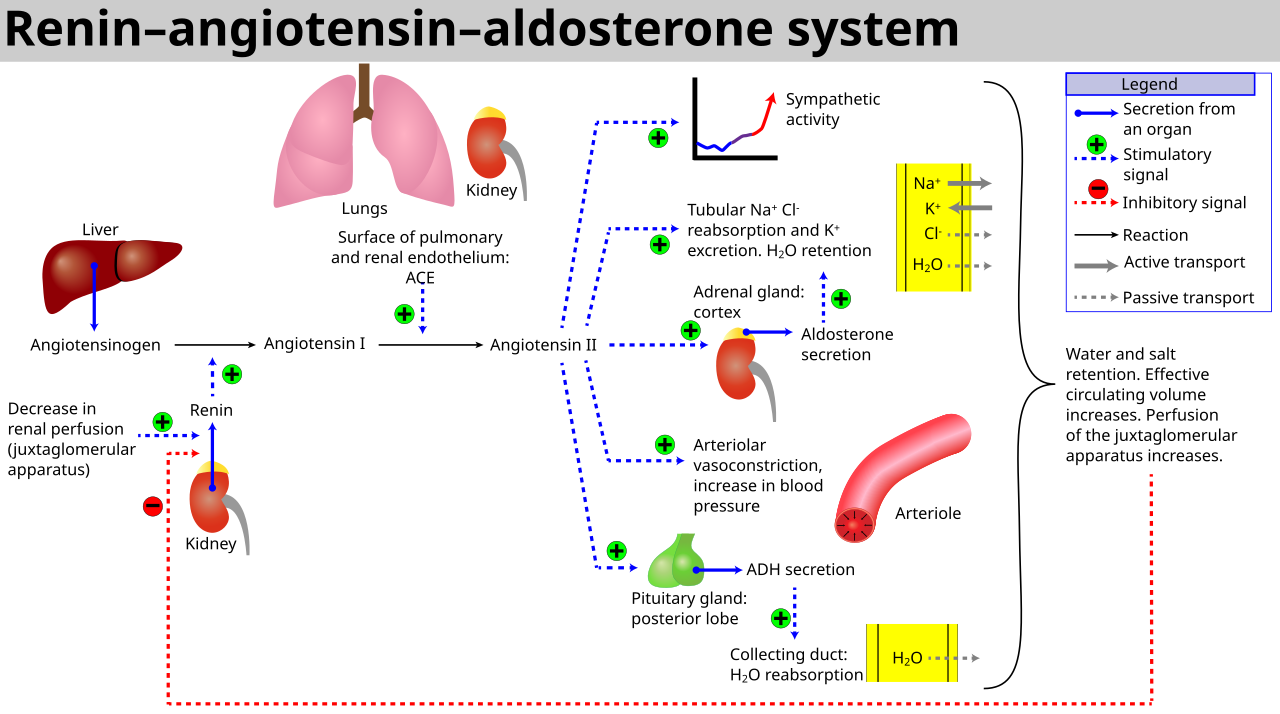
In this renin-angiotensin diagram, which drug class blocks the step labeled ACE (angiotensin I to angiotensin II)?
Angiotensin receptor blockers
ACE inhibitors
Aldosterone antagonists
Beta blockers
ACE inhibitors (-pril) block the conversion of angiotensin I to II. ARBs act later, at the AT1 receptor; aldosterone antagonists block the end-organ hormone; beta blockers lower renin release but do not block this step.
Image: Soupvector, CC BY-SA 4.0, via Wikimedia Commons.
A patient taking lisinopril develops a persistent dry cough. What is the most likely mechanism?
Histamine release from mast cells
Beta-2 receptor blockade
Accumulation of bradykinin
Excess angiotensin II
ACE also degrades bradykinin; when it is blocked, bradykinin accumulates and irritates the airway. Angiotensin II is reduced, not raised, and ACE inhibitors do not act on beta-2 receptors. Switching to an ARB usually resolves the cough.
A patient's apical pulse is 52 bpm before a scheduled dose of metoprolol. What is the best nursing action?
Hold the dose and notify the prescriber
Give the dose and recheck in 1 hour
Give half the dose
Give the dose with a potassium supplement
A heart rate below the hold parameter (commonly 60) risks symptomatic bradycardia and heart block. Giving the drug anyway or giving half a dose is not a nursing decision; potassium has no role.
Why is sublingual nitroglycerin contraindicated within 24 hours of taking sildenafil?
Sildenafil inactivates nitroglycerin in the stomach
Both drugs cause severe hyperkalemia
Nitroglycerin raises sildenafil levels to toxic range
Both increase cGMP, causing profound hypotension
Nitrates release nitric oxide, raising cGMP; PDE-5 inhibitors prevent cGMP breakdown. Together they can cause life-threatening hypotension. There is no effect on potassium or stomach inactivation.
Which electrolyte disturbance is most associated with loop diuretics such as furosemide?
Hyperkalemia
Hypokalemia
Hypercalcemia
Hypernatremia
Loop diuretics waste potassium (and magnesium and calcium). Hyperkalemia is the problem with potassium-sparing diuretics; hypercalcemia is seen with thiazides.
Which finding suggests digoxin toxicity?
Dry mouth and sedation
Constipation and dry cough
Nausea, blurred vision and yellow-green halos
Flushing and headache
Digoxin toxicity causes GI upset, visual disturbances (yellow-green halos) and arrhythmias. Dry mouth and sedation point to clonidine; cough to ACE inhibitors; flushing and headache to nitrates or vasodilators.
What is the usual INR target for a patient with atrial fibrillation or venous thromboembolism on warfarin?
2.0 to 3.0
1.0 to 1.5
3.5 to 4.5
4.0 to 5.0
The standard therapeutic INR range is 2 to 3. A range of 2.5 to 3.5 is used for some mechanical valves. A normal INR in people not on warfarin is about 1.
Which agent reverses the effect of warfarin?
Protamine sulfate
Vitamin K (phytonadione)
Naloxone
Flumazenil
Vitamin K restores synthesis of factors II, VII, IX and X. Protamine reverses heparin; naloxone and flumazenil reverse opioids and benzodiazepines.
Which agent reverses unfractionated heparin?
Vitamin K
Idarucizumab
Protamine sulfate
Aminocaproic acid
Protamine binds heparin ionically. Idarucizumab reverses dabigatran; vitamin K reverses warfarin; aminocaproic acid is an antifibrinolytic.
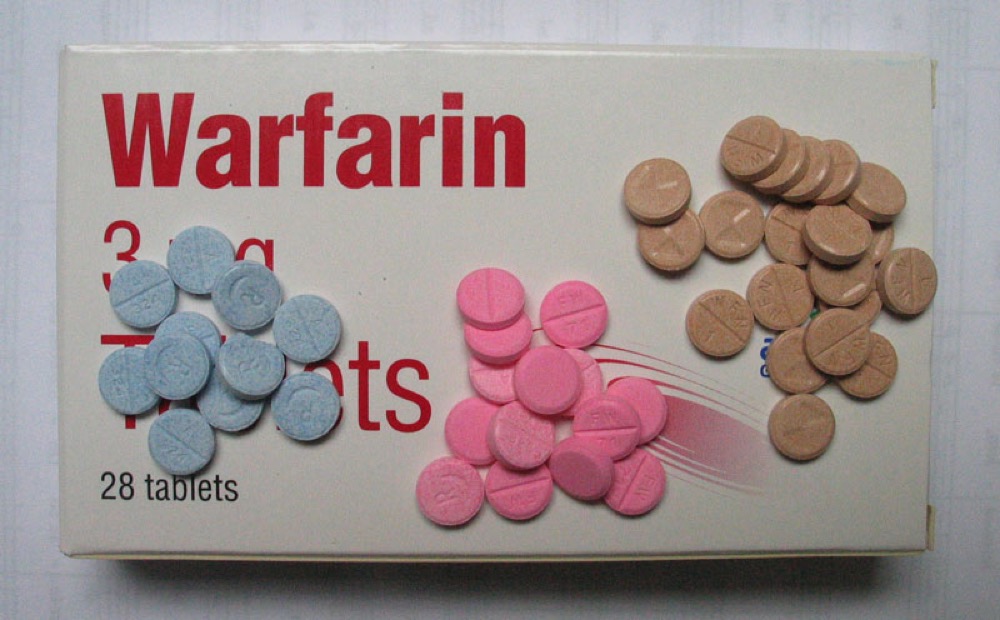
Warfarin tablets come in different colors for each strength. What is the main reason?
To tell patients which brand they are taking
To help prevent dosing errors; but always read the label
To protect the drug from light
Color indicates how fast the tablet dissolves
Color coding helps catch strength mix-ups, but colors differ by country and manufacturer, so the label must always be checked.
Image: Gonegonegone, CC BY-SA 3.0, via Wikimedia Commons.
A patient starts atorvastatin. Which symptom should they report promptly?
Mild headache in the first week
Unexplained muscle pain, tenderness or dark urine
Dry mouth
Mild bloating
Muscle pain with weakness or dark urine may signal myopathy or rhabdomyolysis. Minor effects such as headache are common and not usually dangerous.
Spironolactone is most likely to cause which adverse effect?
Hyperkalemia
Hypokalemia
Ototoxicity
Hyperglycemia only
Spironolactone blocks aldosterone, so potassium is retained. Hypokalemia and ototoxicity are loop diuretic effects. Gynecomastia is the other classic effect.
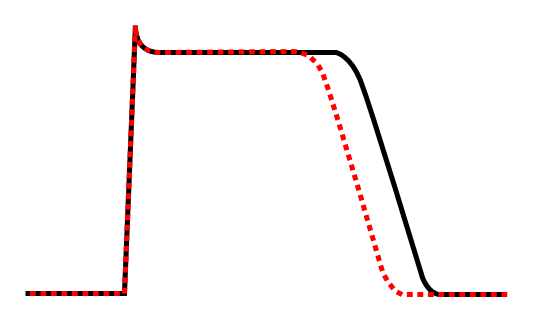
Black = normal action potential; red dotted = with a drug. Which Vaughan Williams class does this effect represent?
Class Ia
Class Ib
Class Ic
Class III
Class Ib drugs (lidocaine, mexiletine) shorten the action potential. Ia prolongs it with a slower upstroke; Ic slows the upstroke only; III prolongs the action potential with an unchanged upstroke.
Image: Ksheka, CC BY-SA 3.0, via Wikimedia Commons.
This plant was the original source of which drug?

Warfarin
Quinidine
Digoxin
Amiodarone
Foxglove (Digitalis purpurea) is the source of digoxin and digitoxin. Quinidine comes from cinchona bark; warfarin was developed from spoiled sweet clover; amiodarone is synthetic.
Image: Robert Flogaus-Faust, CC BY 4.0, via Wikimedia Commons.
Where do loop diuretics act in the nephron?
Proximal convoluted tubule
Distal convoluted tubule
Collecting duct
Thick ascending limb of the loop of Henle
They block the Na+/K+/2Cl- cotransporter in the thick ascending limb. The distal tubule is the thiazide site; the collecting duct is where aldosterone antagonists and ENaC blockers work.
A patient stops taking clonidine abruptly. What is the main risk?
Severe hypotension
Rebound hypertension
Hyperkalemia
Bleeding
Stopping a central alpha-2 agonist suddenly releases sympathetic outflow, causing rebound hypertension, headache and tachycardia. Beta blockers carry a similar warning.
Which adverse effect is most typical of amlodipine?
Peripheral edema
Constipation severe enough to cause obstruction
Cough
Hyperkalemia
Dihydropyridine vasodilation causes ankle edema, flushing and headache. Constipation is classic for verapamil; cough for ACE inhibitors; hyperkalemia for RAAS inhibitors.
Which antihypertensive is considered a first-line choice in pregnancy?
Lisinopril
Losartan
Labetalol
Aliskiren
Labetalol, nifedipine and methyldopa are preferred. ACE inhibitors, ARBs and aliskiren can cause fetal renal damage and are contraindicated.
How is adenosine given for SVT?
Slow IV infusion over 30 minutes
Oral dose with food
Rapid IV push followed by a saline flush
Intramuscular injection
Adenosine's half-life is under 10 seconds, so it must be pushed quickly into a large proximal vein and flushed. A slow infusion would be metabolized before reaching the heart.
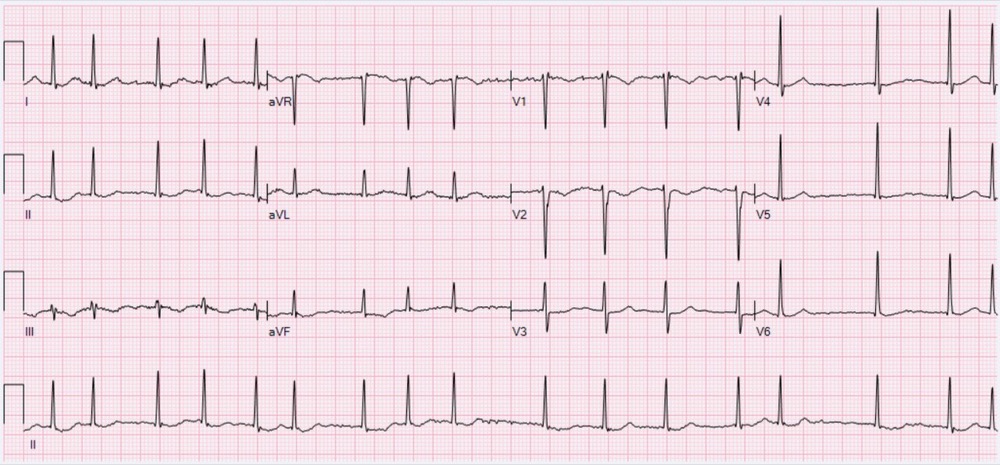
This 12-lead shows an irregularly irregular rhythm without clear P waves. Which drug would be appropriate for ventricular rate control?
Metoprolol
Adenosine
Lidocaine
Amlodipine
Atrial fibrillation: rate control uses beta blockers or non-dihydropyridine CCBs (or digoxin). Adenosine is too short-acting; lidocaine is for ventricular arrhythmias; amlodipine (a dihydropyridine) has no meaningful rate effect.
Image: Ewingdo, CC BY-SA 4.0, via Wikimedia Commons.
How does aspirin inhibit platelet aggregation?
Reversible blockade of P2Y12
Irreversible inhibition of COX-1
Inhibition of factor Xa
Activation of antithrombin
Aspirin acetylates COX-1, reducing thromboxane A2 for the platelet's life. P2Y12 blockade is clopidogrel or ticagrelor; Xa inhibition is apixaban or rivaroxaban; antithrombin activation is heparin.
