Quiz · Hard
Applied questions on excretion, osmoregulation, gas exchange, circulation, kin selection, mimicry and animal phylogeny.
Which characteristic distinguishes a monotreme from other mammals?
It is cold-blooded
It has no mammary glands
It lays eggs
It has no hair
Monotremes (platypus, echidna) lay eggs, but feed their young with milk and have hair.
A scientist shows a shark and a dolphin look similar. This is best explained by:
Convergent evolution to a similar aquatic niche
Sexual selection
Common ancestry from a recent shark-like ancestor
Divergent evolution
Both evolved streamlined bodies to move through water, although a dolphin is a mammal, which is an example of analogy.
A researcher removes the sea star Pisaster from a rocky intertidal zone and mussels take over, reducing species diversity. Pisaster is an example of a:
Pioneer species
Dominant species
Keystone species
Invasive species
A keystone species has an impact much larger than its abundance would suggest. A dominant species is important because it is abundant.
Which of the following correctly matches animal and excretory organ?
Insect: Malpighian tubules
Flatworm: nephron
Insect: nephridia
Earthworm: Malpighian tubules
Insects use Malpighian tubules and annelids use nephridia. Flatworms use protonephridia (flame cells).
A marine bony fish lives in seawater, which is hypertonic to its body fluids. Which statement about the fish is wrong?
It makes small volumes of concentrated urine
It drinks seawater and excretes salt through gills
It loses water by osmosis
It makes large volumes of dilute urine
Seawater is saltier than the fish, so the fish loses water by osmosis and makes little, concentrated urine. Large volumes of dilute urine is what a freshwater fish does.
In a population, a female helps her sister raise offspring. By Hamilton's rule, with r = 0.5 and cost C = 2, how large must the benefit B be for the behavior to be favored?
B > 2
B > 4
B > 0.5
B > 1
rB > C gives 0.5 B > 2, so B > 4.
Which statement best explains why gills of fish are efficient at extracting oxygen?
Water flows in the same direction as the blood
Blood and water flow in opposite directions, keeping a gradient along the lamellae
Gills are lined with lungs
Fish blood contains no hemoglobin
Countercurrent exchange can extract more than 80% of the oxygen. Parallel flow would let the two sides equilibrate halfway.
An animal develops from an embryo whose blastopore becomes the mouth and shows spiral cleavage. It also has a true coelom and a closed circulatory system. It is most likely a:
Lancelet
Jellyfish
Sea urchin
Octopus
Protostome with a true coelom and a closed circulation: cephalopod mollusk. A sea urchin and a lancelet are deuterostomes and a jellyfish has no coelom.
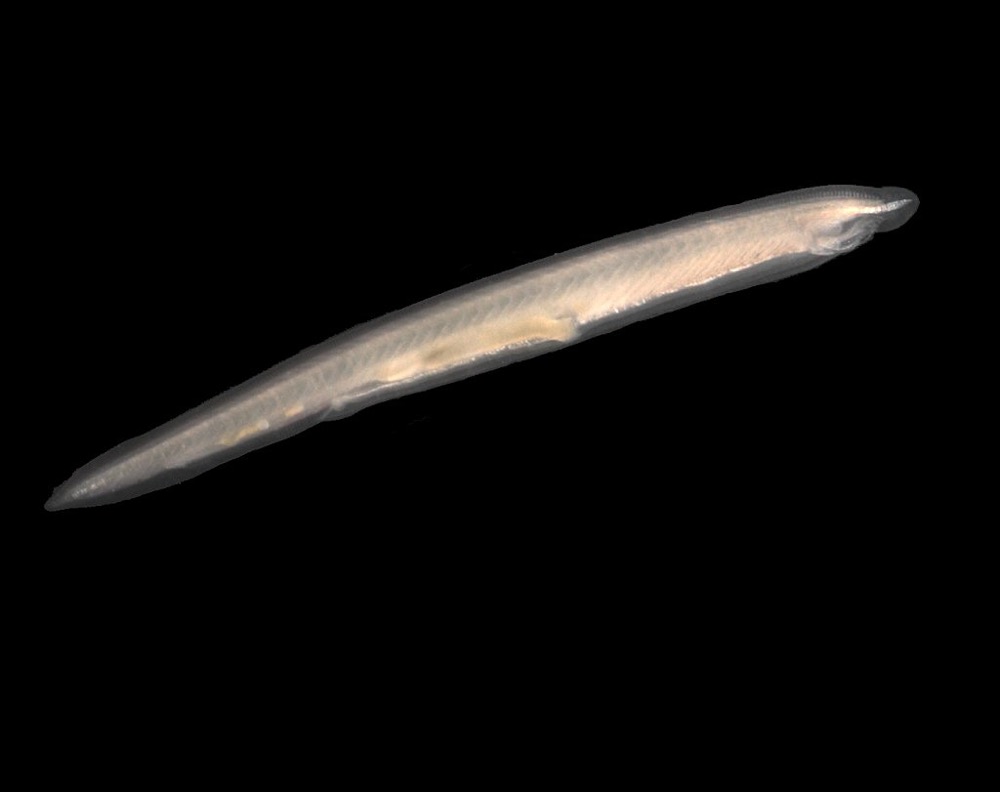
The lancelet has all four chordate traits as an adult, but in humans the notochord:
Is lost completely
Develops into the nerve cord
Is replaced by the vertebral column (intervertebral discs remain)
Becomes the brain
In vertebrates the notochord is replaced by the backbone; remnants form the nucleus pulposus of the discs.
Image: Hans Hillewaert, CC BY-SA 4.0, via Wikimedia Commons.
Which of the following is the best evidence that sponges are animals?
They are heterotrophic, multicellular, and their cells lack walls
They have a nerve net
They photosynthesize
They have cell walls of cellulose
Animals are multicellular heterotrophs without cell walls. Sponges lack true tissues and nerves.
Compared with an open circulatory system, a closed system:
Is found in all arthropods
Has no heart
Has lower pressure
Keeps blood in vessels and delivers oxygen faster
Closed systems keep blood in vessels at higher pressure. Arthropods have an open system.
An insect has spiracles and tracheae. What does this mean for its blood?
It must carry large amounts of oxygen on hemoglobin
It does not need to transport oxygen, since tracheae deliver it directly
It is a closed system
It uses gills
Tracheae supply air to each tissue directly.
A species of hoverfly with no sting looks like a wasp. This is an example of:
Müllerian mimicry
Batesian mimicry
Aposematism in a toxic species
Camouflage
A harmless species mimicking a harmful one is Batesian mimicry. In Müllerian mimicry, both species are harmful.
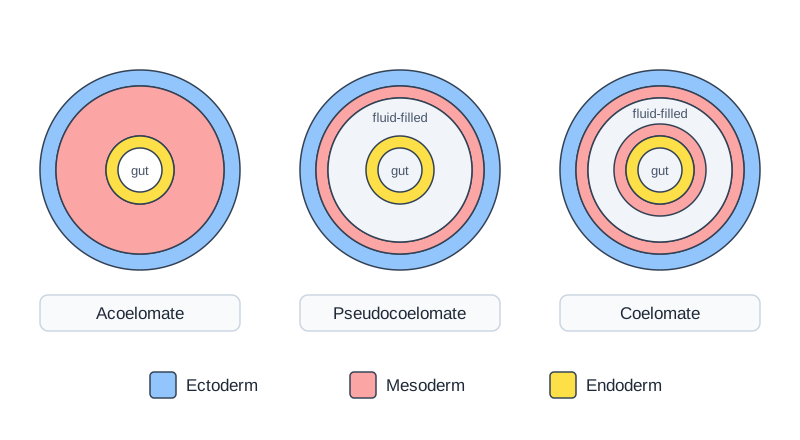
Which sequence of body cavity types, from least to most complex, is correct?
Pseudocoelomate, coelomate, acoelomate
Acoelomate, coelomate, pseudocoelomate
Coelomate, pseudocoelomate, acoelomate
Acoelomate, pseudocoelomate, coelomate
The usual order is acoelomate, pseudocoelomate, coelomate. Note that molecular data suggest these cavity types arose more than once.
Animals A and B share an ancestor more recently than either does with C. On a phylogeny drawn this way, which fact is true?
A and B share a most recent common ancestor not shared with C
C is ancestral to A and B
A and B are the same species
A and B must look more alike than C
Phylogenies show relatedness through common ancestry, not similarity.
