Quiz · Hard
Applied questions on inhibition, Km and Vmax, graph interpretation, and protein structure.
In the graph, curve A is an uninhibited enzyme and B and C are inhibited. Which statement is correct?
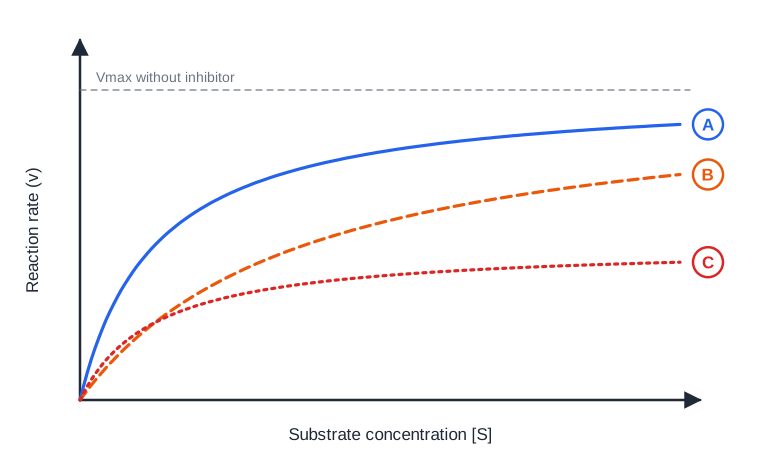
B is competitive and C is noncompetitive
Both are noncompetitive
B is noncompetitive and C is competitive
Both are competitive
B approaches the same Vmax at high substrate (competitive). C has a lower Vmax that substrate cannot rescue (noncompetitive).
A drug raises the apparent Km of an enzyme but leaves Vmax unchanged. The drug is most likely
A cofactor
A noncompetitive inhibitor
An irreversible inhibitor
A competitive inhibitor
Higher Km with unchanged Vmax is the signature of competitive inhibition.
An enzyme has Vmax of 80 µmol/min and Km of 2 mM. What is the rate at [S] = 2 mM?
80 µmol/min
20 µmol/min
2 µmol/min
40 µmol/min
At [S] = Km the rate is Vmax / 2. Using v = Vmax[S]/(Km+[S]) gives 80 x 2 / 4 = 40.
Enzyme X has Km = 0.5 mM and enzyme Y has Km = 5 mM for the same substrate. Which statement is best?
They have the same affinity but different Vmax
X has higher affinity for the substrate
X always has the greater Vmax
Y has higher affinity
A lower Km means half-maximal rate is reached at a lower substrate concentration. Km says nothing certain about Vmax.
A noncompetitive inhibitor is added. Which change is expected on a Michaelis-Menten plot?
Higher Vmax, lower Km
Lower Vmax, same Km
Same Vmax, higher Km
No change at high [S]
The inhibitor effectively lowers the amount of active enzyme, reducing Vmax.
The product of a metabolic pathway binds to an allosteric site on the pathway's first enzyme and lowers its activity. This is
Cooperativity
Feedback inhibition
Competitive inhibition
Irreversible inhibition
End-product feedback saves resources by shutting down the pathway when product is plentiful.
A mutation changes a surface amino acid far from the active site to another polar amino acid. Enzyme activity is unchanged. Which is the best explanation?
The mutation changed the peptide bond
Polar amino acids are always interchangeable with nonpolar ones
The change does not alter the overall tertiary structure or the active site
Primary structure never affects function
Primary structure influences function through folding. A conservative surface change often leaves the active site untouched.
In sickle-cell hemoglobin a polar glutamate is replaced by nonpolar valine. Why does this cause polymerization?
The peptide bond is broken
A new hydrophobic patch on the surface sticks to another hemoglobin
The change adds a disulfide bridge
The heme group is lost
The exposed hydrophobic valine interacts with a hydrophobic pocket on other hemoglobin molecules at low oxygen.
Reducing agent mercaptoethanol breaks disulfide bonds in a protein. Which level of structure is most directly affected?
None; disulfides are not structural
Tertiary (and quaternary where subunits are bridged)
Primary only
Secondary only
Disulfide bridges link cysteine R groups, which belong to tertiary structure.
Ribonuclease unfolds in urea and mercaptoethanol, and refolds when both are removed. What does this show?
Chaperones are always required
Peptide bonds reform spontaneously
The primary structure contains the information for folding
Denaturation is always permanent
This classic Anfinsen experiment showed that the amino acid sequence can determine native conformation.
A cell uses ATP hydrolysis (ΔG = -7.3 kcal/mol) to drive a reaction with ΔG = +4 kcal/mol. The coupled process
Cannot occur
Has ΔG = 0
Is endergonic overall
Is exergonic overall
The net ΔG is about -3.3 kcal/mol, so the coupled process proceeds.
Which would a catalyst NOT change?
The pathway of the reaction
The rate
The equilibrium constant of the reaction
The activation energy
Catalysts speed both directions equally and do not change equilibrium.
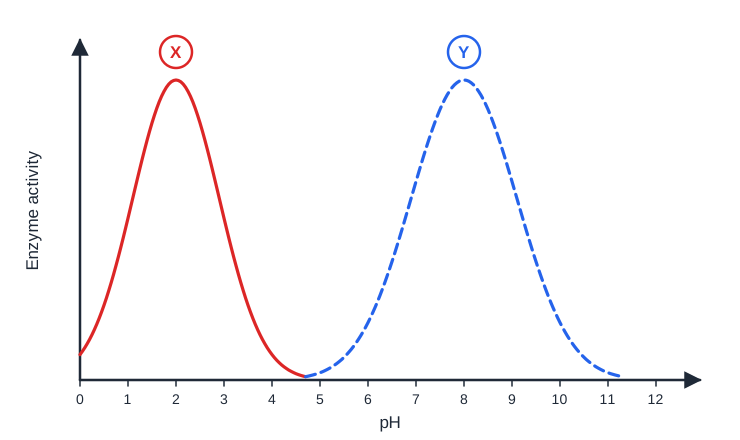
In the activity-vs-pH graph, which would be the best interpretation of curve Y falling to zero in strongly acidic conditions?
The enzyme was competitively inhibited
The acidic environment denatured the enzyme
pH changes the peptide bonds
The substrate evaporated
Ionizable R groups change charge, destroying the active site structure.
Which sequence of events is correct for induced fit?
Substrate binds, active site changes shape, product forms and is released
Product binds, then substrate forms
Active site changes shape, then substrate leaves
The enzyme is consumed in the reaction
The enzyme is regenerated unchanged and ready for another cycle.
A student boils an enzyme solution and finds no activity at 37 °C afterward. Which conclusion is best supported?
37 °C is too cold for all enzymes
The substrate was lost
Boiling broke its peptide bonds
Boiling denatured the enzyme irreversibly
The primary structure remains but the folded active site is lost.
Which molecule is a coenzyme?
NAD+
Pepsin
Glycogen
Mg2+
Coenzymes are organic cofactors. Mg2+ is an inorganic cofactor.
