Quiz · Medium
Twenty questions on absolute and comparative advantage, trade theory, tariffs and quotas, the WTO and trade blocs, with diagrams.
Country A needs 2 hours to make a shirt and 4 hours to make a table. Country B needs 1 hour for a shirt and 3 hours for a table. Which is true?
A has an absolute advantage in tables
B has an absolute advantage in both, A has the comparative advantage in tables
B has the comparative advantage in tables
A has the comparative advantage in shirts
B is faster at both. A's opportunity cost of a table is 2 shirts, B's is 3 shirts, so A gives up less for tables and has the comparative advantage in tables.
Comparative advantage is determined by...
total output
opportunity cost
absolute productivity
wage levels
The country with the lower opportunity cost of a good has the comparative advantage in it, regardless of absolute productivity.
Looking at the PPFs, which country has the comparative advantage in sugar cane?
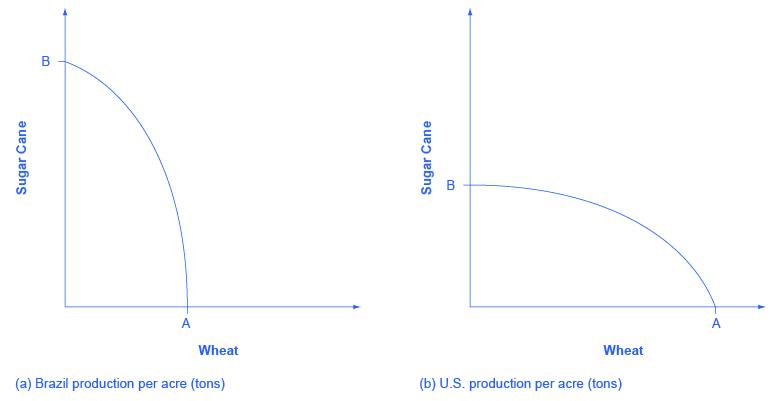
Brazil
Neither
Both equally
The United States
Brazil's frontier is steep in sugar cane: it gives up little wheat for each unit of sugar. The US gives up a lot.
Image: OpenStax College, CC BY 4.0, via Wikimedia Commons.
In Ricardo's diagram (England 36 cloth or 30 wine, Portugal 40 cloth or 45 wine), which country should export wine?
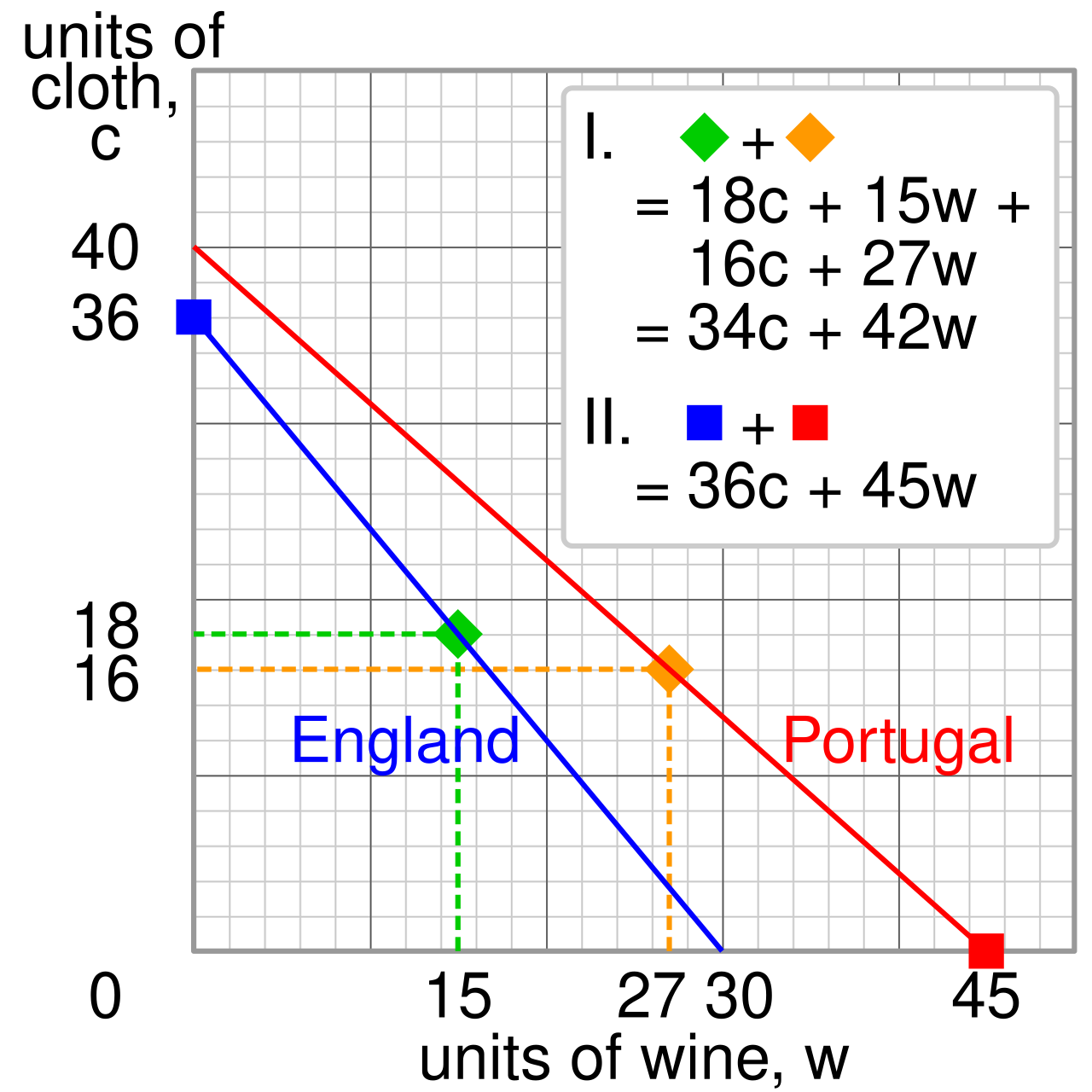
Neither
Both
England
Portugal
Portugal's opportunity cost of wine is 40/45 = 0.89 cloth, below England's 1.2 cloth.
Image: Cmglee, CC BY-SA 4.0, via Wikimedia Commons.
Who is the author of 'On the Principles of Political Economy and Taxation' (1817), which set out comparative advantage?
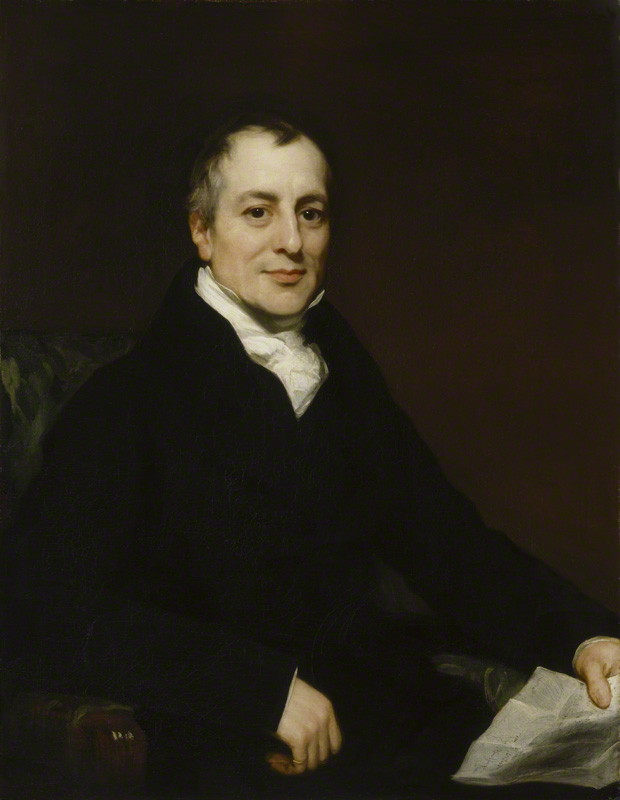
Adam Smith
John Maynard Keynes
Paul Krugman
David Ricardo
Smith argued for absolute advantage in 'The Wealth of Nations' (1776).
A tariff on imports in a small country does which of the following?
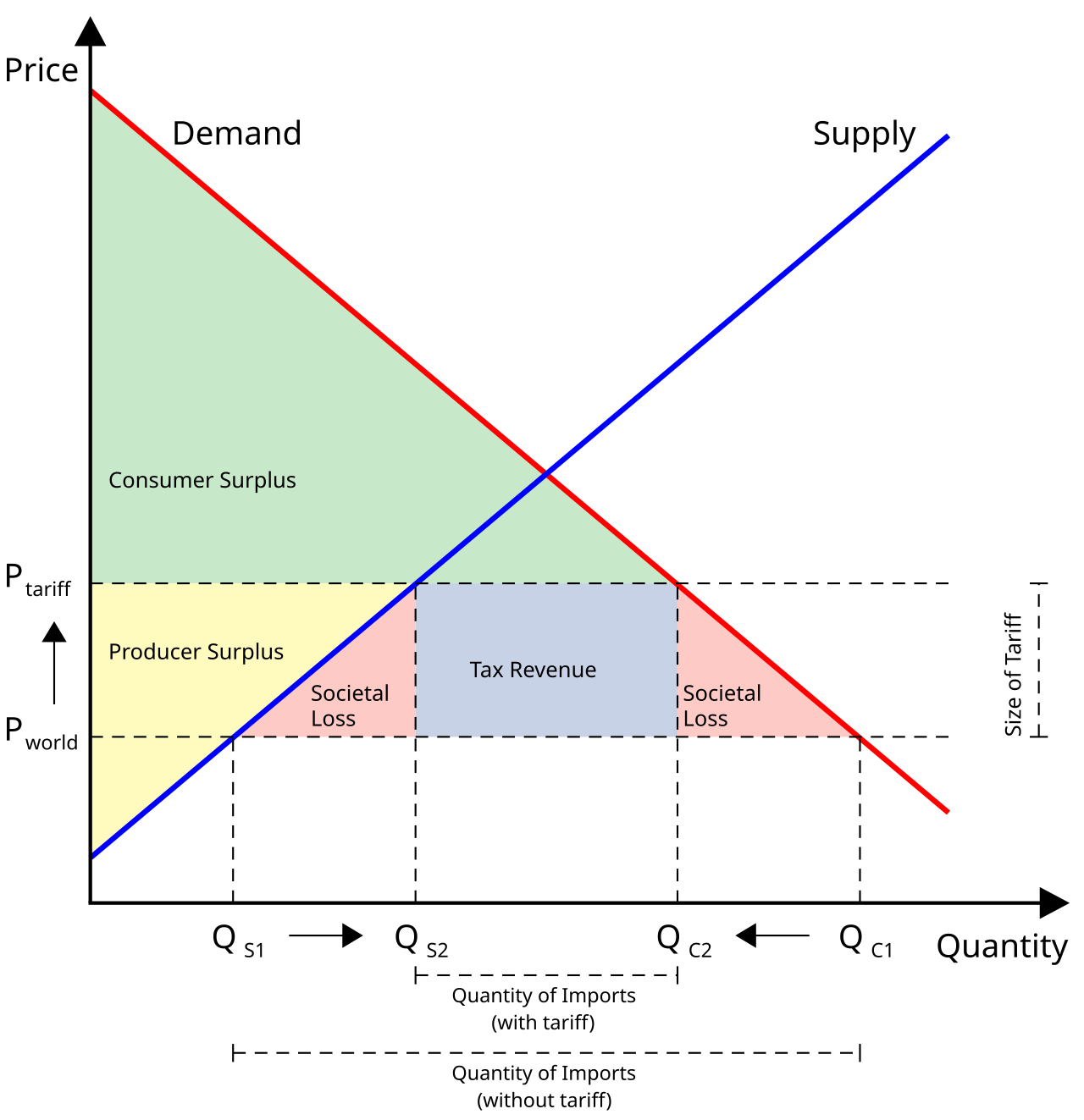
Lowers the domestic price
Raises imports
Raises domestic consumption
Raises the domestic price and lowers imports
The domestic price becomes the world price plus the tariff. Quantity demanded falls and domestic production rises.
Image: Austin512, CC BY 3.0, via Wikimedia Commons.
Who gains from a tariff?
Domestic producers and the government
Everyone equally
Foreign producers
Domestic consumers
Producers gain surplus and the government collects revenue. Consumers lose more than the combined gains, leaving a deadweight loss.
The government collects tariff revenue equal to...
the tariff per unit times domestic production
the tariff per unit times the quantity imported after the tariff
the change in consumer surplus
the tariff per unit times the free-trade quantity demanded
Imports are the difference between quantity demanded and quantity supplied at the tariff-inclusive price.
Which institution replaced the GATT in 1995?
The OECD
The International Monetary Fund
The World Bank
The World Trade Organization
The GATT began in 1947 and became the WTO on 1 January 1995.
The most-favored-nation principle in the WTO means...
imports must be treated like domestic goods
a member must give every other member the best terms it gives any member
the largest economy gets priority
countries must have equal tariffs
MFN is non-discrimination among trading partners. Treating imports like domestic goods is national treatment.
What is the difference between a free trade area and a customs union?
A customs union has a common external tariff
A free trade area has no internal tariffs, a customs union does
A free trade area includes a common currency
A customs union allows free movement of labor
Both remove internal tariffs. A customs union also adopts a common tariff against outsiders.
Which is an example of a free trade area?
USMCA
The euro area
The European Union's single market
Mercosur's common external tariff
USMCA has no common external tariff. The EU and Mercosur are customs unions or deeper.
An import quota differs from a tariff in that...
it raises prices less
it lowers the quantity of imports less
it raises revenue for the government
the gap between domestic and world price goes to license holders rather than the government
Unless licenses are auctioned, quota rents are captured by importers or foreign exporters.
A country that exports garments and imports machinery is likely to be...
capital-abundant
the same as any other country
land-abundant
labor-abundant, according to Heckscher-Ohlin
The theorem says a country exports goods that intensively use its abundant factor.
Intra-industry trade, such as cars traded between Germany and France, is best explained by...
absolute advantage
tariff differences
product differentiation and economies of scale
Ricardian cost differences alone
Similar countries trade differentiated goods to get variety and scale economies.
The Smoot-Hawley Tariff Act of 1930...
raised US tariffs and was followed by retaliation
created the WTO
started NAFTA
lowered US tariffs
It increased tariffs on thousands of goods, and trading partners retaliated, shrinking world trade during the Depression.
Which of these is NOT a gain from trade?
Technology transfer
A higher trade surplus automatically
Greater variety
Lower prices
A trade surplus is not a goal in itself; the gains come from specialization, variety and competition.
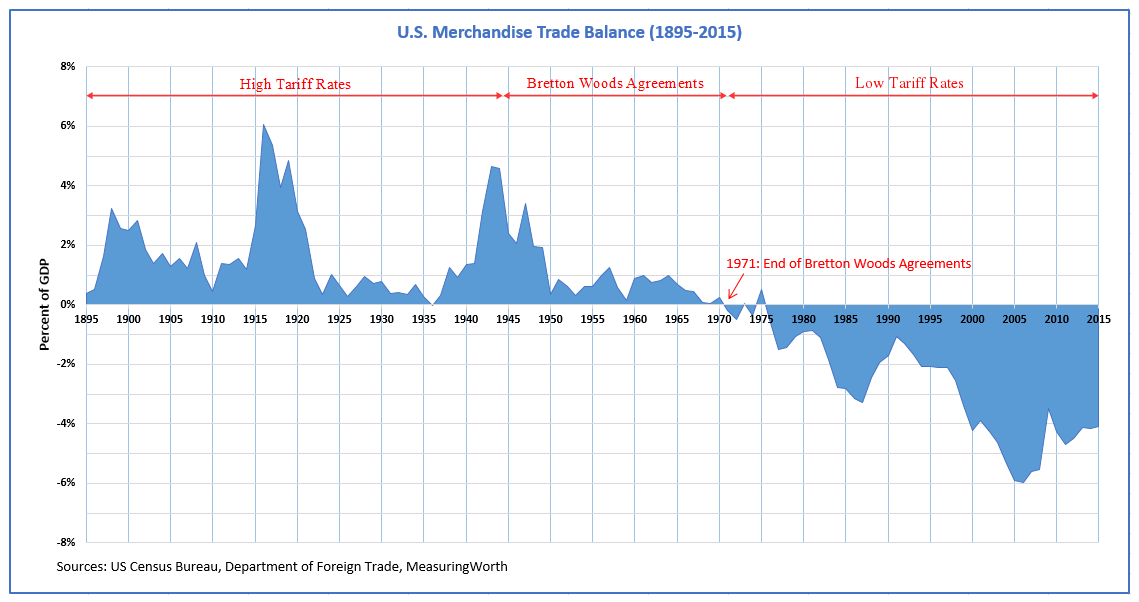
In the chart, from which period do US merchandise trade deficits become persistent?
During World War I
Only in the 1930s
From the mid-1970s
From 1895
Surpluses are the norm until the 1970s; after 1971 deficits become typical.
Image: James 4, CC BY-SA 4.0, via Wikimedia Commons.
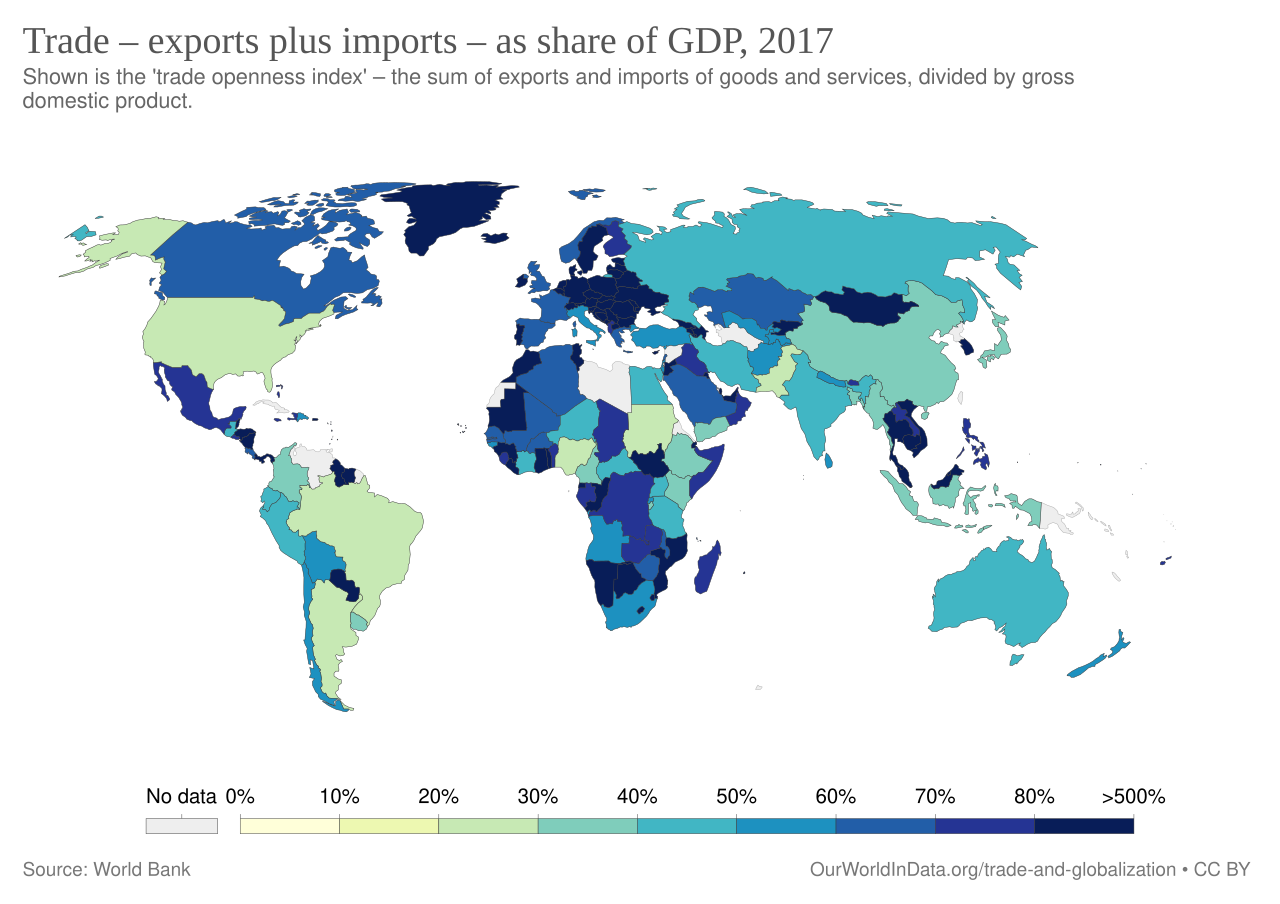
This map shows exports plus imports as a share of GDP. Which kind of economy tends to have a lower share?
Small open economies
Large economies such as the United States
Island city-states
Countries in a customs union
Large domestic markets let firms sell mainly at home, so the trade share is lower.
Image: Our World in Data, CC BY 3.0, via Wikimedia Commons.
Free trade benefits both countries only if the terms of trade lie between...
the two currencies' exchange rates
the two countries' opportunity costs
the two countries' tariff rates
the world price and zero
Outside that range, one country would be giving up more than it would at home.
