Quiz · Medium
Foundational questions on Kounin, procedures vs rules, consequences, behavior functions, PBIS tiers and seating arrangements.
A teacher is helping one group but notices two students whispering across the room and says, 'Marcus, eyes on your own work' without stopping. Which Kounin concept is this?
Fragmentation
Withitness and overlapping
Overdwelling
A flip-flop
She knows what is happening everywhere (withitness) and handles it without interrupting the group (overlapping).
Which is the best example of a classroom procedure rather than a rule?
Pencils are sharpened before the bell, and used pencils go in the cup
Respect others
Be kind
Keep hands and feet to yourself
A procedure explains how to do a routine task. Rules state general behavioral expectations.
Which classroom rule is best written?
Don't talk
No running, no shouting, no pushing
Be good
Use a quiet voice during group work
Good rules are positively stated, specific and observable. 'Be good' is vague; the other options are negative lists.
A teacher says, 'When you talk while I'm giving directions, I can't be heard, and I feel frustrated.' This is an:
Logical consequence
Assertive command only
I-message
Reward
It states behavior, effect and feeling without blaming (Gordon).
A student spills paint and is asked to clean it up. This is:
Positive punishment unrelated to the behavior
A logical consequence
A reward
Time-out
The consequence is related to the behavior, respectful and reasonable.
Dreikurs' four mistaken goals of misbehavior do NOT include:
Fun
Attention
Power
Display of inadequacy
The goals are attention, power, revenge and display of inadequacy.
A student shouts out for attention. The teacher gives attention to a nearby student who is raising a hand. This uses:
Negative punishment
Extinction of all attention
Overlapping
Reinforcing the appropriate behavior while ignoring the minor misbehavior
Attention follows hand raising, not calling out. It works only for minor behavior.
Which seating arrangement best supports whole-class discussion in which students must see each other?
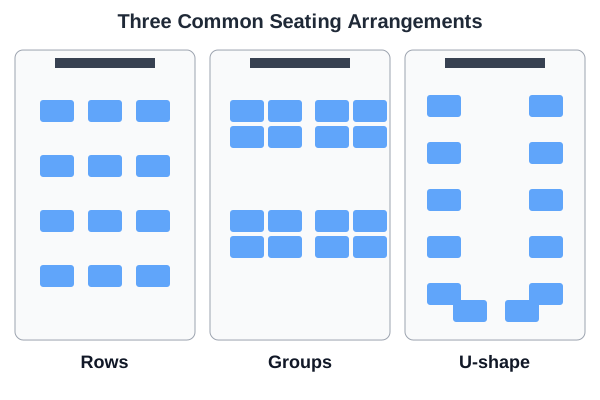
Rows facing the front
Pairs facing the wall
U-shape or circle
Random placement
Students can see each other and the teacher can move inside the U.
What does PBIS Tier 1 provide?
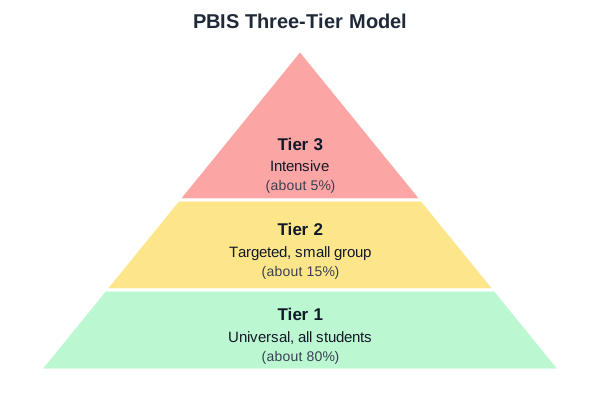
Individual behavior plans
Universal support for all students
Small group social skills
Special education placement
About 80 percent of students respond to universal expectations and teaching.
Which describes a check-in/check-out program?
A Tier 2 intervention with daily feedback from an adult mentor
A Tier 1 schoolwide announcement
A Tier 3 evaluation
A discipline hearing
It gives a small group of at-risk students structure and daily feedback.
What does the 'A' in the ABC model of behavior stand for?
Action
Attitude
Awareness
Antecedent
Antecedent (what happens before), Behavior, Consequence.
Which is NOT one of the four common functions of behavior?
Attention
Escape or avoidance
Boredom with the teacher
Access to tangibles
The four functions are attention, escape, access to tangibles, sensory stimulation.
Behavior-specific praise sounds like:
Good job
Thanks for lining up quietly and keeping your hands to yourself
You're the best
Nice
Specific praise tells the student exactly what to repeat.
Which signal is most effective for getting a class's attention?
A consistent, taught cue like a chime or raised hand
Talking louder than the class
Flicking the lights randomly
Repeating 'Quiet' several times
A routine signal, taught and practiced, avoids power struggles and yelling.
A teacher spends 20 minutes passing out materials one table at a time. Which concept does this violate?
Withitness
Group alerting
Proximity control
Smooth, efficient transitions and procedures
Lost time from inefficient routines reduces academic learning time.
A student refuses to sit down and says, 'You can't make me.' What is the best first response?
Argue until he complies
Send him to the principal immediately
Stay calm, offer a limited choice and follow up privately
Shame him in front of the class
Avoid a power struggle and public audience.
Which statement about rewards is supported by the overjustification effect?
Rewards always increase motivation
External rewards for an already enjoyable activity can reduce intrinsic interest
Praise is always harmful
Rewards have no effect
The reward changes why the student thinks they are doing it.
The 'first days of school' advice from Harry Wong emphasizes:
Teaching and practicing procedures and routines
Covering content immediately
Strict punishments
Seating by ability
Time invested in routines early pays off all year.
Restorative practices primarily focus on:
Quick suspensions
Ranking students
Increasing detentions
Repairing harm and relationships
Restorative approaches bring together those affected to repair and learn.
