Quiz · Hard
Harder scenario-based questions on choosing methods, spotting bias, interpreting correlations and confounders, and understanding significance and ethics.
A researcher surveys 400 people from a list of 8,000 using every 20th name after a random start. The list is sorted alphabetically by household, and every 20th entry is a corner apartment. What is the main risk?
Stratification error
Social desirability bias
Ecological fallacy
Periodicity: the interval may align with a pattern in the list and bias the sample
Systematic samples can be biased when the list has a periodic structure matching the interval. A random start does not fix it.
A city has 60% renters and 40% owners. A researcher wants 500 respondents that reflect this and be randomly chosen within each group. What should she do?
Proportionate stratified sample: 300 renters and 200 owners
Snowball sample starting with renters
Quota sample of 250 each
Cluster sample of 500 households
Proportionate stratification samples each stratum randomly in proportion to its size: 60% of 500 is 300. A quota sample would be non-random.
A phone survey reaches only landlines during working hours and reports on household decisions. Which two biases are most likely?
Hawthorne effect and ecological fallacy
Coverage bias and nonresponse bias
Interviewer effect and cohort effect
Demand characteristics and attrition
People without landlines or at work are excluded or less likely to answer. The other pairs describe problems of observation, group-level inference or longitudinal designs.
In a study the correlation between hours of TV and aggression is r = 0.6. A critic says family conflict causes both. What is this critic describing?
Reverse causation only
An intervening variable
A Type II error
A confounding (spurious) variable
Family conflict is a third variable influencing both. An intervening variable would be on the causal path from TV to aggression.
Researchers find that TV viewing leads to lower sleep, which in turn leads to lower grades. Sleep is a(n)...
confounding variable
dependent variable
control variable
intervening (mediating) variable
The effect of TV on grades is transmitted through sleep. A confounder would cause both TV and grades.
A student concludes from data showing that countries with higher average income have higher suicide rates that rich individuals are more likely to die by suicide. This is an example of...
operationalization error
the ecological fallacy
selection bias
triangulation
The data describe countries, not individuals; the individual-level claim does not follow.
A newspaper poll of 20,000 readers who voluntarily mailed in a questionnaire predicts an election. Which lesson does the Literary Digest 1936 failure teach?
A large sample cannot correct a biased selection method
Bigger samples remove bias
Random samples are always small
Mail surveys are always accurate
The Digest polled 2.4 million replies yet got the wrong winner because of biased frames and nonresponse. Gallup's smaller, better-designed sample was right.
In an experiment participants are randomly assigned to two groups and the treatment is given to one. What does random assignment achieve?
It makes the groups equivalent on average, supporting causal inference
It guarantees the sample represents the population
It eliminates all researcher bias
It increases the reliability of the measure
Random assignment supports internal validity, while random sampling supports external validity. Don't swap the two.
In Pager's audit study, applicants with similar resumes were sent to apply for jobs. What kind of design is this?
A semi-structured interview study
A field experiment
A content analysis
A longitudinal panel study
Researchers manipulated race and criminal record in a real setting. This reveals discrimination that survey self-reports may conceal.
A covert observer joins a group without telling them its purpose. Which defense is most often offered, and which objection most often follows?
Participants behave naturally; but there is no informed consent
The group pays; but it is expensive
The group is large; but it cannot be replicated
The researcher is trained; but data are unreliable
Covert observation avoids the Hawthorne effect but violates informed consent and may require deception, which ethics boards scrutinize.
Which design is best for studying how people's incomes change over their lives?
Panel study
Structured interview
Content analysis of newspapers
Cross-sectional survey
Following the same individuals over time reveals individual change; a cross-sectional survey only shows one moment.
The chi-square test is most suitable for...
calculating a sampling interval
comparing two means
measuring the strength of a linear relationship between two interval variables
testing association between two categorical variables
Chi-square compares observed counts with expected counts in a table. Pearson's r would be used for two interval variables.
For a cross-tab with row total 60, column total 50 and N = 200, the expected count in that cell is...
12
15
25
30
E = (row total x column total)/N = 60 x 50 / 200 = 15. Dividing by the wrong total is a typical error.
A poll of 1,000 with p = 0.5 has a margin of error of about 3.1 points. What does this mean?
3.1% of respondents lied
The poll is biased by 3.1%
The true population value is probably within about 3 points of the estimate
The population is 3.1% larger
Margin of error describes sampling error only. It doesn't cover biased questions or coverage problems.
Which design best suits a sociologist who wants to understand the meanings homeless people give to shelter life?
A laboratory experiment
Semi-structured interviews or ethnography
A mailed closed-question survey
Official statistics only
Interpretivist aims call for depth and flexibility. Surveys would impose categories.
A researcher repeats a survey to different samples every two years. Which design is this?
Natural experiment
Trend study (repeated cross-section)
Cohort study with the same people
Panel study
The respondents differ each wave, which is what separates a trend study from a panel.
In a study with z = 2.0, about what percentage of values lie above this score in a normal distribution?
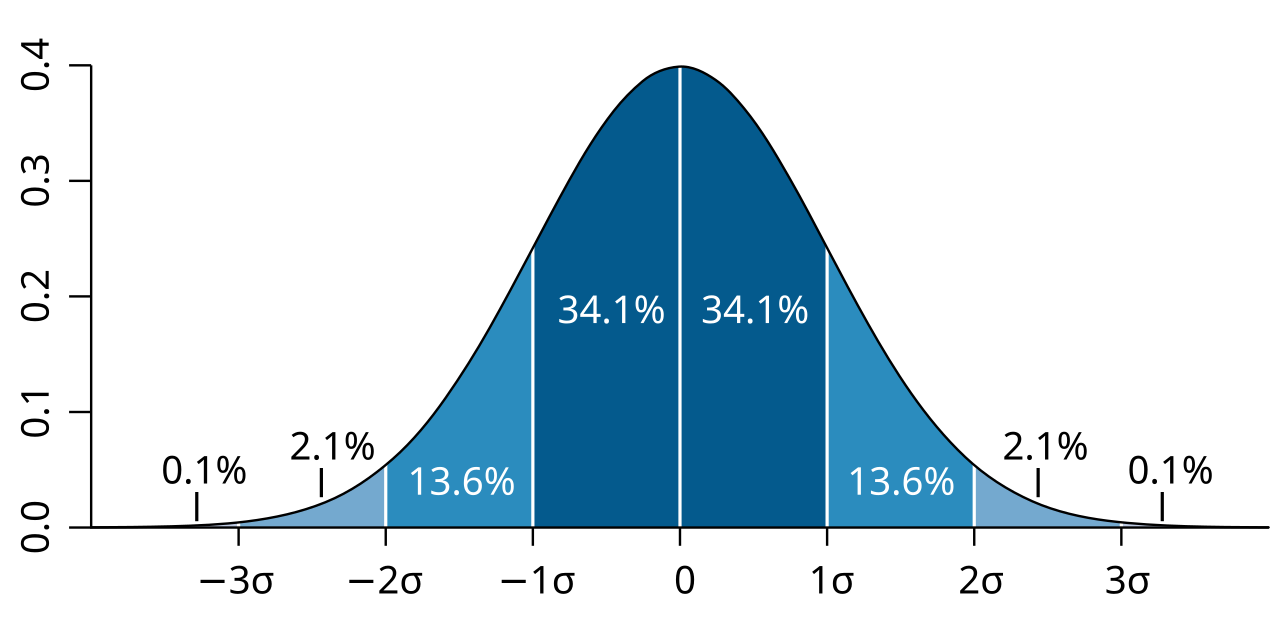
About 2.3%
About 13.6%
About 34.1%
About 5%
The tails beyond +2 SD on the chart sum to 2.1% + 0.1% = 2.2%, about 2.3% unrounded. The 5% figure is the two-sided area beyond +/-2 SD. Image: M. W. Toews, CC BY 2.5, via Wikimedia Commons.
Which statement about Stanford and Milgram ethics is most accurate?
Neither used human participants
Both were approved under the Belmont Report
Both gave participants full information before starting
Both caused participant distress and are cited as prompting tighter ethics rules
They predate the Belmont Report and modern IRB rules and are frequently cited as examples that prompted tighter ethics regulation.
