Quiz · Medium
Conceptual questions on resistances, dimensionless groups, radiation and exchanger behavior.
Compared with parallel flow, a counterflow exchanger with the same terminal temperatures has:
A smaller LMTD
A larger LMTD, so a smaller area
The same LMTD
A lower effectiveness
Counterflow keeps a more uniform ΔT along the exchanger, giving a larger LMTD, less area and higher effectiveness for the same NTU.
Which statement about steady conduction through layers in series is correct?
Each layer has the same temperature drop
Each layer carries the same heat rate
The layer with the highest k has the largest temperature drop
Resistances are added as reciprocals
In steady state the same q passes through every layer. The drop in each layer is q R, so the layer with the largest resistance (lowest k for equal thickness) drops most. Resistances in series simply add; reciprocals are for parallel paths.
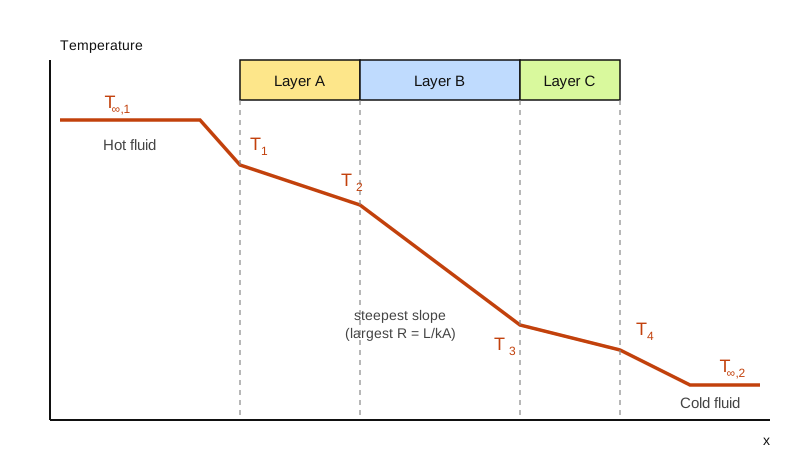
In the wall shown, which layer has the lowest thermal conductivity (equal thicknesses)?
B
A
C
They are all equal
Same flux, so the layer with the steepest temperature gradient has the smallest k. Layer B has the steepest slope.
The Biot number is the ratio of:
Convection resistance to conduction resistance inside the solid
Momentum to thermal diffusivity
Buoyancy to viscous forces
Conduction resistance inside the solid to convection resistance at the surface
Bi = hL/k_s = (L/k_s)/(1/h). A small Bi means the solid is nearly uniform in temperature. Option 3 is Gr and 4 is Pr.
A thin copper plate is quenched in water. Which assumption is most likely valid?
Steady state
Radiation dominates
Semi-infinite solid
Lumped capacitance
Copper has a very high k and the plate is thin, so Bi is very small and the temperature is uniform inside.
For a cylindrical pipe with outer radius smaller than k/h, adding insulation:
Increases heat loss until the critical radius is reached
Raises the surface temperature to infinity
Always lowers heat loss
Has no effect
Below the critical radius r_c = k/h, the outer convective resistance falls faster than the insulation resistance rises, so heat loss rises to a maximum at r_c and only then decreases.
Which dimensionless number is the heat-transfer analog of the Schmidt number?
Stanton
Prandtl
Grashof
Nusselt
Pr = ν/α compares momentum and thermal diffusivities, just as Sc = ν/D does for mass. Nusselt is the analog of Sherwood.
Dittus-Boelter (Nu = 0.023 Re^0.8 Pr^n) uses n = 0.4 when the fluid is:
Heated
Cooled
In laminar flow
In natural convection
n = 0.4 for heating the fluid and 0.3 for cooling it. The correlation applies only to turbulent flow.
In fully developed laminar flow in a tube with constant wall temperature, Nu is approximately:
3.66, independent of Re
2
4.36 and rises with Re
0.023 Re^0.8
Nu = 3.66 for constant wall temperature, 4.36 for constant heat flux; both independent of Re and Pr.
Radiative emissive power of a blackbody is proportional to:
T^2
T^3
T^4
T
E_b = σT^4 with T in kelvin.
Wien's displacement law says that as temperature increases, the peak emission wavelength:
Becomes infinite
Increases
Stays constant
Decreases
λ_max T = 2898 μm·K, so a hotter body peaks at shorter wavelengths.
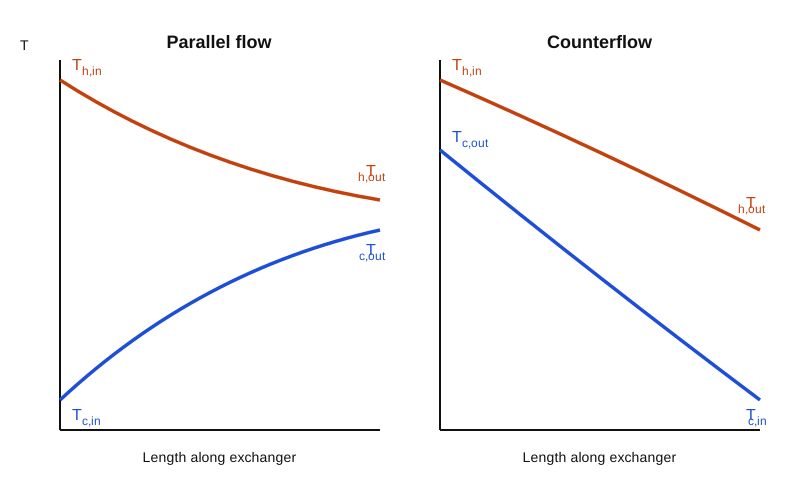
In which exchanger can the cold fluid leave hotter than the hot fluid leaves?
Neither
Parallel flow only
Both
Counterflow only
In counterflow the cold outlet meets the hot inlet, so it can exceed the hot outlet temperature. In parallel flow both streams approach a common temperature.
When one fluid condenses at constant temperature (C_r = 0), the effectiveness is:
Always 1
NTU/(1+NTU)
1 - exp(-NTU)
(1 - e^-NTU)/2
C_r = 0 collapses every arrangement to ε = 1 - e^(-NTU).
Which is the best location for fins on a gas-to-liquid exchanger?
Neither: fins never help
Both sides equally
The gas side
The liquid side
Fins add area to the side with the smaller h (gas), where the resistance is largest. Adding area to the liquid side hardly changes U.
The critical heat flux in pool boiling marks:
The maximum heat flux for nucleate boiling, beyond which film forms
The start of nucleate boiling
The condensation limit
The minimum film-boiling flux
Past CHF, vapor blankets the surface and temperature jumps, which can burn out the heater. The Leidenfrost point is the minimum flux for film boiling.
Which condensation mode gives much higher heat-transfer coefficients?
Neither can condense
Filmwise
Dropwise
Both are equal
In dropwise condensation, drops expose bare surface, so h can be about 5 to 10 times higher than in filmwise condensation, but it is hard to maintain.
True or False: The convective heat transfer coefficient h is a property of the fluid only.
True
False
h depends on the fluid properties and also on velocity, geometry, surface condition and flow regime.
In a shell-and-tube exchanger, the highly fouling fluid is normally placed:
In the tubes
Either side without consequences
On the shell side
In the baffles
Tube-side fluid is easier to clean (open the heads and clean tubes mechanically) and velocities are easier to keep high.
The overall U in 1/U = 1/h_i + R_f + 1/h_o is dominated by:
The wall conductivity always
The average of h_i and h_o
The smallest h or largest resistance
The largest h
Resistances add, so the largest resistance (smallest h) controls U. Improving the fluid with already-high h barely changes U.
Natural convection becomes important compared with forced convection when:
Bi is small
Re is very large
Gr/Re² is about 1 or larger
Pr is 1
Gr/Re² measures buoyancy versus inertia. Near 1 both contribute; much larger than 1, natural convection dominates.
A radiation shield with the same emissivity is placed between two large parallel plates. The net radiative exchange becomes:
The same
Zero
About half
Doubled
One shield doubles the radiative resistance (two gaps in series), halving the exchange.
