Quiz · Easy
20 questions on letters, vowel length, breathings, accents, diphthongs and old inscriptions, for first-year Classical Greek students.
Which Greek letter is pronounced ps?
ϕ
ψ
ξ
π
ψ (psi) is ps, as in "lips". ξ is ks, and φ is p with a puff of breath (later f).
Which letter is used for the long o sound?
ω (omega)
ο (omicron)
υ (upsilon)
θ (theta)
ω is the long vowel, ο the short one. Omega means "big o", omicron "little o".
Which two vowels are always short?
η and ω
α and ι
ι and υ
ε and ο
ε (epsilon) and ο (omicron) are always short; η and ω are always long; α, ι and υ may be either.
What does a rough breathing (ἁ) indicate?
The vowel is long
A stressed syllable
An h sound before the vowel
A silent letter
ὁ is read ho, ἡμέρα is read hemera. A smooth breathing (ἀ) means no h.
Which of these words begins with a rough breathing?
ἀγορά (marketplace)
ἔργον (work)
ὄνομα (name)
ὕδωρ (water)
ὕδωρ is rough: it gives English hydro-. Initial υ always has a rough breathing; ἀγορά, ἔργον and ὄνομα all have smooth breathings.
How is ου pronounced in Classical Greek?
oo, as in "boot"
ow, as in "cow"
o + u, two sounds
ew, as in "few"
ου is a single vowel, not two: λόγου ends in oo.
In ἄγγελος (messenger), the γγ is pronounced as:
gg, as in "egg"
nj, as in "angel"
j, as in "jam"
ng, as in "finger"
The first gamma before another velar (γ, κ, ξ, χ) is a nasal: ang-elos.
The mark in τῷ (the small ι under the ω) is called:
smooth breathing
circumflex
iota subscript
grave
The iota subscript marks a dative singular here; it was not pronounced in Classical Greek.
An accent can fall on:
any syllable
one of the last three syllables only
only the first syllable
only the last syllable
The three positions are ultima, penult and antepenult: θεός, λόγος, ἄνθρωπος.
A circumflex can only stand on:
a long vowel or a diphthong
a short vowel
a consonant
the first letter of a word
τῆς, σῶμα, οἶκος. A circumflex on ε or ο is impossible.
What is the final form of sigma?
σ
c
ϲ
ς
ς is used only at the end of a word: σοφός begins with σ and ends with ς.
The question mark in Ancient Greek looks like:
a question mark ( ? )
an exclamation mark
a semicolon ( ; )
a raised dot ( · )
τί ἐστιν; means "What is it?" The raised dot (·) is a colon or semicolon in English.
Which pronunciation system do most classrooms teach?
Modern Greek pronunciation
Erasmian pronunciation
Byzantine pronunciation
Latin pronunciation
Erasmian is a conventional system based on spelling. It differs from reconstructed Classical Attic and from Modern Greek.
The letters ΧΣ in an old Athenian inscription stand for:
ξ (xi)
ψ (psi)
χ (chi) only
ς (final sigma)
The old Attic alphabet lacked ξ and ψ and spelled them ΧΣ and ΦΣ. Athens adopted the Ionic alphabet in 403/2 BC.
In the Ionic alphabet that Athens adopted in 403/2 BC, which letters mark the long e and the long o?
ε and ο
α and ι
ς and σ
η and ω
Ionic Η (eta) and Ω (omega) are the long vowels; ε and ο are always short. The old Attic alphabet used Ε and Ο for both short and long sounds.
What is the Latin spelling of Greek χ?
x
kh only
ch
c
χρόνος is chronos, as in chronology. Greek κ, by contrast, is c or k.
Which Greek word does the first line of this inscription give?
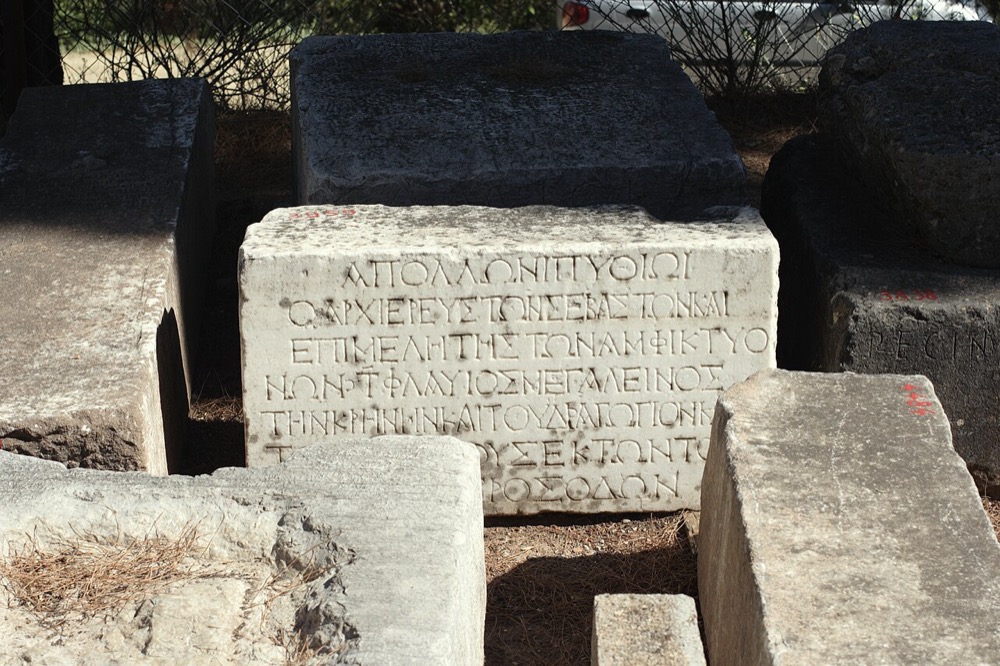
Ἀθηνᾷ Πολιάδι (To Athena Polias)
Ἀπόλλωνι Πυθίῳ (To Apollo Pythios)
Διονύσῳ Ἐλευθερεῖ (To Dionysus Eleuthereus)
Ποσειδῶνι Ἰσθμίῳ (To Poseidon of the Isthmus)
The stone is from Delphi and the line reads ΑΠΟΛΛΩΝΙ ΠΥΘΙΩΙ. Apollo's cult title Πύθιος refers to his sanctuary at Pytho (Delphi).
Image: Zde, CC BY-SA 4.0, via Wikimedia Commons.
The writing style of this papyrus fragment of Homer, with no spaces between words, is called:
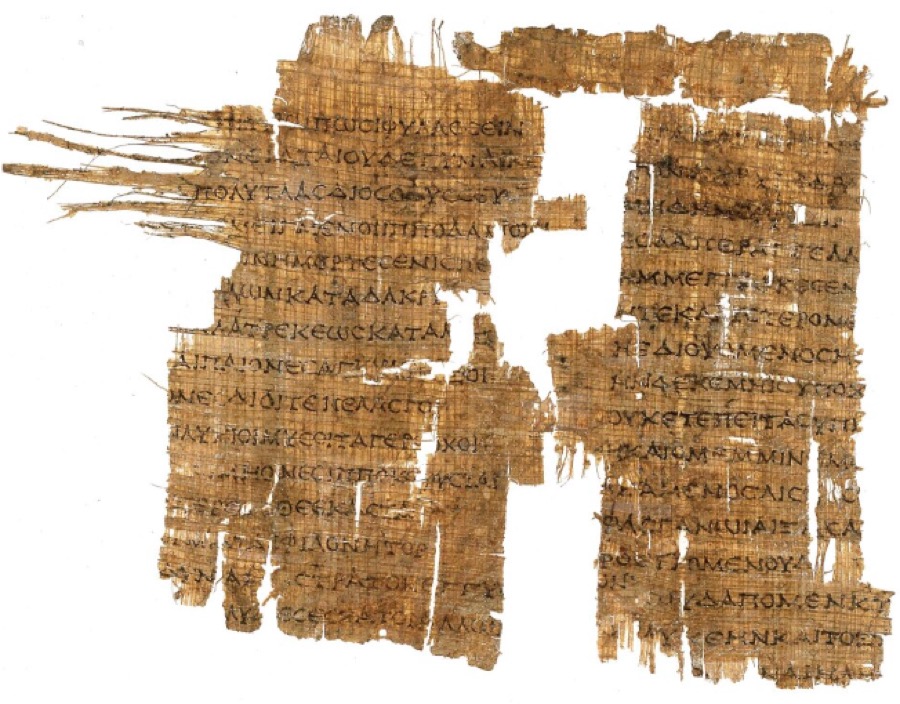
scriptio continua
codex binding
palimpsest
minuscule
Early Greek manuscripts and inscriptions run words together. A palimpsest is a reused manuscript; minuscule is the lowercase script of the Byzantine era.
Image: University of Michigan, public domain, via Wikimedia Commons.
In Ancient Greek, the vowels η and ω are always long.
True
False
η (eta) and ω (omega) are long vowels. ε and ο are always short, while α, ι and υ may be either.
The Greek letter υ is pronounced like English "u" in "but".
True
False
Classical υ is a rounded front vowel like French u or German ü. English words write it as y: psyche, hydro-.
