Quiz · Hard
Hubble's law and redshift calculations, the CMB, nucleosynthesis, inflation, dark matter evidence (lensing, Bullet Cluster) and the composition of the universe.
What is the main evidence that the universe is expanding?
Distant galaxies show redshifts proportional to their distances
The night sky is dark
Galaxies are arranged in spirals
All stars are the same age
Hubble's law, v = H0 d. The dark night sky (Olbers' paradox) is explained by a finite age, not directly by expansion.
When was the cosmic microwave background released?
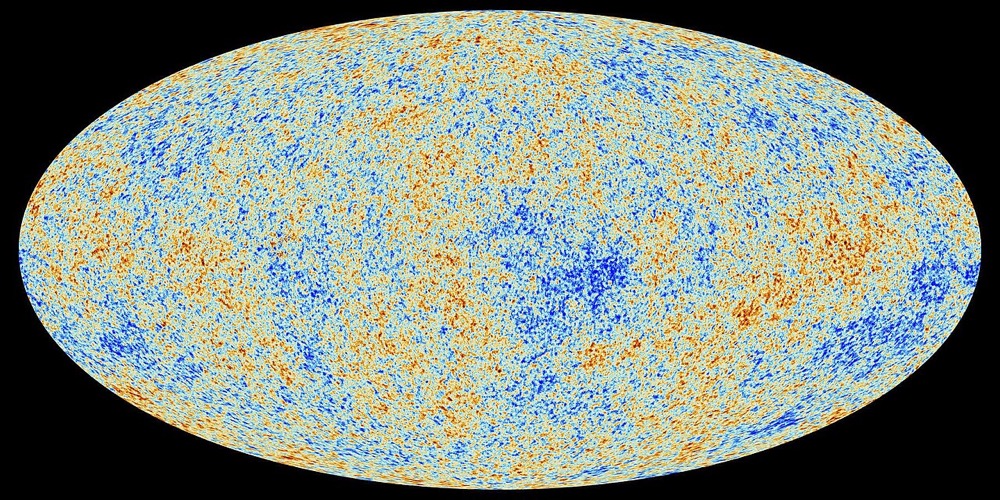
About 380,000 years after the Big Bang
Immediately at the Big Bang
About 1 billion years after the Big Bang
About 13.8 billion years after the Big Bang
At recombination, neutral atoms formed and the universe became transparent. Before that, photons scattered constantly off free electrons.
Image: ESA and the Planck Collaboration, CC BY 4.0, via Wikimedia Commons.
The CMB today has a temperature of about
3,000 K
270 K
2.7 K
27 K
The CMB was about 3,000 K when released; expansion has stretched it by a factor of about 1,100 to 2.725 K.
The tiny temperature variations in the CMB (about 1 part in 100,000) are important because they
prove the universe is cold
are the seeds of galaxies and clusters
show the CMB comes from nearby stars
are noise from Earth's atmosphere
Slightly denser regions collapsed under gravity over time to form the large-scale structure.
Image: ESA and the Planck Collaboration, CC BY 4.0, via Wikimedia Commons.
A galaxy has redshift z = 0.05. About how fast is it receding, using v = cz?
1,500 km/s
0.05 km/s
150,000 km/s
15,000 km/s
v = 0.05 x 300,000 = 15,000 km/s. The formula holds for small z. A common slip is forgetting the factor of c.
What distance does the galaxy in the previous question have if H0 = 70 km/s/Mpc?
About 0.0047 Mpc
About 214 Mpc
About 21 Mpc
About 2,140 Mpc
d = v/H0 = 15,000 / 70 = 214 Mpc, about 700 million light-years.
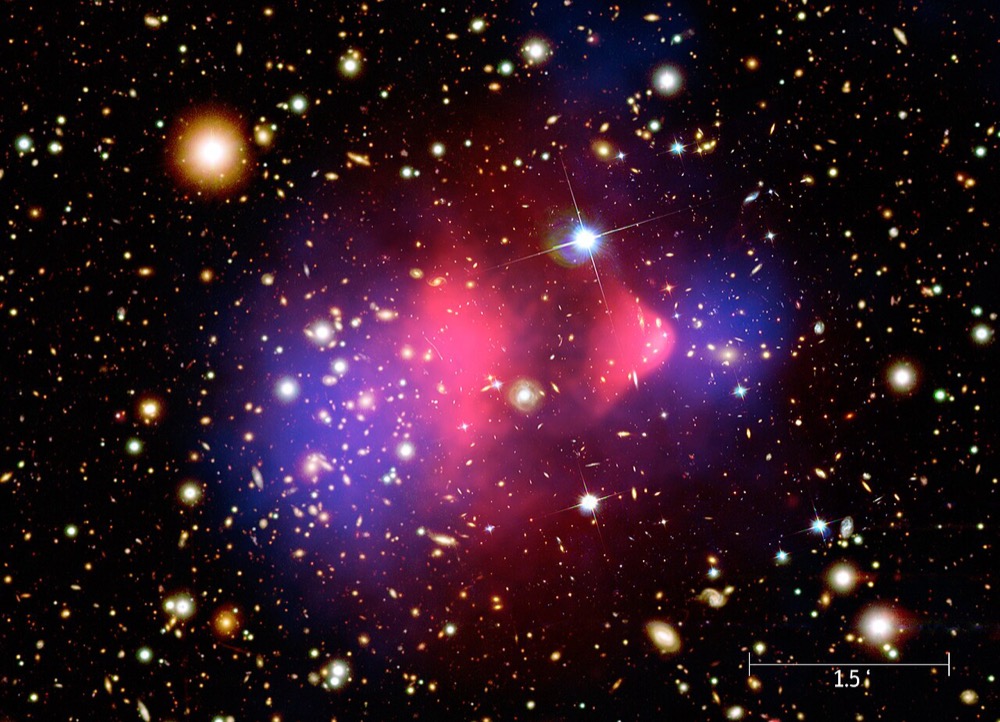
What does the Bullet Cluster image suggest about dark matter?
Dark matter does not exist
Dark matter is hot gas
Most of the mass is separate from the hot gas, so it must be a collisionless component
Dark matter is made of stars
The hot gas (pink) was slowed by the collision, but the lensing mass (blue) passed through. That is explained if most mass is non-interacting dark matter.
Gravitational lensing, as seen with Abell 1689, is the bending of light by
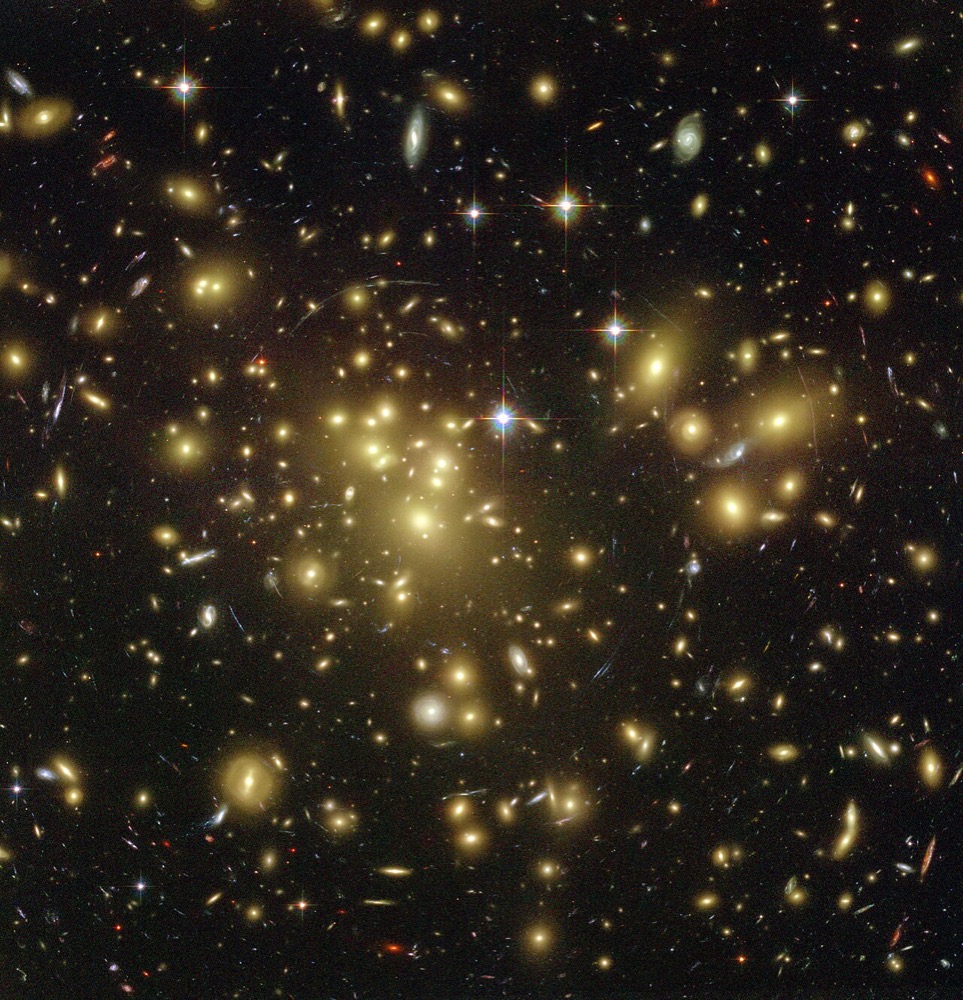
mass, as predicted by general relativity
its magnetic fields
dust in the cluster
expansion of space
The cluster's mass warps spacetime and distorts the background galaxies into arcs. The arc pattern traces the mass distribution, dark matter included.
Which fraction of the universe's energy is dark energy?
About 95%
About 68%
About 27%
About 5%
Dark energy ~68%, dark matter ~27%, ordinary matter ~5%. Dark matter plus dark energy is about 95%, a common mix-up.
What evidence in 1998 showed dark energy exists?
The CMB was found to be smooth
Distant Type Ia supernovae were fainter than expected, so expansion is accelerating
Galaxy rotation curves were flat
Galaxies were found to be spirals
Fainter (farther) supernovae meant the expansion had been speeding up, which is explained by dark energy.
Which was NOT made in significant amounts in Big Bang nucleosynthesis?
Hydrogen
Carbon
Helium-4
Deuterium
Big Bang nucleosynthesis lasted only a few minutes and made mostly H and He plus traces of D, He-3 and Li-7. Carbon and heavier elements were made in stars.
About what mass fraction of normal matter was helium after the Big Bang?
50%
75%
25%
2%
About 75% hydrogen and 25% helium-4 by mass. 75% is the hydrogen share and a common mix-up.
Inflation, proposed by Alan Guth, helps explain
why distant parts of the sky have nearly the same CMB temperature
why Type Ia supernovae have constant luminosity
the rate of star formation today
the Earth's age
A brief burst of rapid expansion means regions now far apart were once in contact, solving the horizon problem and flattening the geometry.
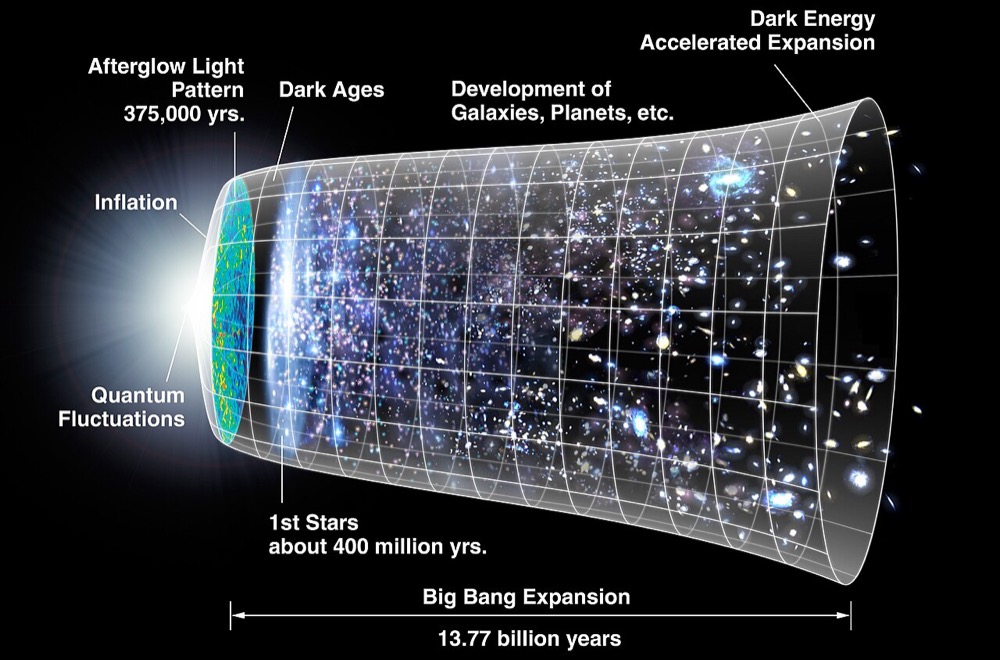
In the timeline of the universe shown, which comes first?
Dark Ages
First stars
Accelerated expansion
Inflation
Order: Inflation, CMB released (375,000 years), Dark Ages, first stars, galaxies, accelerating expansion.
Why is the observable universe about 93 billion light-years across, not 27.6 billion?
The CMB adds extra distance
Light travels faster than c in empty space
The universe is older than 13.8 billion years
Space expanded while the light traveled, so the sources are now farther than the light-travel distance
The light-travel distance is at most 13.8 billion light-years, but the matter that emitted it has been carried farther away by expansion, to about 46 billion light-years now.
What does a flat universe (density equal to the critical density) mean?
The universe is shaped like a pancake
The universe has an edge
The universe will definitely stop expanding
Parallel light rays remain parallel on large scales (Euclidean geometry)
Flat refers to the geometry of space, not its shape as an object. With dark energy, a flat universe still expands forever.
What is the Hubble tension?
The CMB is not uniform
The expansion of space is slowing
Different methods give H0 values of about 67 and 73 km/s/Mpc
Galaxies appear younger than stars
CMB-based (early universe) and distance-ladder (late universe) measurements disagree beyond their quoted errors; it may point to new physics.
Which is a prediction of the Big Bang model that Penzias and Wilson's discovery confirmed?
An all-sky microwave afterglow
The existence of dark matter
A constant rate of expansion
A static universe
Gamow, Alpher and Herman predicted a relic radiation of a few kelvin; in 1965 it was found. The Steady State theory had no explanation for it.
The Big Bang happened at a specific point in space, and galaxies are moving away from that point.
True
False
There is no center. Space itself expanded everywhere, so from any galaxy the others appear to recede.
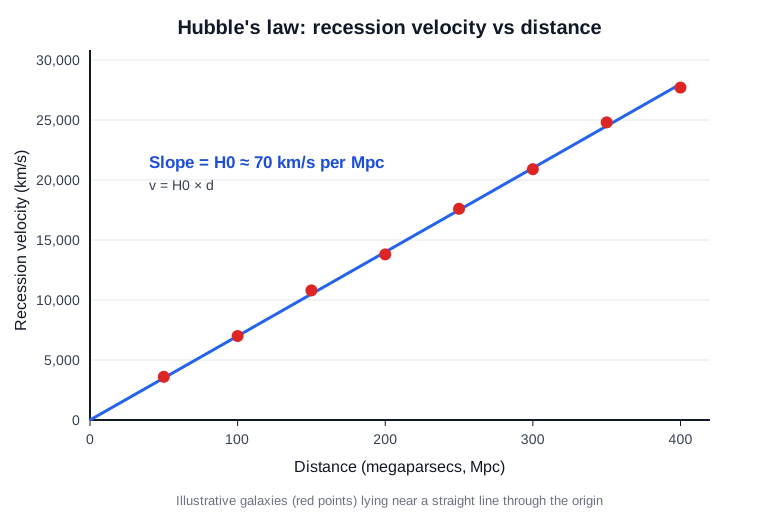
Based on the graph, what does the slope represent?
The critical density
The Hubble constant
The speed of light
The age of the universe
v = H0 d, so the slope of velocity against distance is H0, about 70 km/s/Mpc. The age is related to its inverse.
