Quiz · Hard
Applied, multi-step questions on toxicity, reversal, interactions, antiarrhythmic classes, heart failure therapy and emergencies.
A 72-year-old on digoxin and furosemide has nausea, yellow-green halos and potassium 2.9 mmol/L. Best next step?
Give an extra dose of digoxin to restore effect
Start verapamil
Hold digoxin, check a digoxin level and ECG, and replace potassium
Increase furosemide
Hypokalemia increases digoxin binding and toxicity. Hold it, get a level and ECG, and correct potassium. Extra digoxin or verapamil (which raises digoxin levels) worsens toxicity; more furosemide lowers potassium further. DigiFab is reserved for life-threatening toxicity.
A patient on warfarin has an intracranial hemorrhage and an INR of 6.2. Which is the best reversal strategy?
Oral vitamin K only
4-factor prothrombin complex concentrate plus IV vitamin K
Protamine sulfate
Platelet transfusion
PCC restores factors II, VII, IX, X immediately and IV vitamin K sustains the effect. Oral vitamin K alone is too slow; protamine reverses heparin; platelets do not correct a warfarin coagulopathy.
A patient with HFrEF takes lisinopril, spironolactone and a potassium supplement. Which complication is most likely?
Hypokalemia
Hyperkalemia
Hypercalcemia
Hypoglycemia
ACE inhibitors and aldosterone antagonists both retain potassium, and a supplement adds more. This is a common cause of dangerous hyperkalemia; check potassium and creatinine regularly.
The CAST trial found increased mortality with which antiarrhythmic class after myocardial infarction?
Class Ic
Class II
Class III
Class IV
Flecainide and encainide (class Ic) raised mortality in post-MI patients with ventricular ectopy. Beta blockers (II) reduce post-MI mortality; verapamil is not used after MI with LV dysfunction; amiodarone (III) was neutral.
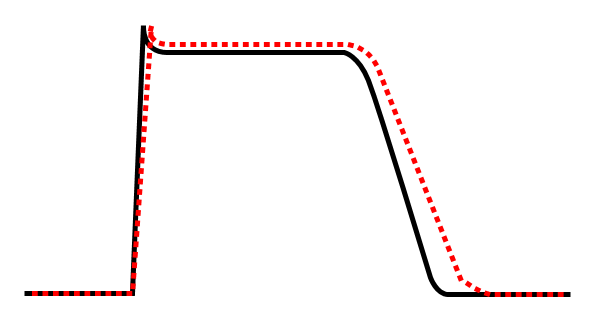
Black = normal; red dotted = with a drug. Which drug produces this effect?
Lidocaine
Flecainide
Amiodarone
Procainamide
Prolonged repolarization with an unchanged phase 0 is class III (amiodarone, sotalol). Lidocaine shortens the action potential, flecainide slows the upstroke only, and procainamide (Ia) slows the upstroke and prolongs the duration.
Image: Ksheka, CC BY-SA 3.0, via Wikimedia Commons.
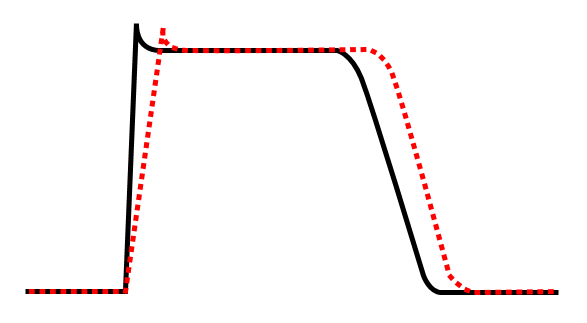
A patient on long-term therapy develops joint pain and a positive anti-histone antibody. Which antiarrhythmic, whose effect on the action potential is shown here, is the classic culprit?
Procainamide
Lidocaine
Verapamil
Amiodarone
Procainamide (class Ia) causes drug-induced lupus. Hydralazine is the other classic cause (especially in slow acetylators). Lidocaine and verapamil do not do this; amiodarone causes thyroid, lung and liver toxicity.
Image: Ksheka, CC BY-SA 3.0, via Wikimedia Commons.
A patient on stable warfarin is started on amiodarone. What should the clinician expect?
INR falls, so increase the warfarin dose
INR rises, so reduce the warfarin dose and monitor closely
No interaction
Potassium rises
Amiodarone inhibits CYP2C9 (and CYP3A4), reducing warfarin clearance; the warfarin dose often needs a 30 to 50% reduction, with frequent INR checks. Rifampin is an example of a drug that lowers INR.
A patient with HFrEF is switched from lisinopril to sacubitril/valsartan. What is the minimum washout after the last ACE inhibitor dose?
No washout is needed
12 hours
24 hours
36 hours
Neprilysin and ACE both degrade bradykinin, so overlap raises the risk of angioedema. A 36-hour washout is required.
A patient with HFrEF (EF 30%) on an ACE inhibitor and carvedilol remains symptomatic. Which add-on has proven mortality benefit?
Amlodipine
Spironolactone
Furosemide
Digoxin
MRAs (spironolactone, eplerenone) reduce death and hospitalization (RALES, EMPHASIS-HF). Digoxin improves symptoms and admissions but not survival; furosemide relieves congestion only; amlodipine is neutral.
A patient on heparin day 7 has platelets falling from 250 to 90 and a new DVT. Which is the best next step?
Continue heparin and monitor
Switch to warfarin immediately
Stop all heparin and start argatroban
Transfuse platelets
This is heparin-induced thrombocytopenia (HIT), a prothrombotic state. Stop all heparin (including flushes) and use a non-heparin anticoagulant such as argatroban. Warfarin alone can precipitate venous gangrene; platelet transfusion is avoided.
A patient took sildenafil 6 hours ago and now has ischemic chest pain. Which drug should be avoided?
Aspirin
Sublingual nitroglycerin
Morphine for refractory pain
Oxygen if hypoxic
Nitrates after a recent PDE-5 inhibitor dose can cause profound hypotension (wait 24 hours after sildenafil, 48 after tadalafil). Aspirin and other measures remain appropriate.
Which beta blocker is the least appropriate for a patient with asthma?
Metoprolol
Atenolol
Bisoprolol
Propranolol
Propranolol is nonselective and blocks beta-2 receptors, risking bronchospasm. Metoprolol, atenolol and bisoprolol are beta-1 selective, though selectivity is lost at high doses.
A patient with acute aortic dissection and severe hypertension needs IV therapy. Which should be given first?
Hydralazine
Nitroprusside alone
Esmolol (or labetalol) to lower heart rate and shear stress
Furosemide
A beta blocker first lowers heart rate and dP/dt; a vasodilator alone causes reflex tachycardia that worsens the shear force on the aortic wall. Add a vasodilator after the heart rate is controlled.
A patient taking verapamil and metoprolol has a heart rate of 38 and low blood pressure. What explains this?
Hypokalemia
Additive suppression of the SA and AV nodes and of contractility
Digoxin toxicity only
Allergic reaction to both
Verapamil (a non-DHP) and beta blockers both slow the SA node and AV conduction and reduce contractility; together they can cause bradycardia, AV block and shock. This combination should generally be avoided.
Which combination carries the greatest risk of myopathy or rhabdomyolysis?
Pravastatin and ezetimibe
Rosuvastatin and aspirin
Simvastatin and clarithromycin
Atorvastatin taken at night
Clarithromycin inhibits CYP3A4, raising simvastatin levels sharply; gemfibrozil, azoles and cyclosporine do the same. Ezetimibe and aspirin do not raise statin exposure, and timing does not matter for atorvastatin.
Which diuretic class reduces urinary calcium excretion and is therefore used to help prevent calcium stones?
Loop diuretics
Thiazide diuretics
Spironolactone
Osmotic diuretics
Thiazides increase distal calcium reabsorption (and can cause hypercalcemia). Loop diuretics increase urinary calcium and are used to treat hypercalcemia.
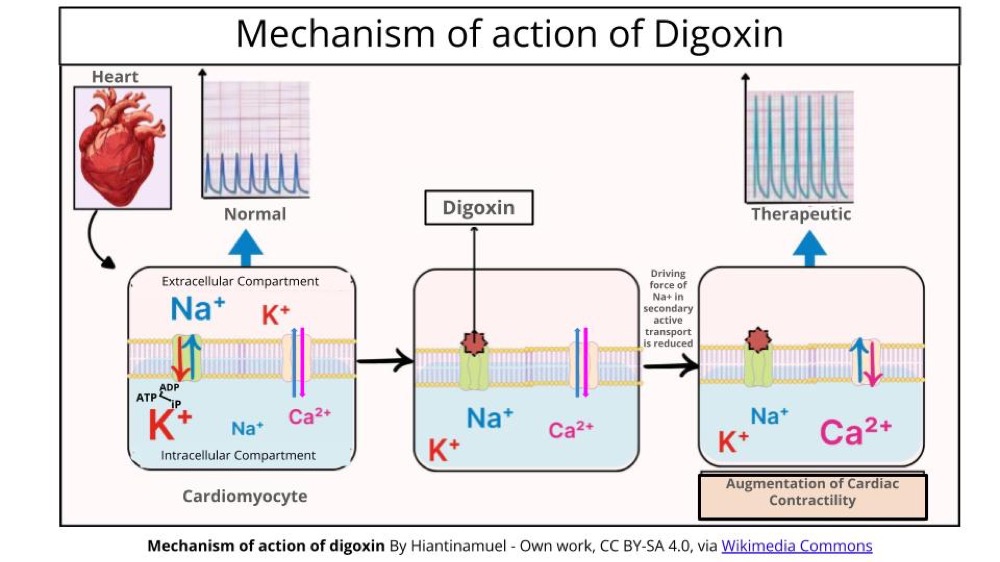
Based on the mechanism of digoxin shown, why does hypokalemia increase digoxin toxicity?
Potassium and digoxin compete for the same site on the Na+/K+ ATPase, so low K+ lets digoxin bind more
Potassium speeds up digoxin metabolism
Digoxin is stored in potassium-poor tissue
Hypokalemia stops renal excretion
Digoxin binds the extracellular K+ site of the Na+/K+ ATPase. With less K+ available, more digoxin binds and the effect is amplified. Hyperkalemia has the opposite effect.
Image: Rachel Sanchez Thwing, CC BY-SA 4.0, via Wikimedia Commons.
A patient with SVT on chronic theophylline receives adenosine 6 mg with no response. What is the most likely reason?
Theophylline blocks adenosine receptors, so larger doses may be needed
Adenosine is only effective orally
Theophylline raises adenosine levels
SVT never responds to adenosine
Methylxanthines (theophylline, caffeine) are competitive adenosine receptor antagonists. Dipyridamole does the opposite and potentiates adenosine. Consider an alternative such as a CCB or a higher adenosine dose.
A patient receiving nitroprusside for 3 days has renal failure. Which toxicity is the main concern?
Thiocyanate (and cyanide) toxicity
Ototoxicity
Hyperkalemia
Pulmonary fibrosis
Nitroprusside releases cyanide that is converted to thiocyanate and excreted renally; prolonged infusion or renal failure causes accumulation (confusion, seizures, metabolic acidosis). Ototoxicity is a loop diuretic effect; pulmonary fibrosis is amiodarone.
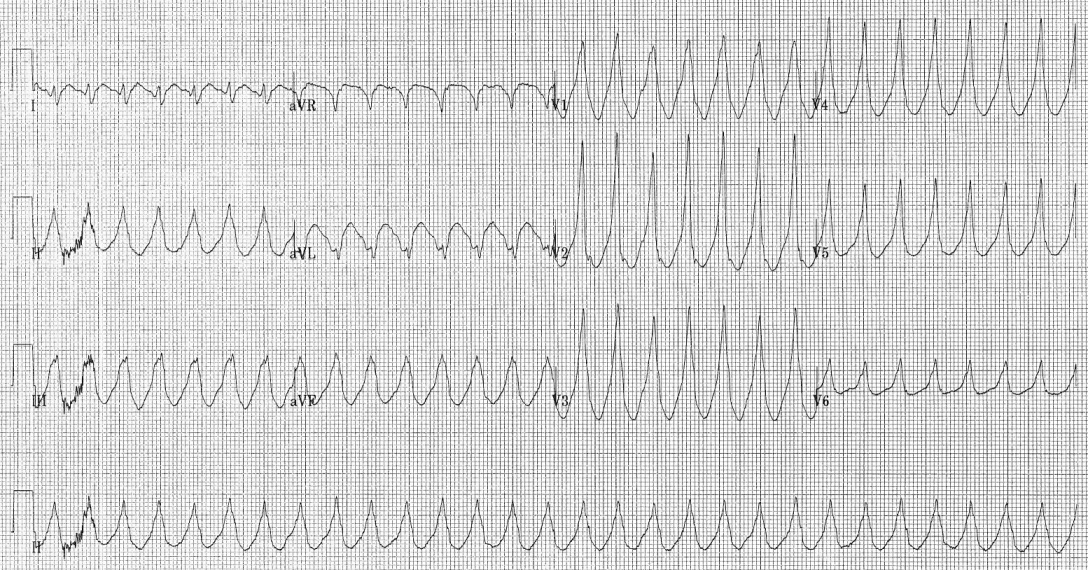
This tracing is a stable, regular, wide-complex tachycardia with a pulse. Which drug is most appropriate?
Adenosine
Verapamil
IV amiodarone (or procainamide)
Digoxin
Wide-complex tachycardia is treated as ventricular tachycardia unless proven otherwise; stable patients get amiodarone or procainamide, and unstable patients are cardioverted. Verapamil can cause hemodynamic collapse in VT; adenosine and digoxin do not treat VT.
Image: Ksheka, CC BY-SA 2.5, via Wikimedia Commons.
