Quiz · Medium
Twenty calculation and concept questions on compounding, annuities, perpetuities, NPV, IRR, payback and project cash flows.
You invest $5,000 at 6% compounded annually. What is the balance after 8 years?
$7,400.00
$7,969.24
$7,518.15
$3,137.06
FV = 5,000 x 1.06^8 = 7,969.24. The simple-interest figure (7,400.00) ignores interest on interest.
What is the present value of $20,000 received in 7 years at a 9% discount rate?
$10,940.68
$36,560.78
$12,269.94
$11,925.35
PV = 20,000 / 1.09^7 = 10,940.68.
By the Rule of 72, about how long does it take money to double at 9% a year?
6 years
9 years
12 years
8 years
72 / 9 = 8 years. The exact figure is ln 2 / ln 1.09, about 8.04 years.
A loan has a stated annual rate of 8% compounded quarterly. What is the effective annual rate?
8.000%
8.160%
8.243%
8.500%
EAR = (1 + 0.08/4)^4 - 1 = 8.243%. Compounding more often than annually raises EAR above the stated rate.
What is the present value of $1,200 received at the end of each of the next 6 years at 8%?
$7,200.00
$5,547.46
$5,991.25
$8,803.11
PV = 1,200 x (1 - 1.08^-6) / 0.08 = 5,547.46. The annuity-due value would be about 5,991.25.
A perpetuity pays $75 a year, with the first payment one year from now. At a 6% discount rate its value is:
$1,250
$450
$1,325
$12.50
PV = 75 / 0.06 = 1,250.
A stock pays $3 next year, and dividends grow 3% forever. With an 11% required return, the value is:
$27.27
$21.43
$38.62
$37.50
Value = D1 / (r - g) = 3 / 0.08 = 37.50. Note D1 is already next year's dividend, so you do not multiply by (1 + g) again.
Which statement about the NPV rule is correct?
Accept when NPV is zero or negative
Accept when payback is under 10 years
Accept an independent project when its NPV is positive
Accept only the project with the highest IRR
A positive NPV means the project earns more than its required return, so it adds value to shareholders.
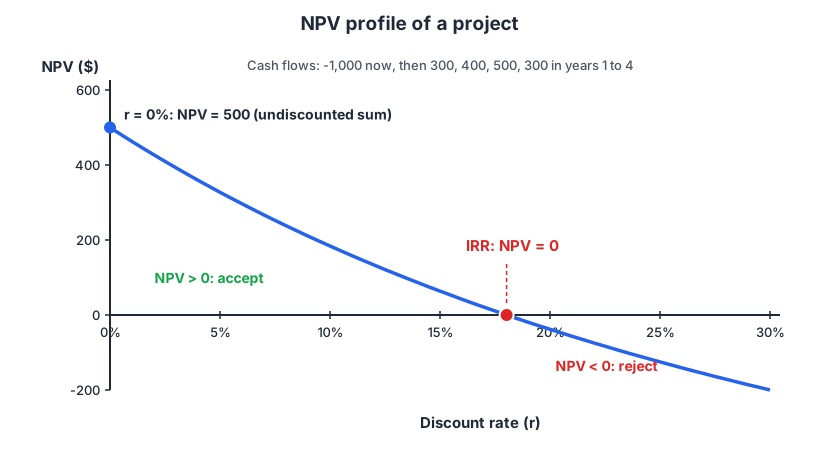
Using the NPV profile, a firm with a required return of 20% should do what with this project?
Accept it, because NPV at 0% is 500
Reject it, because the 20% discount rate is above the IRR of about 18%
Accept it, because the IRR is positive
It cannot be determined from the graph
At 20% the curve is below the axis, so NPV is negative. The 500 at 0% is just the undiscounted sum of cash flows.
A project costs $2,000 and returns $800, $900 and $1,000 in years 1 to 3. What is its payback period?
2.3 years
2.0 years
2.7 years
3.0 years
Cumulative inflows are 800, 1,700 and 2,700. After year 2 the remaining 300 is recovered during year 3: 2 + 300/1,000 = 2.3 years.
A project has a profitability index of 1.15. This means:
NPV is 15 dollars
IRR equals 15%
It repays in 1.15 years
The PV of its future cash flows is 1.15 times the initial investment, so NPV is positive
PI = PV of inflows / initial outlay. PI above 1 is the same as NPV above 0.
Two mutually exclusive projects have conflicting NPV and IRR rankings. Which should a manager follow?
IRR, because percentages are easier to compare
Payback, because it is simplest
NPV, because it measures the dollar value added and assumes reinvestment at the discount rate
Neither, choose both
NPV is the more reliable criterion for mutually exclusive projects, particularly with differences in scale or timing.
The firm paid a consultant $50,000 last year to study a project. When evaluating the project today this cost should be:
Added to the initial outlay
Ignored, because it is a sunk cost
Subtracted from year-1 cash flow
Depreciated over the project's life
A sunk cost has already been incurred and will not change with the decision, so it is not an incremental cash flow.
A machine has annual depreciation of $40,000 and the tax rate is 21%. What is the annual depreciation tax shield?
$8,400
$40,000
$31,600
$19,000
Tax shield = depreciation x tax rate = 40,000 x 0.21 = 8,400. Depreciation is non-cash but reduces taxable income.
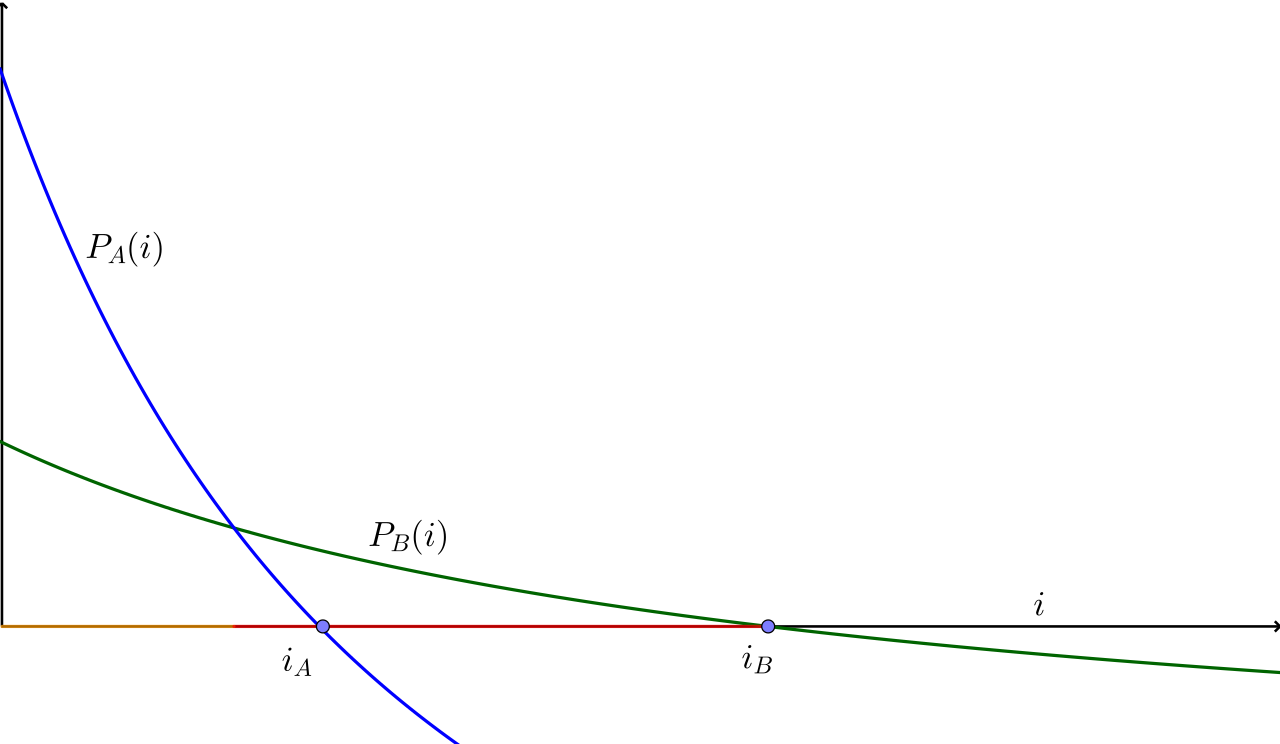
The graph shows NPV profiles for two projects. How do they compare?
A is better at every discount rate
B is better at every discount rate
They have identical IRRs
A has the larger NPV at low discount rates, B has the higher IRR, and they cross at the crossover rate
The steeper curve A starts higher but crosses the axis sooner (lower IRR). Below the crossover rate A has the higher NPV. Above it, B does.
Image: LeoChiukl, CC BY-SA 4.0, via Wikimedia Commons.
Cash flows of -100, +300, -250 over three years will most likely produce:
A single unique IRR
No NPV
Two IRRs (a non-conventional pattern with two sign changes)
An IRR above 100% only
Two sign changes allow up to two IRRs. In such cases rely on NPV or MIRR.
When a new product needs $30,000 more inventory at launch, how does this appear in project cash flows?
As a tax shield
As a cash outflow at the start, usually recovered at the end of the project
As depreciation
It does not affect cash flow
An increase in net working capital ties up cash. It is normally released when the project winds down.
A $200,000 loan at 6% APR is paid monthly. How much of the first monthly payment is interest?
$1,000
$200
$1,199
$12,000
Interest = balance x monthly rate = 200,000 x 0.005 = 1,000. The rest of the payment (about 199) repays principal.
Compared with an ordinary annuity, an annuity due with the same payments, rate and term has:
A lower present value
The same present value
A present value that depends only on the number of payments
A higher present value (by a factor of 1 + r)
Each payment arrives one period sooner, so it is discounted one period less.
Initial cost $500. The project returns $200 at the end of each of the next 3 years. At a 10% discount rate, NPV is closest to:
+$2.63
+$100.00
-$2.63
$0.00
PV of inflows = 200 x 2.4869 = 497.37, which is below 500, so NPV = -2.63. Reject.
