Quiz · Medium
Foundational questions on Piaget's stages, Vygotsky's ZPD, Erikson's crises, attachment, parenting styles and early milestones.
The 'imaginary audience' is most characteristic of:
Infancy
Preschool
Early adolescence
Late adulthood
Teens believe everyone is watching them (Elkind).
A child fits a new animal (a zebra) into her existing 'horse' schema. This is:
Accommodation
Equilibration
Conservation
Assimilation
Fitting new information into an existing schema is assimilation. Changing the schema to fit (creating a 'zebra' category) would be accommodation.
A 3-year-old says the moon is following her car. Which Piagetian idea is most relevant?
Conservation in the concrete operational stage
Animism and egocentrism in the preoperational stage
Object permanence
Hypothetico-deductive reasoning
Preoperational children attribute life and intention to objects and see the world from their own view. Conservation and abstract reasoning come later.
Which stage of Piaget's theory is characterized by object permanence as the key achievement?
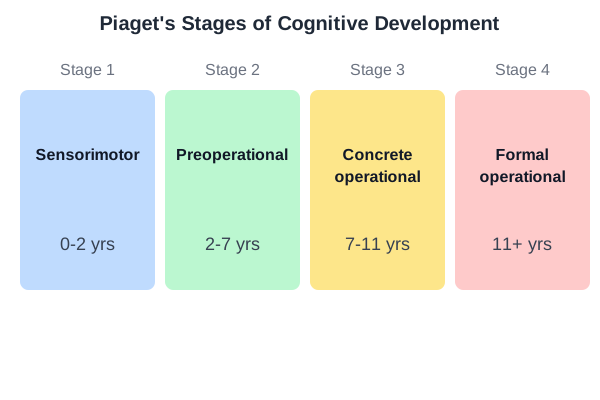
Sensorimotor
Preoperational
Concrete operational
Formal operational
Object permanence emerges in infancy (about 8 months onward).
A child says there is more juice in a tall thin glass than in a short wide glass, after watching it poured from the wide glass. This shows a lack of:
Object permanence
Theory of mind
Seriation
Conservation
Failure to conserve liquid quantity comes from centration on height, typical of the preoperational stage.
Which pair of abilities allows concrete operational children to pass conservation tasks?
Egocentrism and animism
Assimilation and accommodation
Reversibility and decentering
Seriation and symbolic play
Children can mentally undo the pouring (reversibility) and consider height and width together (decentering).
A teenager systematically tests each variable in a science experiment while holding the others constant. Which stage is she using?
Concrete operational
Formal operational
Preoperational
Sensorimotor
Systematic hypothetico-deductive reasoning marks the formal operational stage.
Vygotsky's zone of proximal development is the gap between:
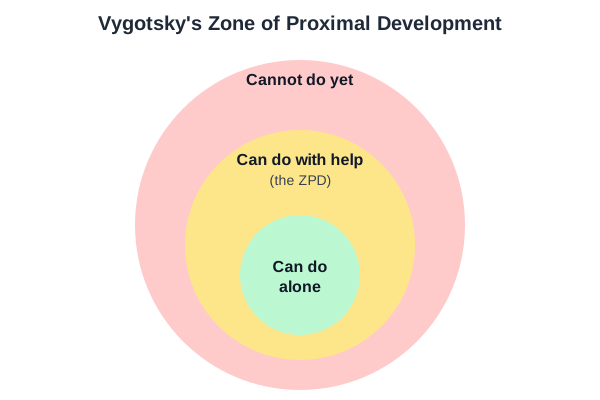
What a child can do alone and what she can do with guidance
What a child knows and what she forgot
A child's age and her grade level
Piaget's stages
The ZPD is where scaffolding is most effective.
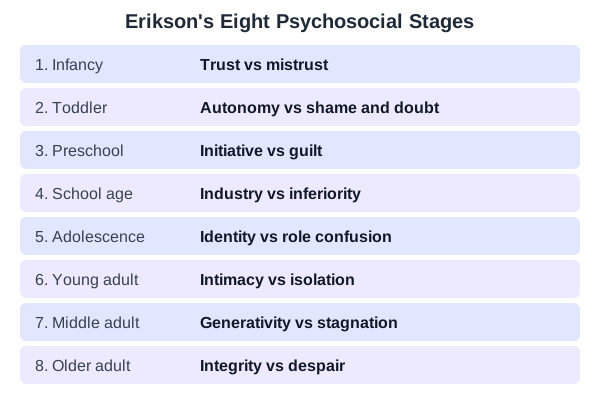
Which is Erikson's crisis for a school-age child?
Initiative vs guilt
Identity vs role confusion
Industry vs inferiority
Trust vs mistrust
School-age children master skills and compare themselves with peers.
Which Erikson stage comes right after 'autonomy vs shame and doubt'?
Industry vs inferiority
Initiative vs guilt
Trust vs mistrust
Identity vs role confusion
The order is trust, autonomy, initiative, industry, identity, intimacy, generativity, integrity.
A child behaves well to avoid punishment. Which Kohlberg stage is that?
Stage 1: obedience and punishment
Stage 3: interpersonal accord
Stage 4: law and order
Stage 5: social contract
Avoiding punishment is Stage 1 preconventional reasoning.
In the Strange Situation, an infant is very upset when the mother leaves and is then easy to comfort and returns to play when she comes back. This is:
Avoidant attachment
Ambivalent attachment
Disorganized attachment
Secure attachment
A secure infant shows distress at separation but is readily soothed at reunion.
Bandura's Bobo doll studies showed that children:
Learn only through direct reinforcement
Imitate only same-age peers
Imitate aggressive behavior they observe in models
Cannot learn aggression
Observational learning does not require the child to be reinforced directly.
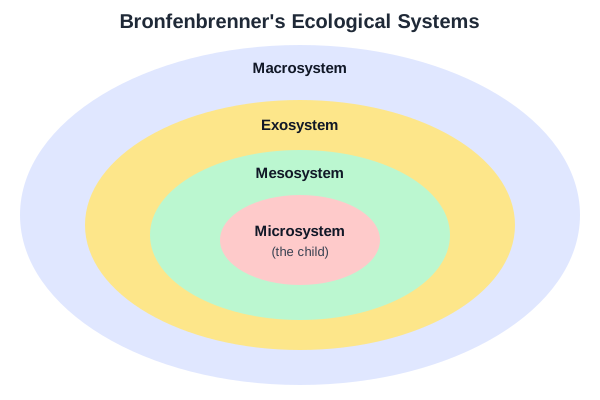
A parent's workplace changes shifts, and the child sees less of the parent. Which Bronfenbrenner system does the workplace belong to?
Microsystem
Exosystem
Mesosystem
Macrosystem
The child is not in the workplace but is affected by it.
A parent sets clear rules, explains the reasons and is warm and responsive. Which Baumrind style is this?
Authoritative
Authoritarian
Permissive
Neglectful
High warmth and high expectations with explanations define authoritative parenting.
Which statement about newborn reflexes is accurate?
Reflexes stay unchanged throughout childhood
Reflexes are learned from parents
The rooting reflex helps with walking
Most primitive reflexes such as the Moro reflex fade in the first months of life
Primitive reflexes are replaced by voluntary movement as the brain matures.
Which describes the cephalocaudal principle?
Development proceeds from outer limbs to the center
Development follows a random pattern
Development proceeds from head to toe
Large muscles develop last
Infants control the head before the trunk and legs.
Which of these is most typical at about 12 months?
Reading simple sentences
First words and pulling up to stand
Riding a bicycle
Full sentences with plurals
First words arrive around 12 months. The others occur years later.
A child says 'I goed to the park.' This is an example of:
Overregularization
Underextension
Telegraphic speech
Babbling
The child applies the regular past-tense rule to an irregular verb, showing rule learning.
Which research design follows the same group of children over many years?
Cross-sectional
Cohort-sequential only
Case control
Longitudinal
Longitudinal designs track the same participants across time.
Which statement about dyslexia is true?
It means seeing letters backward
It is a language-based reading difficulty unrelated to intelligence
It is caused by poor teaching
It is a sign of low IQ
The core problem is phonological processing and word decoding, not vision or intelligence.
