Quiz · Medium
Plans for Reconstruction, the Freedmen's Bureau, Black Codes, the 13th-15th Amendments, military districts, Johnson's impeachment, and the end of Reconstruction, with primary-source images.
Which plan, announced by Lincoln in December 1863, let a Confederate state rejoin the Union once 10% of its 1860 voters swore loyalty?
The Wade-Davis Bill
The Ten Percent Plan
The Reconstruction Acts of 1867
The Compromise of 1877
That is the Ten Percent Plan. The Wade-Davis Bill (1864) was the tougher Radical alternative, requiring a majority of white men to take an oath. The Reconstruction Acts came after Lincoln's death.
What was the main job of the Freedmen's Bureau, created in 1865?
Forcing freed people to return to plantations
Building railroads across the South
Registering Confederate soldiers for pardons
Helping formerly enslaved people with food, schools, medical care, and labor contracts
The Bureau gave practical help to freedpeople (and some poor whites). It did not return people to plantations, though it did supervise labor contracts. Pardons came from the president.
This 1868 illustration shows an agent of which federal agency standing between armed groups of white and Black Southerners?
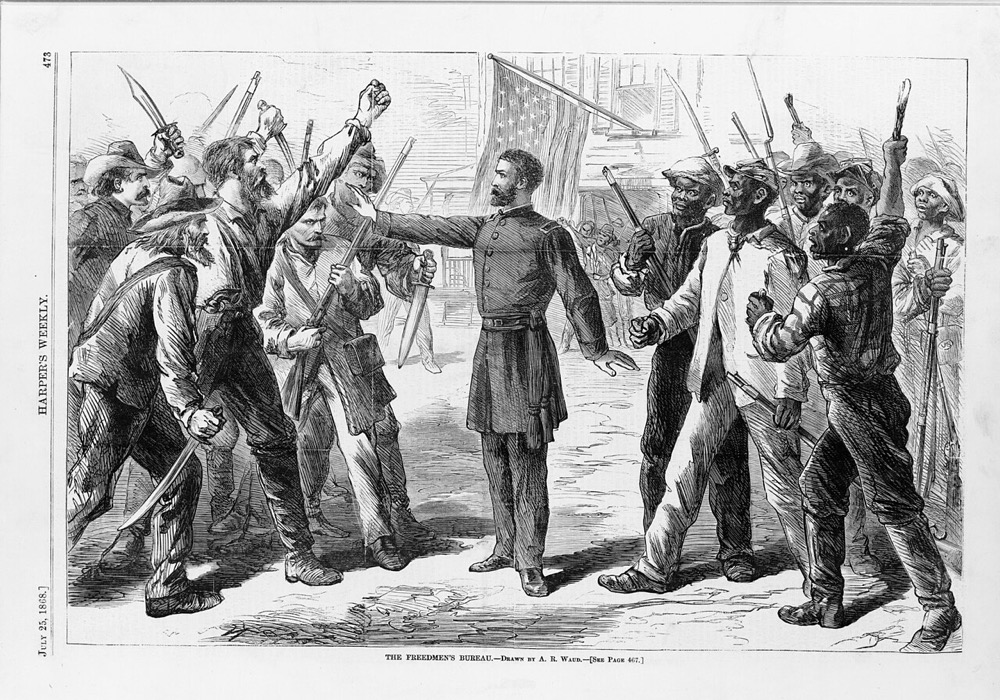
The Freedmen's Bureau
The Pinkerton Agency
The Ku Klux Klan
The Secret Service
The caption reads "The Freedmen's Bureau". Its agents were often caught between Black Southerners and hostile whites. Image: Alfred R. Waud, public domain, via Wikimedia Commons.
The Black Codes passed in 1865-1866 were designed to
Give freed people full citizenship
Punish former Confederate officers
Restrict the freedom and labor of formerly enslaved people
Create public schools for Black children
Black Codes (vagrancy laws, labor contracts, apprenticeships) kept freed people under white control. Their passage helped turn Northern opinion against Johnson's policy.
Which amendment, ratified in 1868, defined citizenship and guaranteed equal protection of the laws?
13th
14th
15th
16th
The 14th Amendment. The 13th abolished slavery (1865) and the 15th banned race-based denial of the vote (1870). The 16th (1913) concerns income taxes.
Which 1867 laws placed ten former Confederate states under military rule in five districts?
The Reconstruction Acts
The Enforcement Acts
The Black Codes
The Freedmen's Bureau Acts
The Reconstruction Acts of 1867. The Enforcement Acts (1870-71) targeted the Klan. Tennessee was not included because it had ratified the 14th Amendment and rejoined.
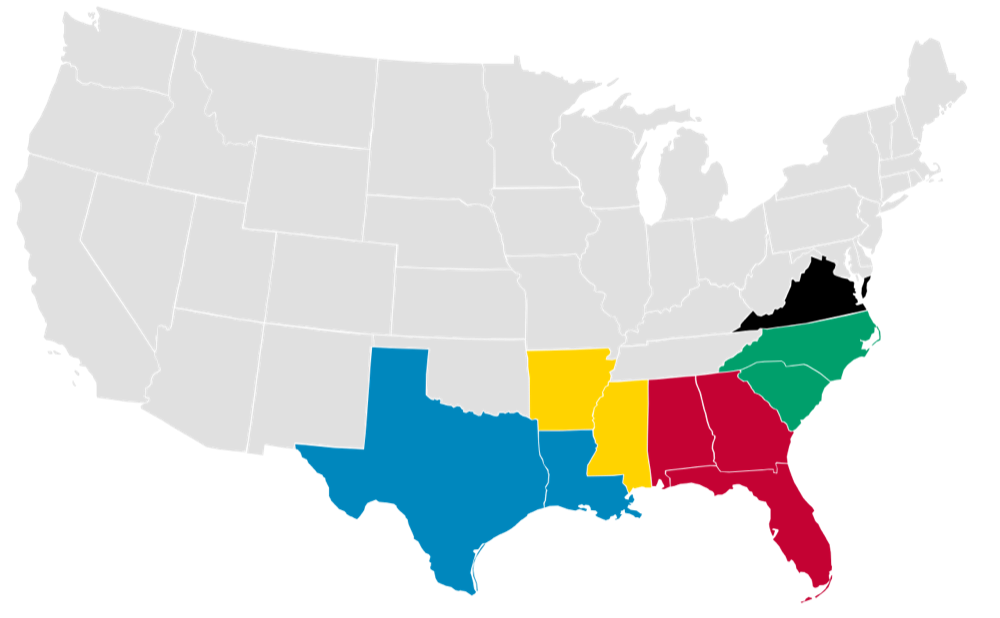
On this map, the blue Fifth Military District consisted of which states?
North and South Carolina
Georgia and Alabama
Mississippi and Arkansas
Texas and Louisiana
Texas and Louisiana made up the Fifth District. Mississippi and Arkansas (yellow) were the Fourth; the Carolinas (green) the Second. Image: JayCoop, CC0, via Wikimedia Commons.
What was the result of the Senate's trial of President Andrew Johnson in 1868?
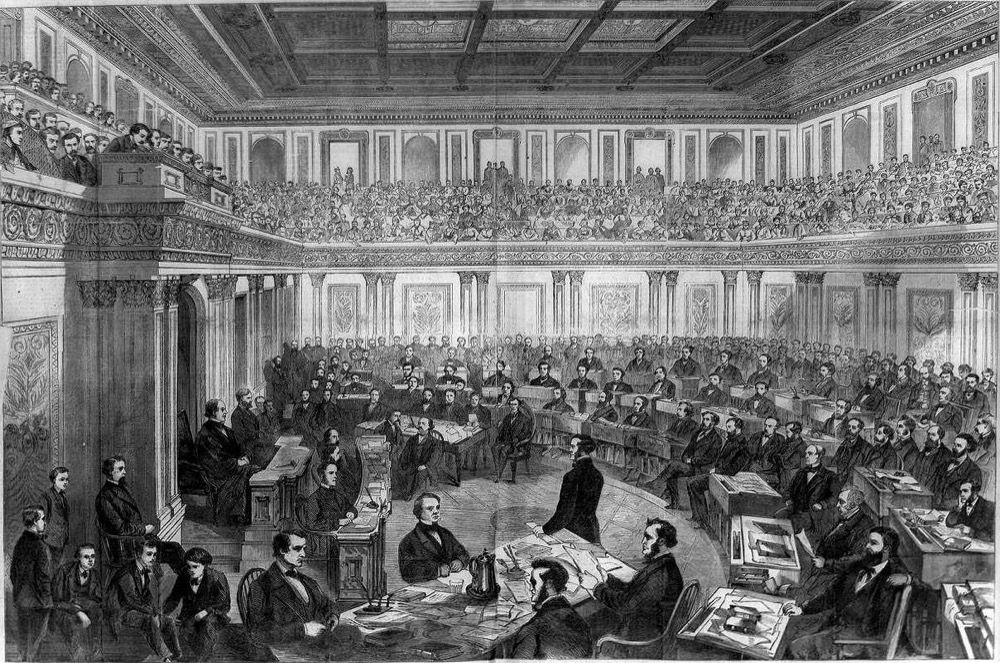
He was convicted and removed from office
He was acquitted by a single vote
He resigned before the vote
The trial ended with a censure
Conviction needed 36 of 54 votes, and the Senate came up one vote short, so Johnson stayed in office. Impeachment is the House's charge; conviction is the Senate's decision.
Why was Andrew Johnson impeached?
For accepting bribes from railroad companies
For violating the Tenure of Office Act by firing Secretary of War Stanton
For supporting the Wade-Davis Bill
For failing to veto the Reconstruction Acts
The Tenure of Office Act barred removing officials without Senate consent; Johnson fired Edwin Stanton to test it. Johnson vetoed (not signed) the Reconstruction Acts.
Which Supreme Court decision narrowly interpreted the 14th Amendment in 1873 in a case about a slaughterhouse monopoly?
Texas v. White
Plessy v. Ferguson
The Slaughter-House Cases
Ex parte Milligan
The Slaughter-House Cases limited the privileges or immunities clause. Texas v. White (1869) held secession unconstitutional; Plessy came in 1896.
Hiram Revels is historically important because he was
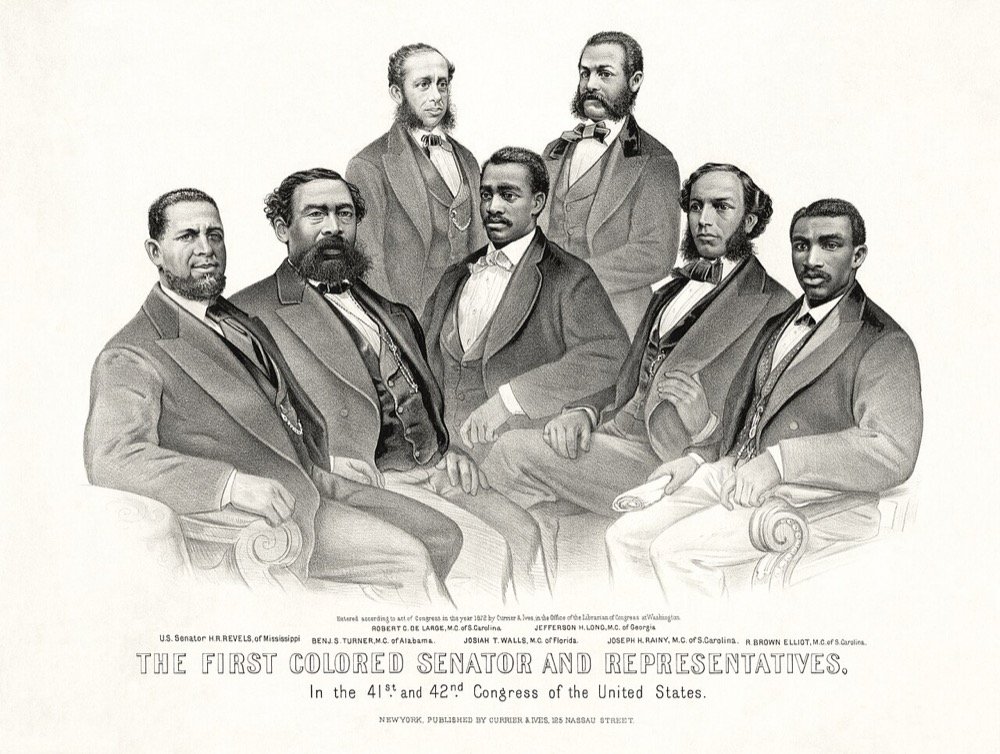
The author of the 14th Amendment
The first Black governor of a Southern state
The commander of the first Black regiment
The first Black member of the US Senate
Revels of Mississippi took his seat in February 1870. He is shown at left in the Currier & Ives print. Image: Currier and Ives (Adam Cuerden restoration), public domain, via Wikimedia Commons.
Which term describes Northerners who moved South after the war, as called by their critics?
Carpetbaggers
Redeemers
Scalawags
Exodusters
Carpetbaggers. Scalawags were white Southern Republicans; Redeemers were Democrats who took back power; Exodusters were Black migrants to Kansas.
Sharecropping was a system in which
Landowners gave farmers free land
Farmers owned tools and rented land for cash only
A farmer who owned no land worked a plot and paid the owner a share of the crop
The federal government leased plantations to freedpeople
Sharecroppers had no land and gave up a share of the crop. Combined with the crop-lien system it often meant debt. Renting for cash while owning tools describes tenant farming, which is a bit different.
The 15th Amendment (1870) did which of the following?
Gave women the right to vote
Banned poll taxes and literacy tests
Prohibited denying the vote because of race or previous servitude
Required all states to hold secret ballots
It banned race-based denial of the vote for men. It did not mention sex and did not ban poll taxes or literacy tests, which states used later.
This 1870 print celebrates the ratification of which amendment?
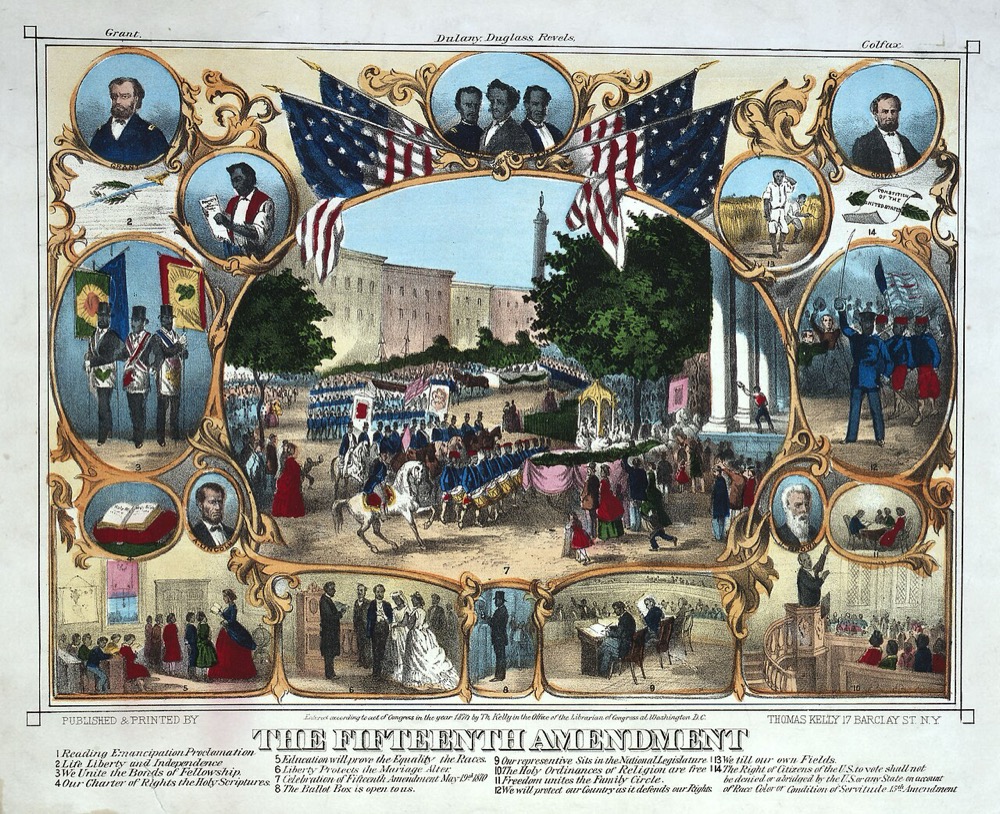
15th Amendment
14th Amendment
13th Amendment
19th Amendment
The print is titled "The Fifteenth Amendment" and shows celebrations of Black suffrage. Image: Thomas Kelly, public domain, via Wikimedia Commons.
Which group was founded by Confederate veterans in Tennessee and used terror to stop Black political participation?
The Union League
The Know-Nothings
The Freedmen's Union
The Ku Klux Klan
The Ku Klux Klan (founded in Pulaski, Tennessee). The Union League mobilized Black Republican voters. The Know-Nothings were an 1850s anti-immigrant party.
Thomas Nast's 1874 cartoon "Worse than Slavery" criticized
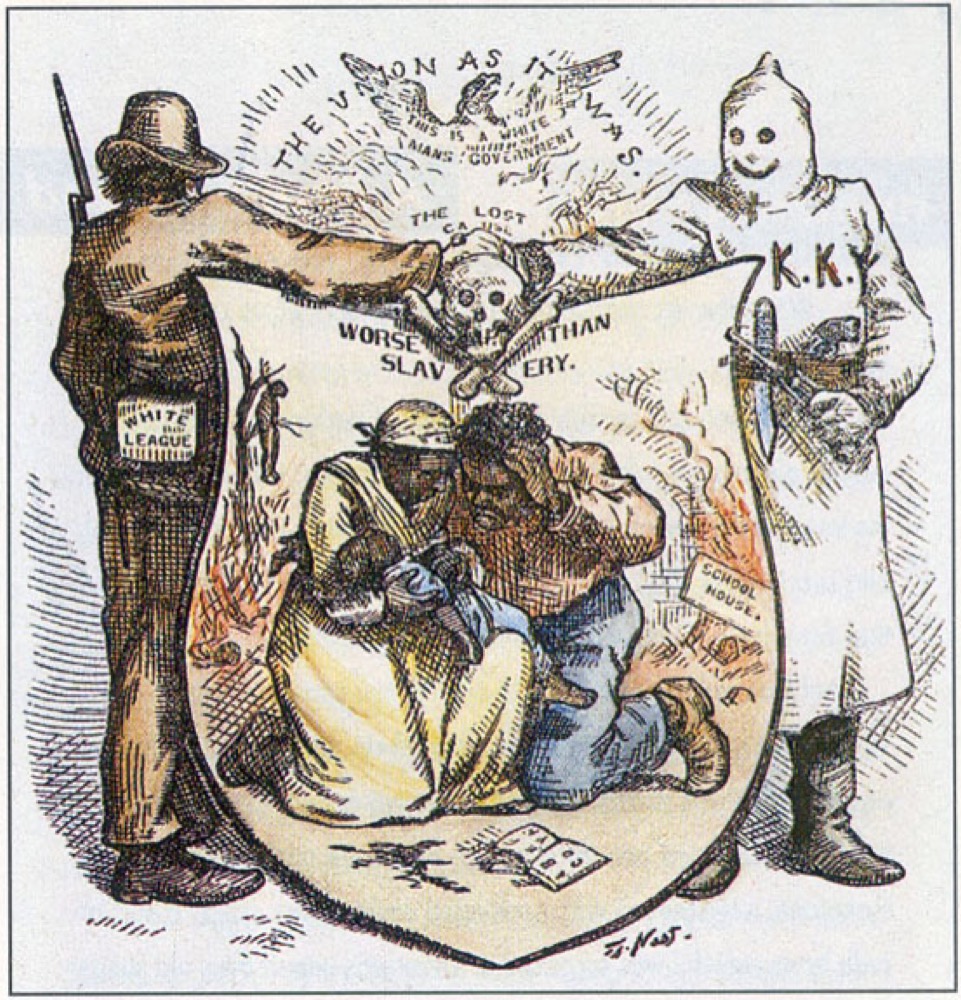
Northern industrialists
White supremacist groups such as the KKK and White League
The Freedmen's Bureau
Abolitionist newspapers
The cartoon shows a hooded Klansman and a White League man over a Black family. Image: Thomas Nast, public domain, via Wikimedia Commons.
The Civil Rights Act of 1866 was significant because it
Gave Black men the right to vote
Was passed over President Johnson's veto and defined citizenship for those born in the US
Created the Freedmen's Bureau
Was struck down immediately by the Supreme Court
Congress overrode Johnson's veto, and the law defined citizenship and basic rights. It did not address voting. The Freedmen's Bureau was created in 1865.
Which statement best describes the Compromise of 1877?
The Union Army returned to enforce voting rights
Tilden became president in exchange for new Black codes
Congress approved the 15th Amendment
Hayes became president and federal troops were withdrawn from the South
Hayes (Republican) took office; troops left South Carolina, Louisiana, and Florida, ending Reconstruction. Tilden won the popular vote but not the Electoral College count.
On this 1876 map, Hayes (red) carried three Southern states. Which of these is NOT one of them?
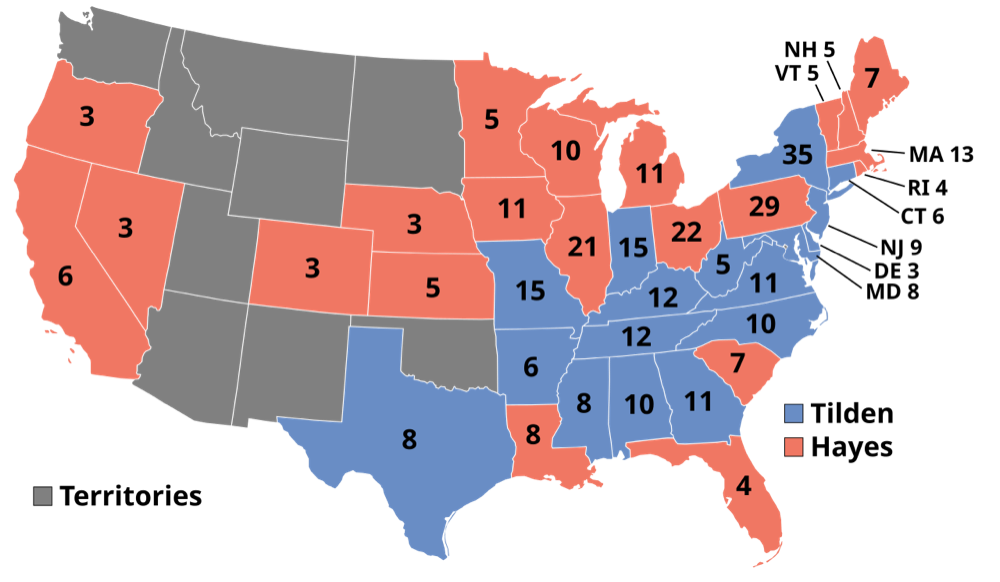
Georgia
Florida
South Carolina
Louisiana
Hayes won Louisiana, Florida, and South Carolina, whose results were disputed. Georgia (blue) went to Tilden. Image: AndyHogan14, public domain, via Wikimedia Commons.
The schoolhouse shown in this photograph is part of which Reconstruction effort?
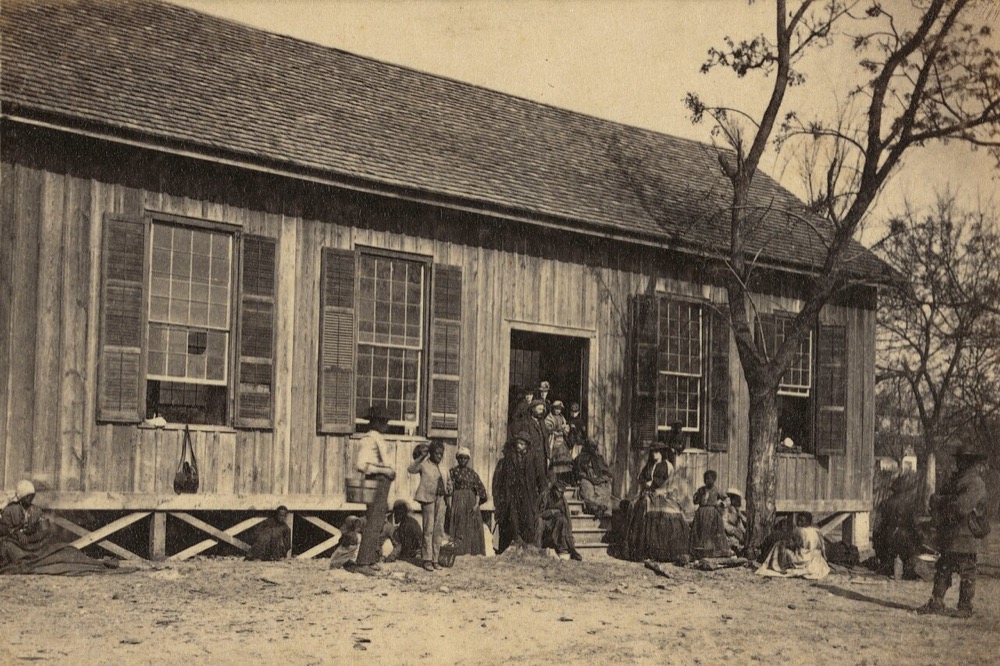
Resettling Native Americans
The Homestead Act
Education for formerly enslaved people
Training Union soldiers
Freedmen's schools were among the most lasting achievements of the era: freedpeople eagerly built and attended them. Image: Samuel A. Cooley, public domain, via Wikimedia Commons.
True or false: The 13th Amendment made it illegal to hold anyone in slavery under any circumstances.
True
False
False. It abolished slavery and involuntary servitude "except as a punishment for crime", a clause later used to justify convict leasing.
