Quiz · Medium
Questions on alliances, the July Crisis, trench warfare, US entry, Versailles and the League of Nations, with maps and photographs.
Which of the four main long-term causes of WWI involved building up large armies and navies?
Alliances
Militarism
Imperialism
Nationalism
MAIN = Militarism, Alliances, Imperialism, Nationalism. The Anglo-German naval race and Germany's army expansion are classic examples of militarism.
What was Italy's position in 1914, although it belonged to the Triple Alliance?
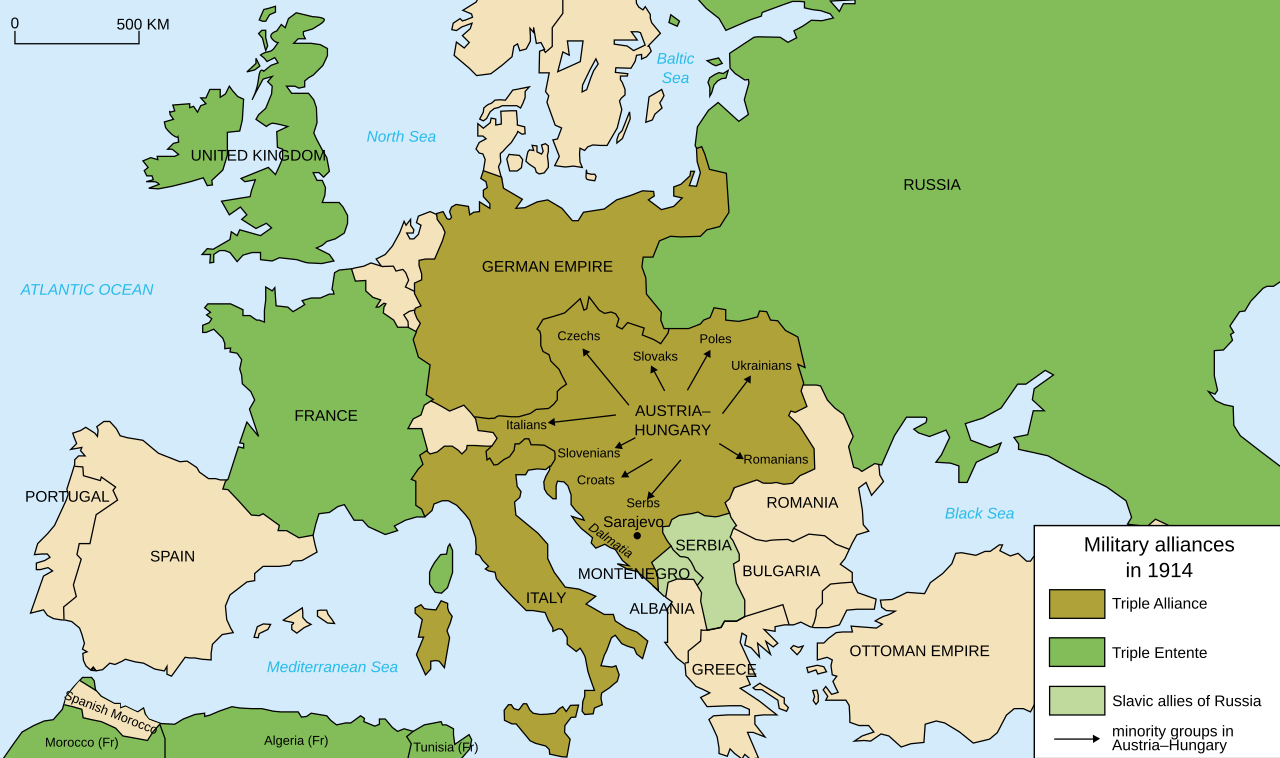
Neutral; it joined the Allies in 1915
It joined Germany immediately
It declared war on Austria-Hungary in 1914
It left the war after the Marne
Italy said the alliance was defensive and Austria had attacked Serbia. It joined the Allies in 1915 after the Treaty of London promised territory. Image: historicair (French original) and Fluteflute, CC BY-SA 2.5, via Wikimedia Commons.
Who assassinated Archduke Franz Ferdinand in Sarajevo on 28 June 1914?
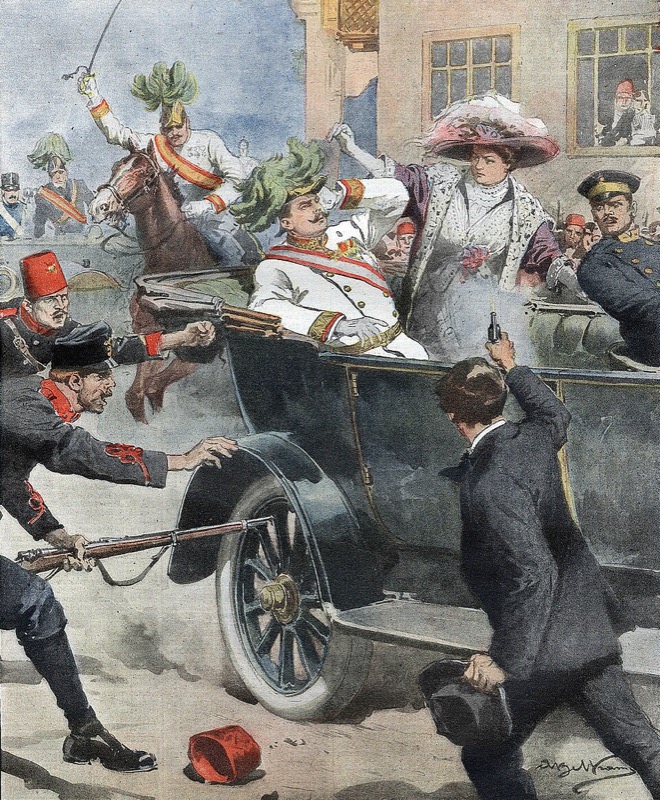
A Russian agent
A German officer
An Albanian nationalist
Gavrilo Princip, a Bosnian Serb nationalist
Princip belonged to Young Bosnia, a group supported by Serbian nationalists. Austria blamed Serbia, though the Serbian government did not order it.
What was the Schlieffen Plan?
A French plan to attack Alsace-Lorraine
A British blockade of Germany
A German plan to defeat France quickly via Belgium, then turn on Russia
A Russian plan to invade East Prussia
It failed because Belgium resisted, Britain entered, Russia mobilized faster than expected and the French and British held at the Marne.
Which statement best explains why Britain entered the war in August 1914?
Russia asked for help against Austria
Germany violated Belgian neutrality, which Britain had guaranteed
Britain was bound by a Triple Entente treaty to fight
Germany sank the Lusitania
The Entente was not a formal military alliance; the Lusitania sinking came in 1915.
Why were trench lines so hard to break through in 1915-17?
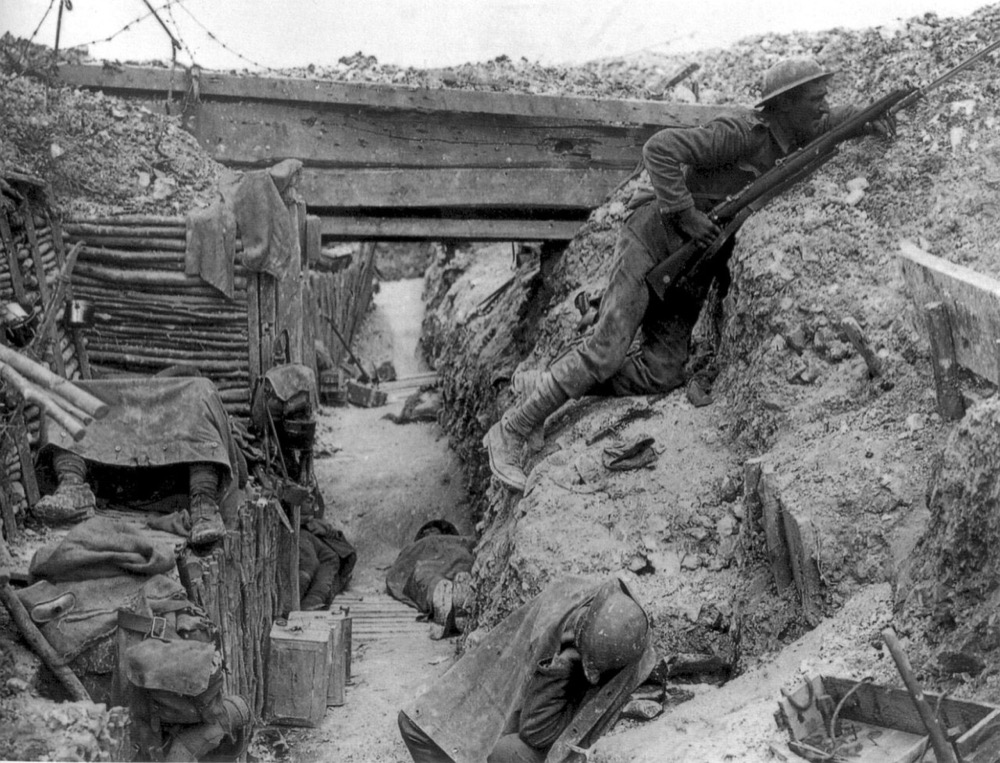
Machine guns, barbed wire and artillery gave the defense a big advantage
Tanks were used in large numbers from 1914
Neither side had artillery
Both armies used guerrilla tactics
Tanks only appeared in 1916 and were unreliable until 1917-18. Offensives like the Somme (1916) cost huge casualties for small gains.
Which battle is associated with the French phrase 'They shall not pass'?
The Marne
Passchendaele
Gallipoli
Verdun
Verdun (1916) was a symbol of French determination. Gallipoli was an Allied campaign against the Ottomans; Passchendaele (1917) was a British offensive in Flanders.
What was the main result of the sinking of the Lusitania?
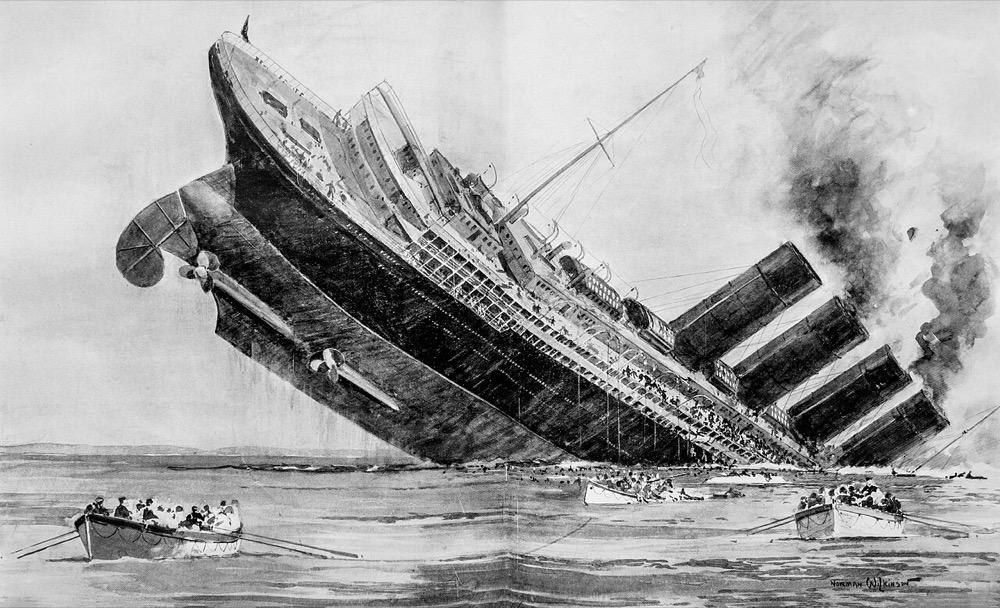
The US immediately declared war
Britain surrendered the Atlantic
It increased American hostility to Germany
Germany ended all U-boat attacks permanently
The US entered the war only in April 1917, after unrestricted submarine warfare resumed and the Zimmermann Telegram was published.
Which pair of events brought the US into WWI in 1917?
The sinking of the Lusitania and Pearl Harbor
Unrestricted submarine warfare and the Zimmermann Telegram
The Russian Revolution and the Balfour Declaration
Germany's invasion of France and Belgium
President Wilson asked Congress for war on 2 April and it was declared on 6 April 1917.
Why did Russia drop out of the war in 1918?
The Bolsheviks seized power and signed the Treaty of Brest-Litovsk
The Tsar surrendered at Tannenberg
Germany invaded and occupied Moscow
The Allies abandoned Russia
After the October Revolution, Lenin accepted harsh terms for peace. The treaty was annulled after Germany's defeat.
In which place and in which room was the Treaty of Versailles signed?
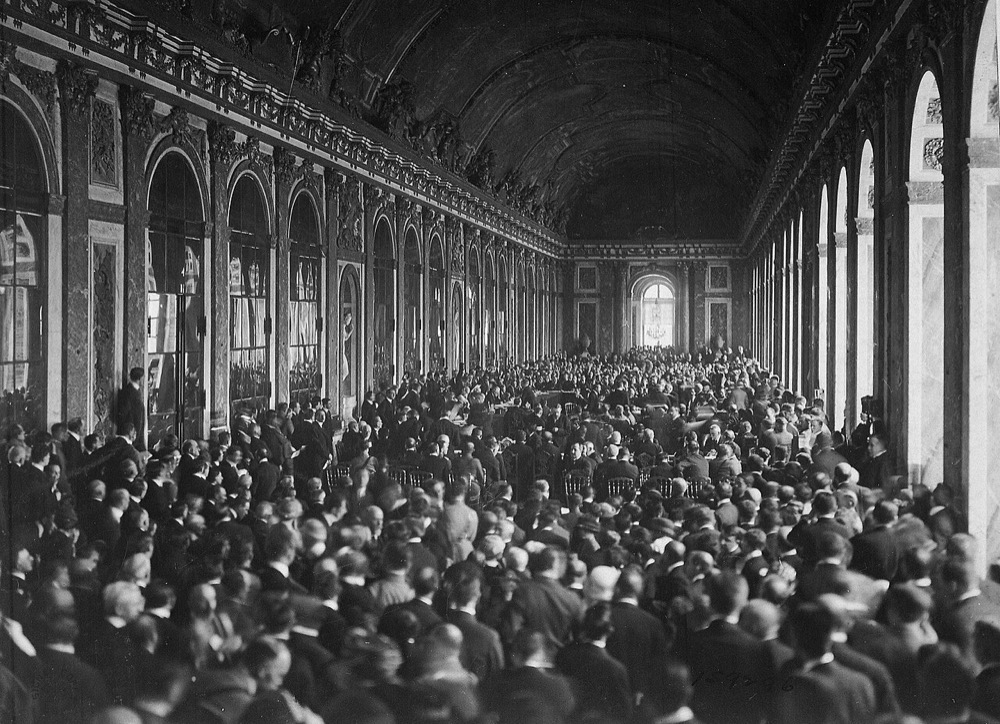
The Reichstag in Berlin
A railway carriage in Compiegne
The Elysee Palace in Paris
The Hall of Mirrors, Palace of Versailles
The railway carriage at Compiegne was the site of the November 1918 armistice (and of the 1940 French surrender).
Which was NOT a term of the Treaty of Versailles?
Germany had to accept responsibility under Article 231
Germany lost its colonies
Germany was allowed to unite with Austria
The German army was limited to 100,000 men
The treaty forbade union (Anschluss) with Austria. The other three options are standard terms.
What did Wilson's Fourteen Points propose that most differs from what the Treaty of Versailles did to Germany?
Abolishing the German Empire
National self-determination and a peace without harsh punishment
Occupying the Ruhr
Creating the Soviet Union
Germans felt tricked, because they had asked for an armistice expecting a peace based on the Fourteen Points.
Which pair is correctly matched?
Clemenceau - wanted to weaken Germany to protect France
Wilson - wanted to dismember Germany
Lloyd George - wanted no punishment at all
Orlando - led the German delegation
Wilson pressed for a League and self-determination; Lloyd George wanted a middle course; Orlando represented Italy.
The flag-and-border map shows territory Germany lost in 1919. Which country received Alsace-Lorraine?
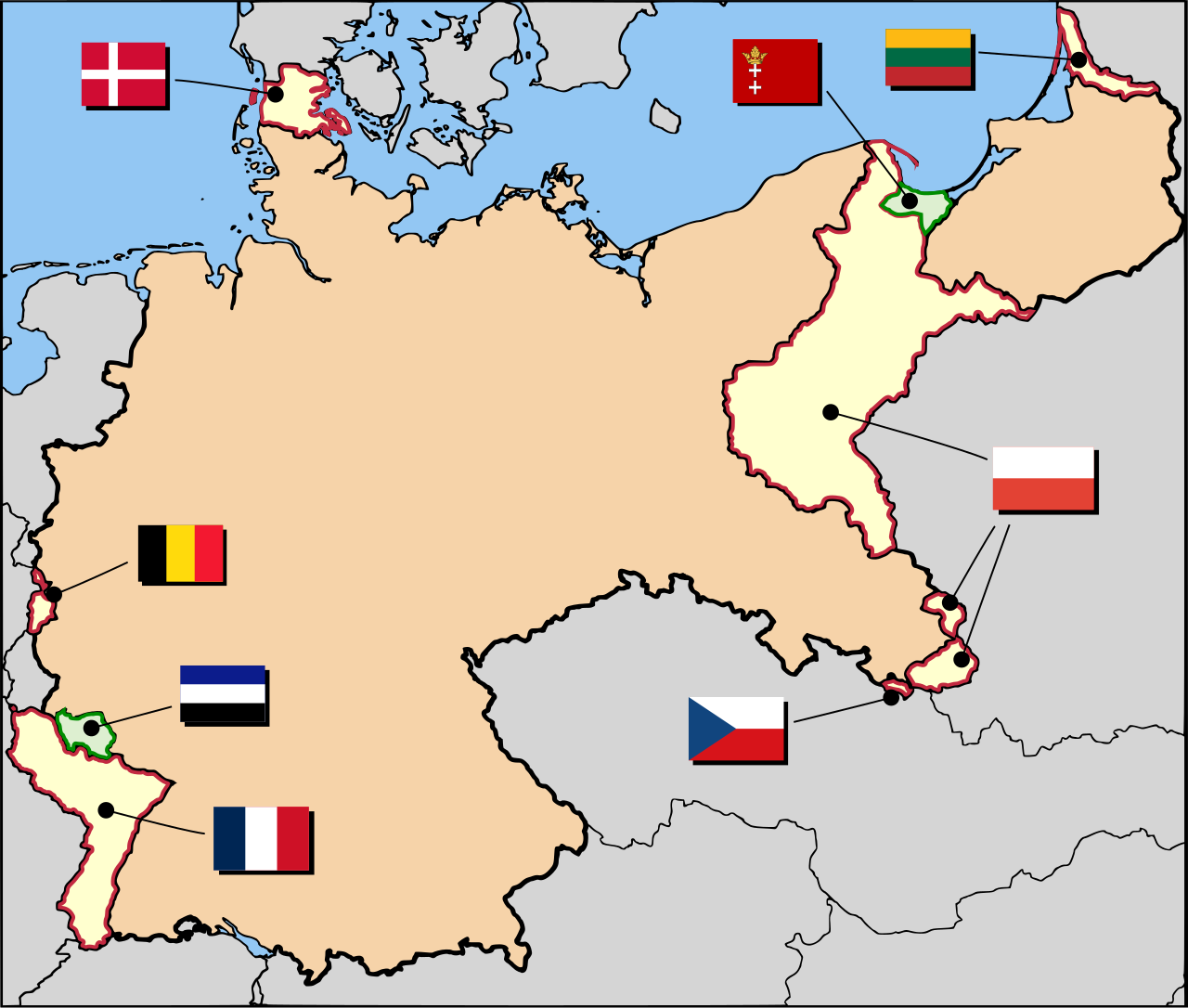
Belgium
Poland
Czechoslovakia
France
Alsace-Lorraine had been German since 1871. Belgium got Eupen-Malmedy, Poland got the corridor, Czechoslovakia got Hlucin. Image: User:52 Pickup, CC BY-SA 2.5, via Wikimedia Commons.
The 'Polish Corridor' was important because it:
Gave Germany access to the Black Sea
Created an independent Austria
Gave Poland sea access but separated East Prussia from the rest of Germany
Placed Danzig under Polish law
Danzig was a Free City under League protection, not part of Poland. The corridor was a major German grievance and Hitler's excuse in 1939. Image: User:52 Pickup, CC BY-SA 2.5, via Wikimedia Commons.
The League of Nations was created by the Treaty of Versailles but the United States never joined it.
True
False
The US Senate refused to ratify the treaty, and with it US membership in the League.
Why did the League of Nations fail in the 1930s?
Germany and Japan controlled it
It had no army and its main members were unwilling to confront aggressors
The US dominated it
It banned all use of force
Manchuria (1931) and Abyssinia (1935) showed the League could pass resolutions but not enforce them.
Which event was the main immediate cause of Hitler becoming chancellor in January 1933?
The Great Depression and the Nazi surge in elections, followed by conservative deals
The Treaty of Versailles alone
A Nazi military coup
The burning of the Reichstag
The Reichstag fire (Feb 1933) came after Hitler was already chancellor and was used to remove civil rights.
The Locarno Treaties (1925) were important because:
They reduced reparations to zero
They banned all weapons
They created the League of Nations
Germany accepted its western borders and the 'spirit of Locarno' improved relations
Locarno did not guarantee Germany's eastern borders, a weakness Hitler later exploited.
The Armenian genocide of 1915 was carried out by:
Tsarist Russia
Bulgaria
The Ottoman government
Austria-Hungary
It occurred during WWI, and the deportations and massacres killed around a million or more Armenians.
Which statement about the end of WWI is correct?
The Treaty of Versailles ended the fighting in 1918
The armistice took effect at 11 a.m. on 11 November 1918, but the peace treaty was signed in June 1919
The war ended with an unconditional German surrender in Berlin
The armistice was signed in the Hall of Mirrors
An armistice is a ceasefire; the treaty followed after the Paris Peace Conference.
