Quiz · Medium
Foundational questions on classifying ODEs, slope fields, separable and linear equations, growth, cooling and logistic models, Euler's method, characteristic equations and phase portraits.
What is the order of ?
1
2
It is not defined
3
Order is the highest derivative present, here the third derivative.
Which equation is linear?
Linear: y and its derivatives appear to the first power with coefficients that depend only on x. , and are nonlinear.
The general solution of is
Separating gives . The constant C stays as a multiplier.
Solve .
General solution ; .
The solutions of are
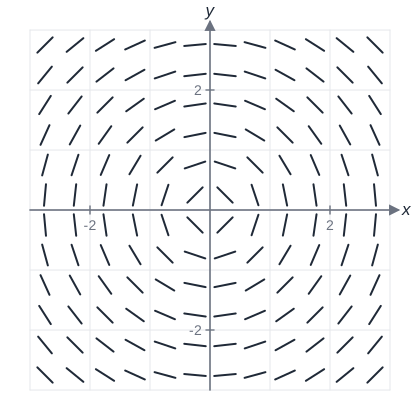
circles
parabolas
exponentials
straight lines through the origin
gives , matching the circular pattern of the slope field.
In this slope field the segment slopes depend only on x. Which equation fits?
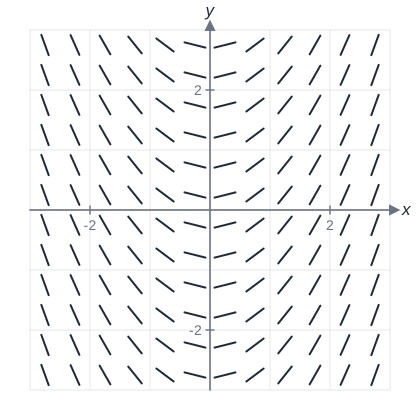
Slopes are the same along vertical lines and zero on the y-axis; solutions are parabolas .
For , which equilibrium is stable?
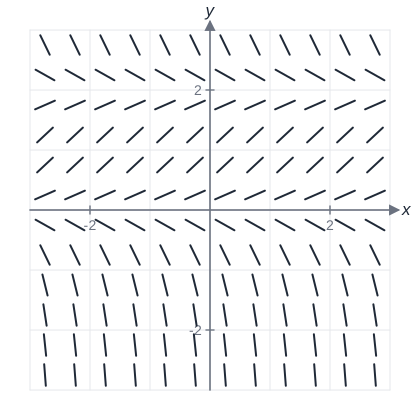
Both
Neither
Just below 2 the slope is positive; just above 2 it is negative, so solutions are pulled toward 2. Near 0, solutions move away.
The integrating factor for is
.
The equation is
not exact
exact, with
exact, with
separable only
, so it is exact. and . (It is also separable.)
A population grows at a rate proportional to its size and doubles in 5 hours. Then k equals
, so .
Newton's law of cooling for an object in a room at temperature :
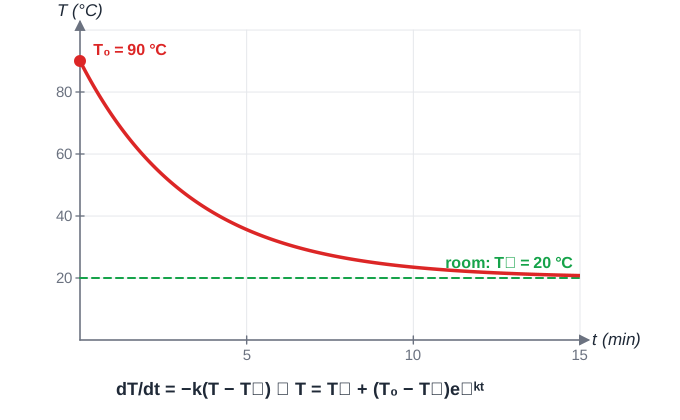
The rate of change is proportional to the difference from the surroundings. would cool the object toward 0.
For the logistic equation , the growth rate is greatest when P equals
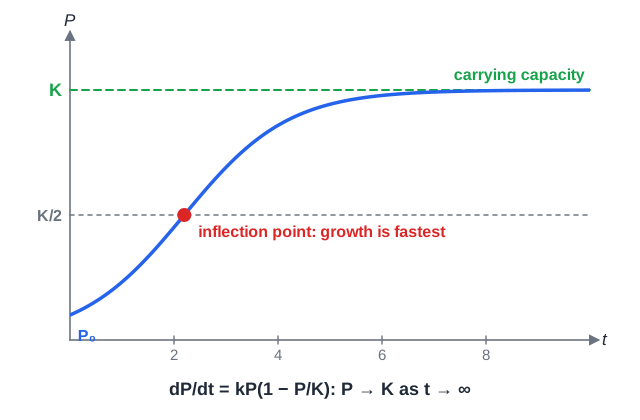
is a downward parabola in P with maximum at , the inflection point of the solution.
Euler's method with for , gives
1.0
1.2
1.1
1.01
.
The characteristic equation of has roots 2 and 3, so the general solution is
Distinct real roots give a sum of exponentials; the sign in the exponent equals the sign of the root.
The solution of is
Roots give oscillation with frequency 2 (not 4).
If is a double root, the general solution is
A repeated root needs an extra factor of x for the second independent solution.
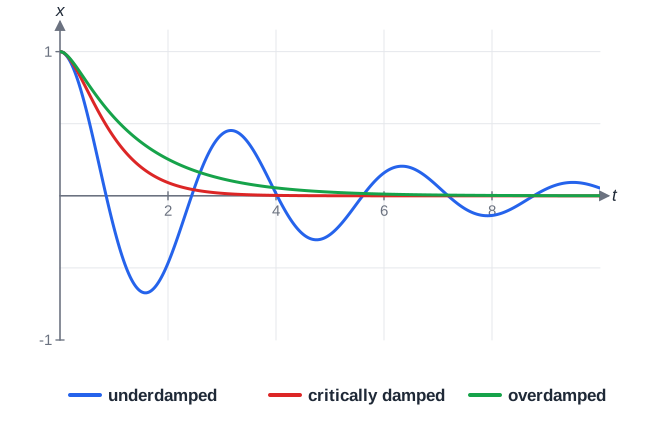
A spring-mass system with is
overdamped
critically damped
underdamped: decaying oscillation
undamped
Negative discriminant means complex roots, so the solution oscillates while decaying.
is
. The second option is cosine's transform.
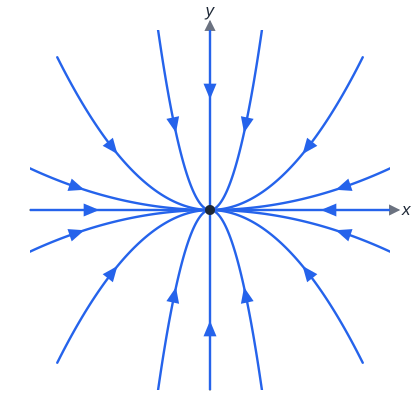
The eigenvalues of a linear system are and . The origin is a
saddle
spiral sink
stable node
center
Both real eigenvalues are negative, so all solutions decay to 0 without rotating.
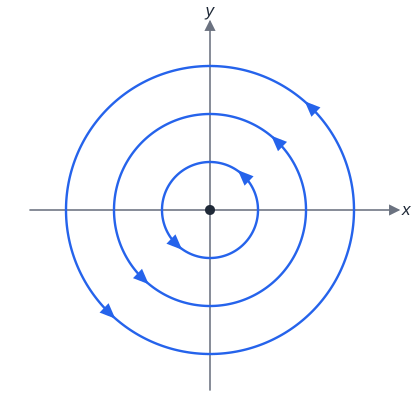
Eigenvalues give which phase portrait?
A saddle
A spiral sink
A center: closed circular orbits
A stable node
Pure imaginary eigenvalues mean rotation with no growth or decay.
