Quiz · Medium
Foundational practice on rational exponents, exponential and log graphs, domain and asymptotes, inverses, growth and decay factors and one-step exponential and log equations, with graph questions.
A solution has mol/L. What is its pH?
-5
5
0.00001
9
.
Which graph shows ?
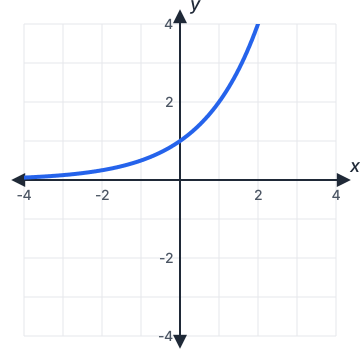
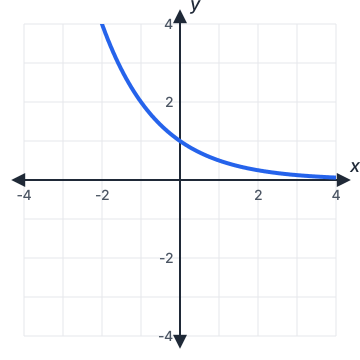
Base between 0 and 1: decay through (0, 1), approaching y = 0 on the right. The first graph is , the mirror image.
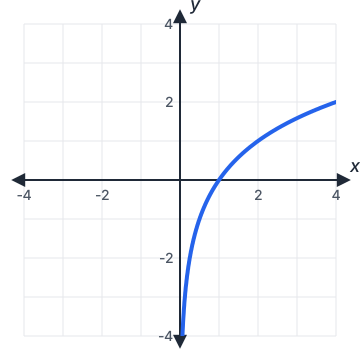
Which graph shows ?
Log graphs live only at x > 0, pass through (1, 0) and have the vertical asymptote x = 0.
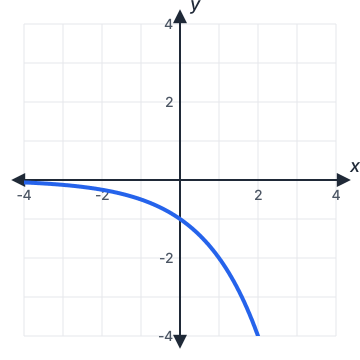
Which graph shows ?
: the growth curve reflected across the x-axis, through (0, -1), with range y < 0. would be the decay graph.
Simplify .
and . adds the exponents instead of multiplying them.
Evaluate .
-9
9
Root, then power, then reciprocal: 3, then 9, then 1/9. A negative exponent never makes the result negative.
Evaluate .
27
3
4
9
. The logarithm is the exponent, not the quotient 81/3.
True or false: .
True
False
False: . equals .
Which is the logarithmic form of ?
The base stays the base, and the logarithm equals the exponent.
What is the horizontal asymptote of the graph shown?
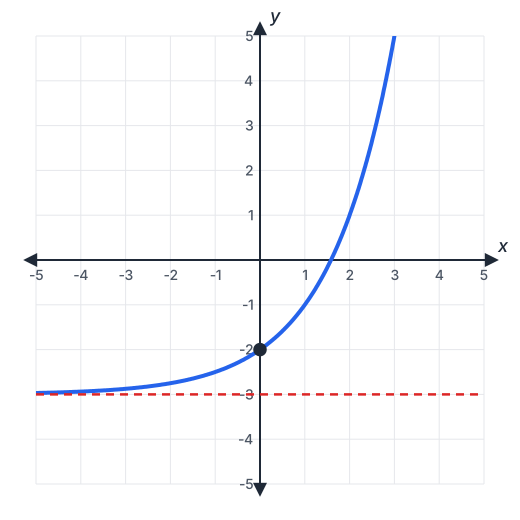
The graph is : shifted down 3, so the asymptote moves from y = 0 to y = -3. y = -2 is the y-intercept.
What is the domain of the function graphed?
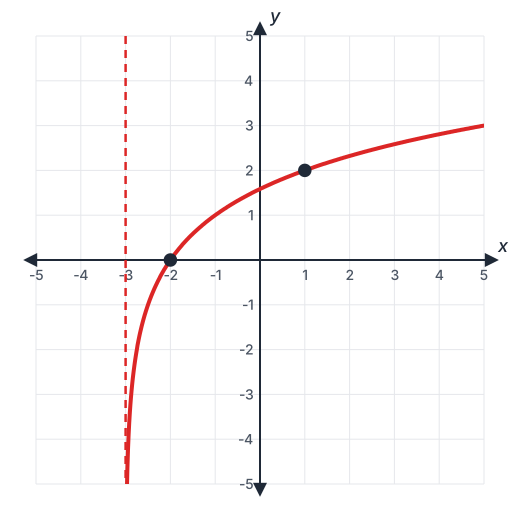
All real numbers
The graph is , with vertical asymptote x = -3. x = -2 is the x-intercept, not the boundary.
What is the domain of ?
All real numbers
Solve . The inequality is strict because log 0 is undefined.
Solve .
1
2
-2
4
, so .
Solve .
3.5
4.5
5
2
. 3.5 comes from using 2 · 3 = 6 instead of 3².
The model describes:
Growth of 92% per period
Decay of 8% per period
Decay of 92% per period
Decay of 0.92% per period
The decay factor 0.92 means 92% remains, so 8% is lost each period.
A quantity grows by 6% per year. What is its yearly growth factor?
0.06
1.6
6
1.06
Growth factor = 1 + r = 1.06.
What is the half-life of the substance graphed?
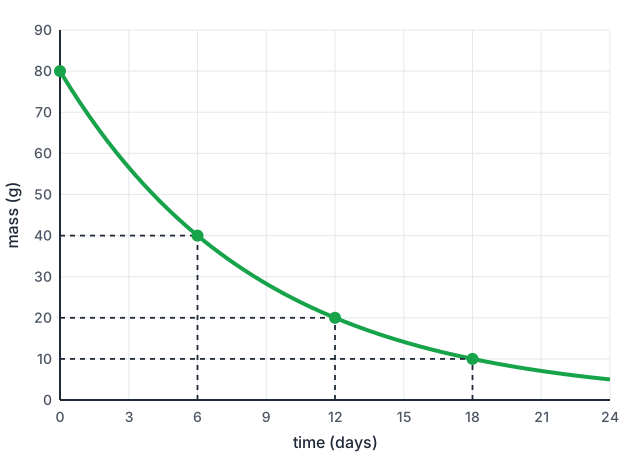
3 days
6 days
12 days
40 days
The mass drops from 80 g to 40 g at t = 6. 40 is the mass at that time, not the half-life.
Find the inverse of .
Swap x and y: , so . Check: .
The point (3, 8) is on y = 2ˣ. Which point must be on its inverse, the red curve?
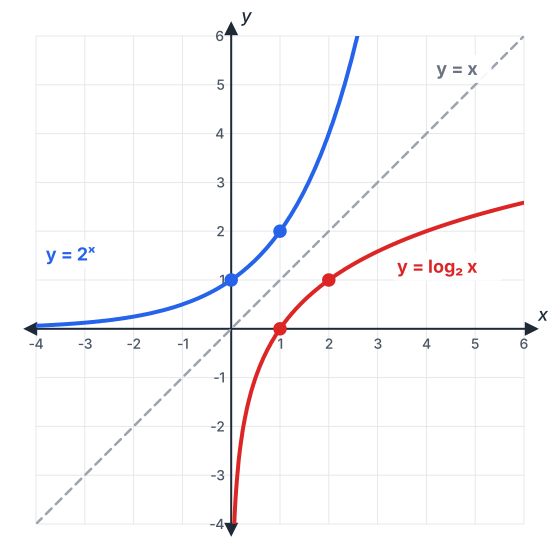
(8, 3)
(3, 8)
(-3, 8)
(3, )
Inverse functions swap coordinates.
Evaluate .
2
1
, and ln undoes e.
