Quiz · Hard
Applied subnetting problems: masks, network and broadcast addresses, host counts, summarization and IPv6.
How many usable host addresses does a /27 subnet provide?
32
30
31
62
A /27 has 5 host bits: 2^5 = 32 addresses, minus the network and broadcast addresses = 30.
What is the subnet mask for a /22 network?
255.255.252.0
255.255.248.0
255.255.254.0
255.255.255.252
22 bits = 8 + 8 + 6 bits: 255.255.252.0. 255.255.254.0 is /23 and 255.255.248.0 is /21.
What is the network address of host 192.168.10.77/27?
192.168.10.32
192.168.10.96
192.168.10.0
192.168.10.64
The /27 block size is 32; 77 lies in the 64 to 95 block, so the network address is .64 and the broadcast is .95.
What is the broadcast address of 172.16.45.200/20?
172.16.45.255
172.16.63.255
172.16.47.255
172.16.32.255
/20 gives a block size of 16 in the third octet. 45 falls in 32 to 47, so the broadcast is 172.16.47.255 and the network is 172.16.32.0.
Which prefix length is the smallest that supports 100 hosts in one subnet?
/24
/25
/26
/27
/25 has 7 host bits = 126 usable hosts. /26 gives only 62. /24 would work but wastes more space than necessary.
Which address is a valid host address in the subnet 10.1.1.128/25?
10.1.1.200
10.1.1.127
10.1.1.128
10.1.1.255
The /25 subnet runs from 10.1.1.128 (network) to 10.1.1.255 (broadcast), so usable hosts are .129 to .254. 10.1.1.127 belongs to the previous subnet.
Which of these is NOT a private IPv4 address?
172.20.5.9
10.200.1.1
192.168.100.5
172.32.5.9
RFC 1918 reserves 172.16.0.0 to 172.31.255.255. 172.32.x.x is public.
How many /26 subnets can be created from a /24 network?
2
8
4
16
Borrowing 2 bits gives 2^2 = 4 subnets of 64 addresses each (.0, .64, .128, .192).
Two hosts are configured as 192.168.1.130/25 and 192.168.1.100/25. Can they communicate directly without a router?
Yes, both are in 192.168.1.0/24
No, they are in different subnets
Yes, because they share the same default gateway
No, because both use private addresses
/25 splits the range into .0-.127 and .128-.255. .100 is in the first, .130 in the second, so a router is required.
Which summary route covers 192.168.0.0/24, 192.168.1.0/24, 192.168.2.0/24 and 192.168.3.0/24 exactly?
192.168.0.0/22
192.168.0.0/23
192.168.0.0/21
192.168.0.0/24
Four contiguous /24s share the first 22 bits. /23 covers only two of them and /21 would include four extra /24 networks.
A point-to-point router link needs exactly two usable addresses. Which prefix is the usual choice?
/29
/28
/24
/30
/30 has 4 addresses and 2 usable hosts. Modern gear can use /31 (RFC 3021) on point-to-point links, but /30 is the classic answer.
What is the usable range of 192.168.5.64/26?
192.168.5.64 to 192.168.5.127
192.168.5.65 to 192.168.5.127
192.168.5.65 to 192.168.5.126
192.168.5.1 to 192.168.5.62
The block is 64 to 127. The network address is .64 and the broadcast .127, so hosts are .65 to .126.
What is the wildcard mask for the subnet mask 255.255.255.240?
0.0.0.240
0.0.0.15
0.0.0.16
0.0.0.7
The wildcard mask is the inverse: 255 - 240 = 15.
Which IPv6 address is the shortest valid form of 2001:0db8:0000:0000:0000:0000:0000:0001?
2001:db8::1
2001:db8:::1
2001:db8::0:1
2001:0db8::1::
Leading zeros are dropped and one run of zero groups becomes ::. Using :: twice or with three colons is invalid.
Which IPv6 prefix identifies link-local unicast addresses?
fc00::/7
2000::/3
ff00::/8
fe80::/10
fe80::/10 is link-local. fc00::/7 is unique local, 2000::/3 global unicast, and ff00::/8 multicast.
Which statement about IPv6 is correct?
It still uses ARP to find MAC addresses
Addresses are 64 bits long
It has no broadcast; multicast and neighbor discovery are used instead
NAT is required to reach the internet
IPv6 uses NDP (ICMPv6) instead of ARP and multicast instead of broadcast. Addresses are 128 bits and global addresses are routable without NAT.
In the image, how many host bits does a /26 mask leave?
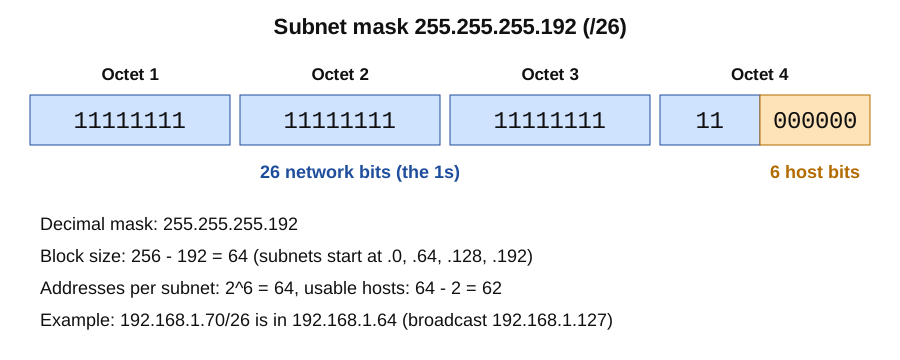
2
6
26
8
32 - 26 = 6 host bits, giving 2^6 = 64 addresses per subnet and 62 usable hosts.
A company needs 5 subnets from 192.168.50.0/24, each with at least 25 hosts. Which mask works?
255.255.255.224
255.255.255.240
255.255.255.192
255.255.255.248
/27 gives 8 subnets of 30 hosts. /28 would only fit 14 hosts, /26 gives just 4 subnets, and /29 holds 6 hosts.
A host with IP 10.0.0.10/8 pings 10.255.255.255. What kind of traffic is this?
A loopback test
A multicast to a group
A unicast to the last host
A directed broadcast to the whole 10.0.0.0/8 network
With a /8 mask, 10.255.255.255 is the broadcast address (all host bits 1). Directed broadcasts are normally blocked by routers.
Which range does the CGNAT shared address space 100.64.0.0/10 end at?
100.100.255.255
100.255.255.255
100.127.255.255
100.64.255.255
A /10 has 22 host bits, so the second octet spans 64 to 127: 100.64.0.0 to 100.127.255.255.
