Quiz · Medium
Check your understanding of doping, diodes, rectifiers, BJT and MOSFET regions and basic op-amp gains.
Which dopant produces n-type silicon?
Phosphorus
Boron
Gallium
Germanium
Phosphorus is a group V donor with an extra electron. Boron and gallium are group III acceptors (p-type). Germanium is another semiconductor, not a dopant here.
A silicon diode is forward biased and conducting. About how large is the voltage across it?
0.3 V
0.7 V
5 V
0 V
Silicon needs about 0.6-0.7 V. 0.3 V is typical of germanium.
Which element would you use to build a simple 5.1 V voltage reference from a reverse-biased device?
A Schottky diode
An LED
A Zener diode
A photodiode
A Zener operates in reverse breakdown with a nearly constant voltage. A Schottky is for low forward drop and speed.
An LED (2 V drop) runs from 5 V at 10 mA. What series resistor is needed?
R = (5 - 2) / 0.01 = 300 ohms. 500 ohms comes from dividing the full 5 V by 10 mA, ignoring the LED drop.
A bridge rectifier is fed with 60 Hz AC. What is the output ripple frequency?
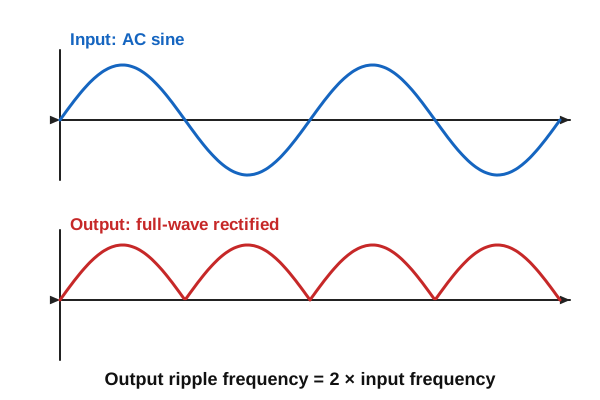
120 Hz
60 Hz
30 Hz
240 Hz
Both half-cycles are used, so the ripple frequency doubles. A half-wave rectifier would give 60 Hz.
A BJT has I_B = 20 μA and beta = 100 in the active region. What is I_C?
20 mA
2 mA
0.2 mA
2.02 mA
I_C = beta x I_B = 100 x 20 μA = 2 mA. 2.02 mA is the emitter current I_E.
Which BJT region has both junctions forward biased?
Active
Cutoff
Saturation
Reverse-active
Saturation = BE and BC both forward. Active = BE forward, BC reverse. Cutoff = both reverse.
In the symbol shown, which terminal is the emitter?
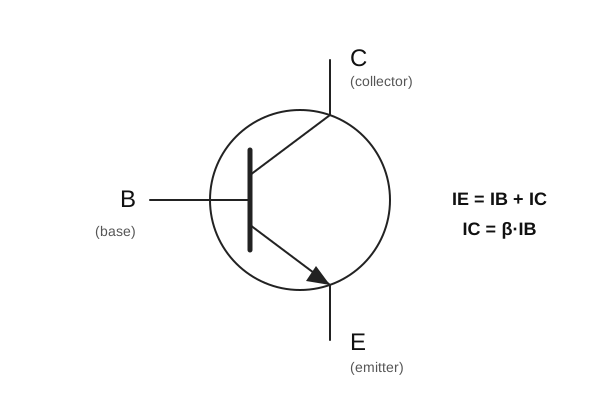
The terminal at the top
The terminal on the left
The terminal at the center of the circle
The terminal with the arrow, at the bottom
The emitter carries the arrow; the left lead is the base and the top lead is the collector.
Which statement about an NMOS transistor's gate current is correct?
It is essentially zero in DC
It equals I_D / beta
It equals I_S
It is large when V_GS exceeds V_th
The gate is insulated by an oxide, so DC gate current is negligible. The I_B = I_C / beta relation belongs to BJTs.
An NMOS in saturation has mA/V², V and V ().
8 mA
4 mA
2 mA
16 mA
I_D = 0.5 x 2 x (3 - 1)^2 = 4 mA. 8 mA forgets the factor of one half.
Inverting amplifier with kΩ and kΩ. A 0.2 V input gives
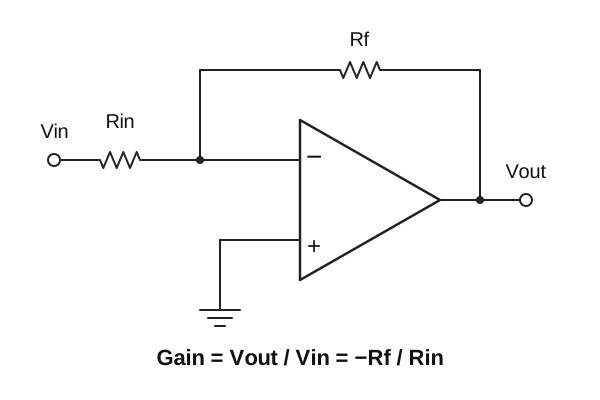
+2 V
-0.2 V
-2 V
+20 V
Gain = -Rf / Rin = -10, so Vout = -2 V. The sign is negative because the input is on the inverting terminal.
A non-inverting amplifier uses kΩ and kΩ. The gain is
19
-19
18
20
Gain = 1 + Rf/R1 = 20. 19 forgets the 1 +.
The 'virtual ground' in an inverting op-amp amplifier refers to
the inverting input sitting at about 0 V without being tied to ground
the output being connected to ground
the non-inverting input being open
the power supply midpoint
Feedback forces V- to equal V+ (0 V), but no current flows into the input, so it is not a real ground connection.
A voltage gain of 10 000 is how many dB?
40 dB
80 dB
100 dB
20 dB
20 log10(10 000) = 80 dB. 40 dB corresponds to a gain of 100.
A comparator normally uses negative feedback to set its gain.
True
False
A comparator runs open loop (or with positive feedback for hysteresis), so its output saturates at the rails.
Which class of amplifier suffers from crossover distortion?
Class A
Class C
Class B
Class A with a large emitter resistor
Class B transistors each conduct for only half a cycle, leaving a dead zone near zero volts. Class AB biasing removes it.
