Quiz · Medium
Twenty questions on classical Latin pronunciation: vowels, diphthongs, consonants and the stress rule, to help you hear and spell what you listen to.
In classical Latin, how is the diphthong 'ae' in 'Caesar' pronounced?
Like English 'eye'
Like 'ay' in 'day'
Like 'ee' in 'see'
Like 'e' in 'bed'
Classical ae = [ai], like 'eye'. The 'e' sound is the later medieval and church pronunciation.
How is 'v' pronounced in 'vici' (classical)?
Like English v
Like English w
Like English b
Like English f
Classical Latin v = [w]: Caesar's boast sounds like WEH-nee, WEE-dee, WEE-kee.
How is 'c' pronounced in 'Cicero'?
Like s before i
Like ch before e
Always like k
Like k first, then s
Classical c is always hard: KIK-e-ro. Soft c is a later development.
Where does the stress fall in 'amicus'?
On the first: A-mi-cus
On the last: a-mi-CUS
It has no stress
On the next-to-last syllable: a-MI-cus
The penult has a long i, so it takes the stress.
Where does the stress fall in 'dominus'?
DO-mi-nus
do-MI-nus
do-mi-NUS
DOM-i-NUS
The penult mi is short, so the stress falls on the syllable before: the antepenult.
Where does the stress fall in 'puella'?
PU-el-la
pu-EL-la
pu-el-LA
PU-EL-la
The penult el is closed by ll (a consonant cluster), so it is heavy and takes the stress.
Which syllable is stressed in a two-syllable word like 'rosa'?
The second
Either one
The first
It depends on vowel length
Two-syllable words are always stressed on the first syllable.
How is 'au' in 'laudo' pronounced?
Like 'o' in 'go'
Like 'aw' in 'saw'
Like 'a' in 'father'
Like 'ow' in 'cow'
au is a diphthong [au]: LOW-do.
How is 'oe' in 'poena' pronounced?
Like 'oy' in 'boy'
Like 'ee'
Like 'oh'
Like 'ow'
oe is the diphthong [oi]: POY-na.
How is 'qu' pronounced in 'quis'?
Like k only
Like kw
Like English 'quick' with a long u
Like ku
qu = [kw]: KWIS.
In classical Latin 'natio' is pronounced:
NAH-shun
NAY-shee-oh
NAH-tee-oh
NAH-chee-oh
ti stays 'tee'. The 'sh' sound of English 'nation' came through French.
What is special about the 'i' in 'iam'?
It is silent
It is a long ee
It is pronounced like j in 'jam'
It is a consonant, pronounced like y
Initial i before a vowel is the glide [j]: YAHM. The English 'j' sound is not classical.
How should the double 'l' in 'bellum' be heard?
Held longer; both l's are heard
As a single l
As 'ly'
As a silent l
Double consonants are geminated: BEL-lum, different from 'belum'.
How is 'ch' pronounced in 'pulcher'?
Like 'ch' in 'church'
Like k with a puff of breath
Like 'sh'
Like a silent h
In classical Latin ch (and ph, th) are aspirated stops: PUL-kher.
In classical Latin 'g' in 'gens' sounds like:
The g in 'gem'
A j sound
The g in 'go'
A silent g
Classical g is always hard: GENS, not 'jens'.
Which of these words is stressed on the antepenult?
amare
videre
audire
hominem
hominem: the penult mi is short, so HO-mi-nem. The others have long penults: a-MA-re, wi-DE-re, au-DI-re.
The macron (as in ā) shows:
A long vowel
A short vowel
Stress
A silent letter
Macrons mark vowel length; they are not in the manuscripts but are used in textbooks and help you apply the stress rule.
You hear WEE-dee. Which Latin word do you write?
bidi
vidi
fidi
widi
Classical v is pronounced w, so WEE-dee is spelled vidi. Latin has no letter w.
You hear KAI-sar. Which spelling is right?
Cesar
Caisar
Caesar
Kesar
The sound ai (eye) is spelled ae in Latin. Latin spelled the hard k sound with c.
Using the flowchart, where does the stress fall in 'legere'?
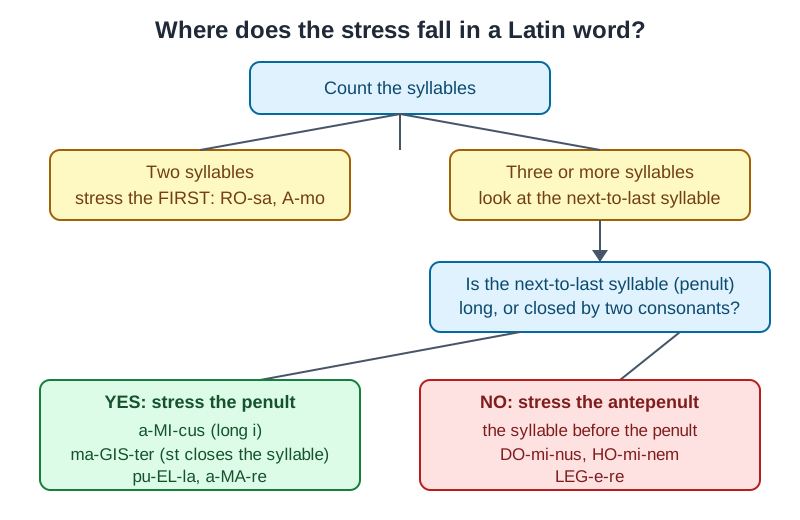
le-GE-re
le-ge-RE
LE-GE-re
LEG-e-re
The penult ge is short and open, so stress goes to the antepenult.
