Quiz · Easy
Plurals, case endings, possession, questions with mı, değil and var/yok, comparison and word order. For beginner learners.
What is the plural of kedi (cat)?
kedilar
kedis
kediler
kedileri
Kedi ends in the front vowel i, so it takes -ler: kediler. Kedileri would mean 'their cat' or 'the cats' (accusative).
Which is correct: 'I live in Istanbul'?
İstanbul'da yaşıyorum
İstanbul'de yaşıyorum
İstanbul'ta yaşıyorum
İstanbul'dan yaşıyorum
The last vowel is u (back), and l is voiced, so the suffix is -da: İstanbul'da. -dan means from.
How do you say 'I am going to Ankara'?
Ankara'da gidiyorum
Ankara'a gidiyorum
Ankara'dan gidiyorum
Ankara'ya gidiyorum
Dative after a vowel needs the buffer y: Ankara'ya. -da is in, -dan is from.
What is the accusative of kitap (book)?
kitapı
kitabı
kitaba
kitaptı
The final p softens to b before a vowel suffix: kitap → kitabı. Kitaba is the dative (to the book).
Which sentence means 'I am not a student'?
Ben öğrenci yokum.
Ben öğrenci değilim.
Ben değil öğrenciyim.
Ben öğrenci değil.
Değil negates nouns and adjectives and takes the personal ending: değilim. Yok is only for existence. Without -im (option 4) it is the third person.
Which question is correct for 'Is this your book?'
Bu senin kitabın mi?
Mı bu senin kitabın?
Bu senin kitabınmı?
Bu senin kitabın mı?
The particle is written separately and follows vowel harmony: the last vowel is ı, so mı.
What is 'my city' in Turkish?
şehrim
şehirim
şehirım
şehrım
Şehir drops its second vowel before a vowel suffix: şehrim. Similar: burun → burnum, oğul → oğlum.
Which plural does NOT follow the usual vowel harmony?
kitaplar
evler
saatler
kapılar
Saat ends in a, so you would expect -lar, but it takes -ler because the Arabic loanword has a soft, front l. Kitaplar, evler and kapılar are regular.
How do you ask 'Do you have a car?'
Araba var mı?
Araban yok mu?
Araban var mı?
Senin araba var mı?
Possession is shown by the possessive ending: araban var mı? Araba var mı? means 'Is there a car?', and araban yok mu? means 'Don't you have a car?'.
What does 'Bana kitabı ver' mean?
Give me the book.
Give him the book.
Take the book.
I give you the book.
Bana is the dative of ben (to me), kitabı is the specific object and ver is the imperative: Give me the book. Give him would be ona.
Which is correct for 'for you'?
sana için
seni için
sen için
senin için
Için takes the genitive with personal pronouns: benim için, senin için, onun için, bizim için.
Which is the correct form for 'Ali's book'?
Ali'nin kitap
Ali'nin kitabı
Ali kitabı
Ali'nin kitabın
The owner takes the genitive (Ali'nin) and the owned noun takes the third-person possessive (kitabı).
Which question word means 'where to'?
nerede
nereye
nereden
neden
Nereye is the dative of nere (where): Nereye gidiyorsun? Nerede is where (location), nereden is from where and neden is why.
How do you say 'I am coming from the school'?
Okulde geliyorum.
Okula geliyorum.
Okultan geliyorum.
Okuldan geliyorum.
From is the ablative -dan/-den/-tan/-ten. L is voiced, so -dan: okuldan. Okula would be to school.
How do you say 'There are three cats'?
Üç kedi var.
Üç kediler var.
Kedi üç var.
Üç kedi yok.
After a number the noun stays singular: üç kedi. Option 4 means there are no three cats.
True or false: in Turkish adjectives come after the noun.
True
False
Adjectives come before the noun and do not change for number: büyük ev, büyük evler.
Where does the verb normally go in a Turkish sentence?
Second, after the subject
At the beginning
At the end
After the object only in questions
Turkish is SOV: Ali kitap okuyor. The verb comes last in neutral sentences.
Which means 'Ali is taller than Ahmet'?
Ali Ahmet'ten daha uzun.
Ali Ahmet'e daha uzun.
Ali Ahmet'te daha uzun.
Ali Ahmet'i daha uzun.
The thing compared with takes the ablative: Ahmet'ten. Daha is optional but common.
Which means 'with my friend'?
arkadaşıma
arkadaşla'm
arkadaşımda
arkadaşımla
Ile attaches as -la/-le after the possessive: arkadaşımla. Arkadaşımda is 'at my friend's' and arkadaşıma is 'to my friend'.
How do you say 'I was at home'?
Evdeyim
Evdeydim
Evdedim
Evdeydi
The past of to be is -di, with a buffer y after a vowel: evde + y + dim = evdeydim. Evdeyim is I am at home, evdeydi is he was at home.
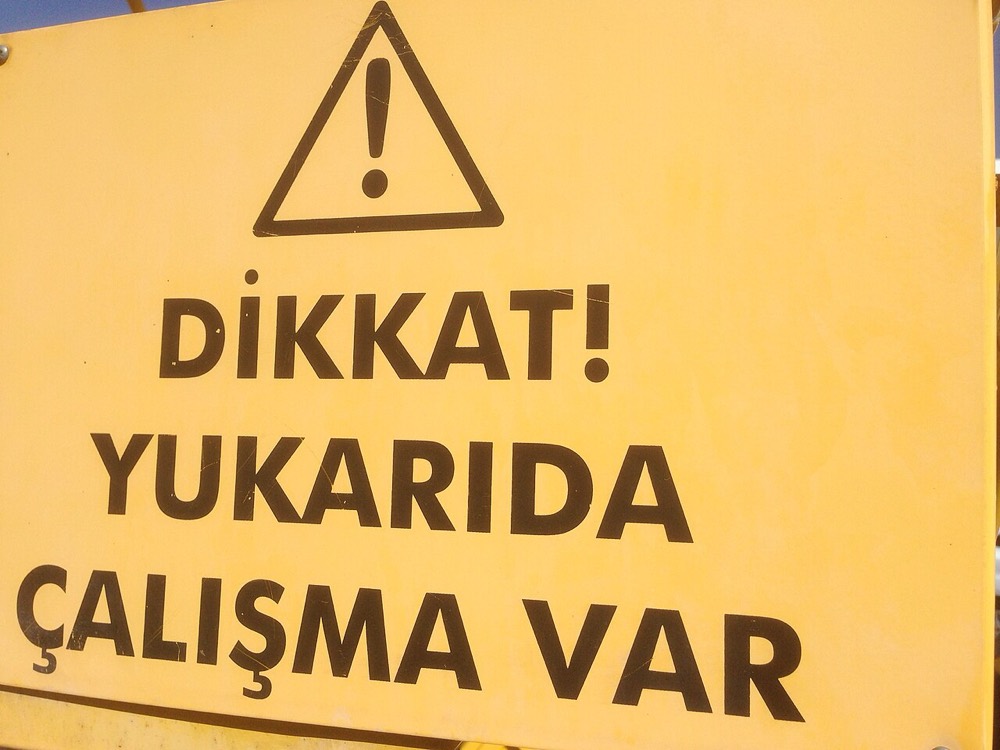
This sign says 'Dikkat! Yukarıda çalışma var.' What does 'var' mean in this sentence?
is not
there is
I have
he goes
Var means there is or exists. The sign warns that there is work going on above. Yok would mean there is not. Image: Vikiçizer, CC BY-SA 4.0, via Wikimedia Commons.
