Quiz · Medium
Core questions on research methods, landmark cases, memory systems, attention, language areas and emotion circuits, with diagram questions.
Which structure is marked B in the diagram?
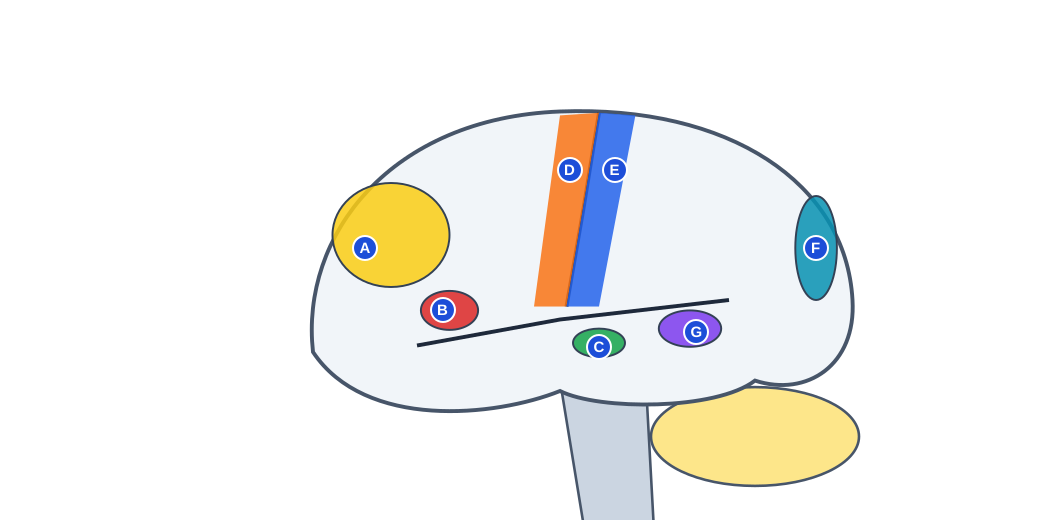
Broca's area
Wernicke's area
Primary motor cortex
Primary auditory cortex
Broca's area in the left inferior frontal gyrus is involved in speech production. Wernicke's area is in the posterior superior temporal gyrus.
Which structure is marked G in the diagram?
Broca's area
Prefrontal cortex
Primary visual cortex
Wernicke's area
Wernicke's area (posterior superior temporal gyrus) supports language comprehension.
Dopamine neurons show a decrease in firing when...
An unexpected reward is received
A reward-predicting cue appears
A reward is received as predicted
An expected reward is omitted
This negative reward prediction error is the basis of learning from disappointment.
Which structure is marked D in the diagram?
Prefrontal cortex
Wernicke's area
Primary motor cortex
Primary somatosensory cortex
The precentral gyrus is just in front of the central sulcus. The somatosensory cortex lies behind it.
Which structure is marked F in the diagram?
Wernicke's area
Primary visual cortex
Primary auditory cortex
Prefrontal cortex
V1 sits at the occipital pole.
What does fMRI measure?
Magnetic fields of neural currents
Blood-oxygen-level-dependent (BOLD) changes linked to neural activity
Direct electrical activity of neurons
Radioactive tracer uptake
EEG measures electrical activity and MEG measures magnetic fields; PET uses radiotracers.
Which method has the best temporal resolution?
EEG/MEG
PET
fMRI
Structural MRI
EEG and MEG record in milliseconds. fMRI is limited by the slow hemodynamic response.
Which method can show that a brain region is causally necessary for a task?
Resting-state fMRI
PET
EEG
TMS (or lesion studies)
Disrupting a region and observing performance changes tests necessity; correlational imaging cannot.
Patient H.M. could no longer form new declarative memories but could learn mirror drawing. This shows...
All memory is lost after temporal lobe damage
Working memory is stored in the hippocampus
Procedural memory is independent of the medial temporal lobe
The hippocampus is not involved in memory
H.M. showed that multiple memory systems exist: explicit (hippocampus-dependent) and implicit (not).
What was the main finding from Phineas Gage?
Damage causes blindness
Language is located in the frontal lobe
Frontal damage can change personality and social behavior while sparing basic cognition
The frontal lobe stores memories
His rod injury involved the frontal lobes: impulsive and socially inappropriate after the accident.
Which structure is critical for the acquisition of conditioned fear?
Cerebellum
Amygdala
Hippocampus only
Occipital cortex
Patient S.M. lacked fear. The hippocampus contributes to context but the amygdala encodes the CS-US link.
Which type of memory allows you to remember what you ate for breakfast this morning?
Episodic memory
Procedural memory
Semantic memory
Priming
Episodic memory is for personal events. Semantic memory is for facts.
Which task best measures working memory?
Pavlovian eyeblink conditioning
Lexical priming
Mirror drawing
Digit span backward
Holding and manipulating information over seconds is the essence of working memory.
Damage to the dorsolateral prefrontal cortex most characteristically causes...
Anterograde amnesia
Fear loss
Prosopagnosia
Perseveration and impaired planning and working memory
Anterograde amnesia points to the hippocampus; prosopagnosia to the fusiform gyrus.
Neglect of the left side of space most commonly follows damage to which region?
Right cerebellum
Left occipital lobe
Right posterior parietal cortex / TPJ
Left frontal lobe
The right hemisphere is dominant for spatial attention.
A patient speaks fluently but with meaningless words, and does not understand speech. What is the diagnosis?
Anomic aphasia
Wernicke's aphasia
Broca's aphasia
Conduction aphasia
Conduction aphasia would show good comprehension; Broca's aphasia would show nonfluent speech.
A patient understands speech and speaks fluently but cannot repeat phrases. Which structure is likely damaged?
Arcuate fasciculus
Primary motor cortex
Hippocampus
Corpus callosum
Conduction aphasia results from disconnection between Wernicke's and Broca's areas.
The N400 ERP component is largest when...
A word is semantically unexpected in a sentence
A syntactic violation occurs
A face is seen
A rare tone is heard
The P300 is for rare target stimuli, the P600 for syntax, and the N170 for faces.
Which theory states that emotion occurs when we interpret our bodily arousal in context?
Cannon-Bard theory
James-Lange theory
Schachter-Singer two-factor theory
Opponent-process theory
James-Lange says arousal causes emotion without appraisal; Cannon-Bard says both occur simultaneously.
Split-brain patients can name an object flashed to which visual field?
Either, equally
The right visual field
Neither
The left visual field
The right visual field projects to the left hemisphere, which has language.
True or false: the hippocampus is needed to learn a new motor skill such as mirror drawing.
True
False
Motor skill learning depends on the striatum and cerebellum. H.M. learned mirror drawing despite having no hippocampus.
True or false: activation of the amygdala during a task proves the person felt fear.
False
True
This is the reverse inference fallacy. The amygdala responds to many stimuli (novelty, salience, positive arousal).
