Quiz · Medium
Twenty-three questions on kinetic and potential energy, power and efficiency, energy sources and transformations, and conduction, convection and radiation.
What is the SI unit of energy?
Joule
Watt
Newton
Pascal
Energy is measured in joules (J). The watt is the unit of power (J/s), the newton of force and the pascal of pressure.
A 4 kg cart moves at 5 m/s. What is its kinetic energy?
20 J
100 J
10 J
50 J
KE = ½mv² = ½ × 4 × 25 = 50 J. 100 J comes from forgetting the ½; 20 J from forgetting to square the speed.
A car doubles its speed from 10 m/s to 20 m/s. By what factor does its kinetic energy change?
2
4
8
It stays the same
KE is proportional to v², so doubling v multiplies KE by 2² = 4.
A 2 kg book sits on a shelf 3 m above the floor. What is its gravitational potential energy? (g = 10 m/s²)
6 J
60 J
30 J
600 J
PE = mgh = 2 × 10 × 3 = 60 J.
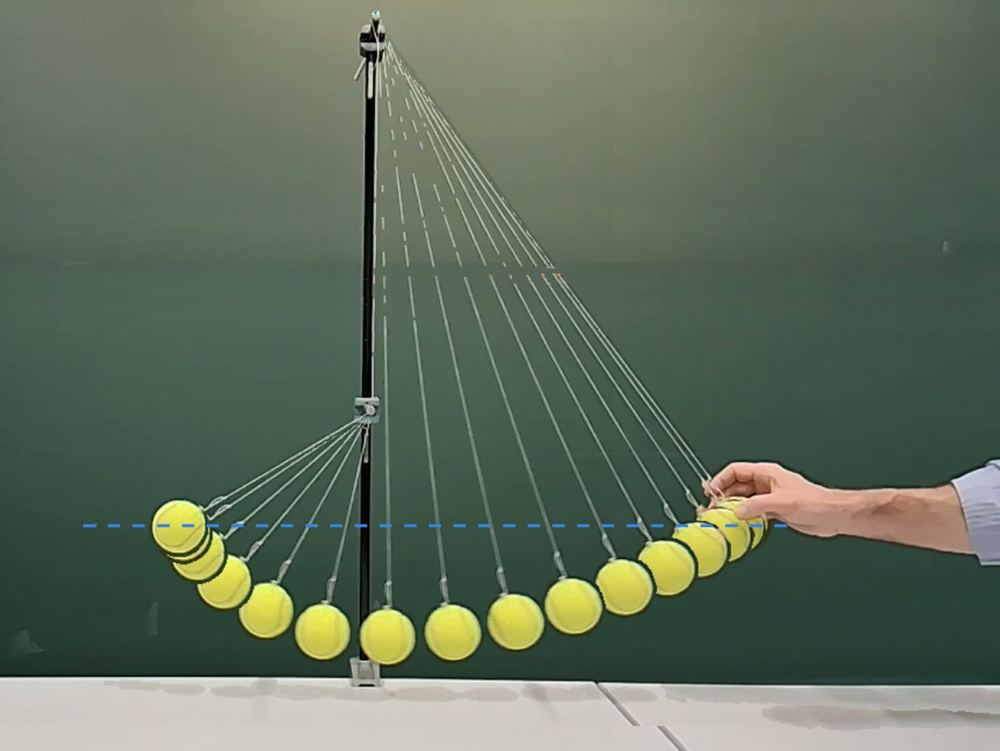
A ball released from the right on a string swings past the bottom and a peg catches the string. It rises to the dashed line, the same height as its start. What principle explains this?
Newton's third law
Conservation of momentum only
The ball gains energy from the peg
Conservation of mechanical energy
With little friction, KE and PE swap while the total stays constant. PE depends only on height, so the ball returns to the same height. A peg changes the path, not the energy.
Image: MikeRun, CC BY-SA 4.0, via Wikimedia Commons.
The cart starts at speed v₀ on the flat and slides up the frictionless curve until it stops momentarily. Which relationship gives the maximum height h₂?
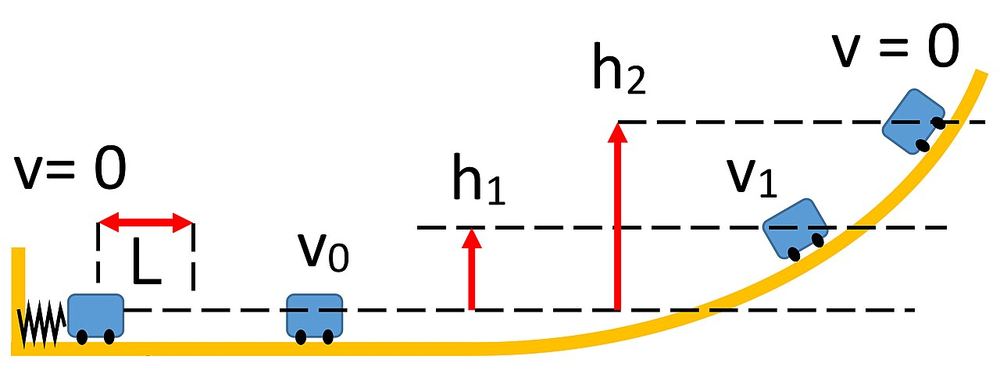
½mv₀² = mgh₂
mv₀ = mgh₂
½mv₀² = gh₂ (mass in only one side)
mv₀² = ½mgh₂
All the initial kinetic energy turns into gravitational potential energy at the top. The mass cancels, so h₂ = v₀²/2g, independent of the cart's mass.
Image: Guy vandegrift, CC BY-SA 3.0, via Wikimedia Commons.
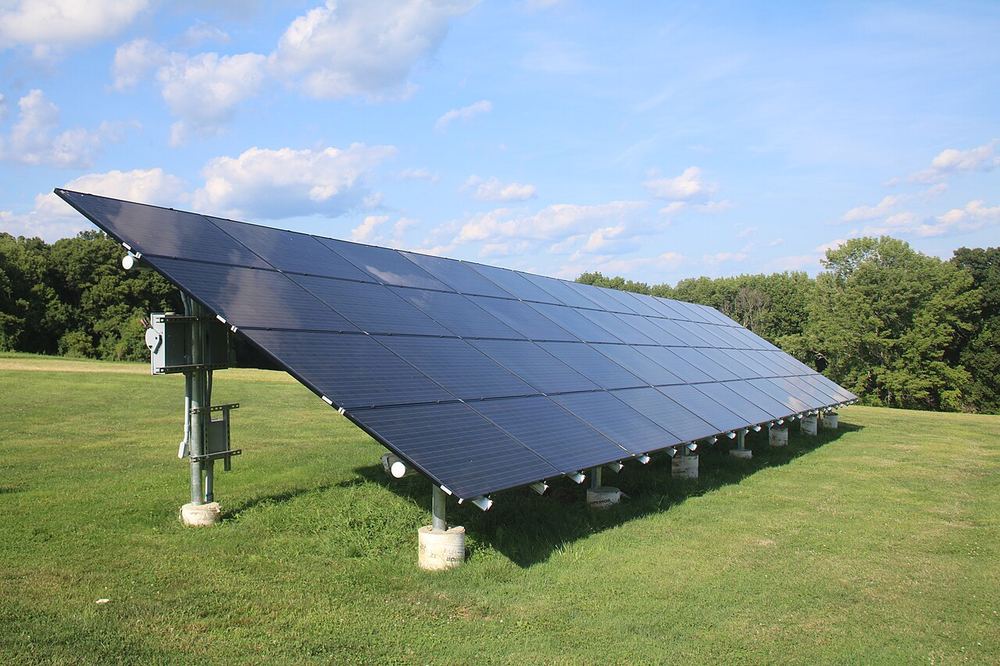
Which energy transformation takes place in a solar panel?
Chemical energy to electrical energy
Thermal energy to kinetic energy
Radiant energy to electrical energy
Kinetic energy to electrical energy
Photovoltaic cells convert light directly into electricity. A battery is chemical to electrical and a generator is kinetic to electrical.
Image: Grendelkhan, CC BY-SA 4.0, via Wikimedia Commons.
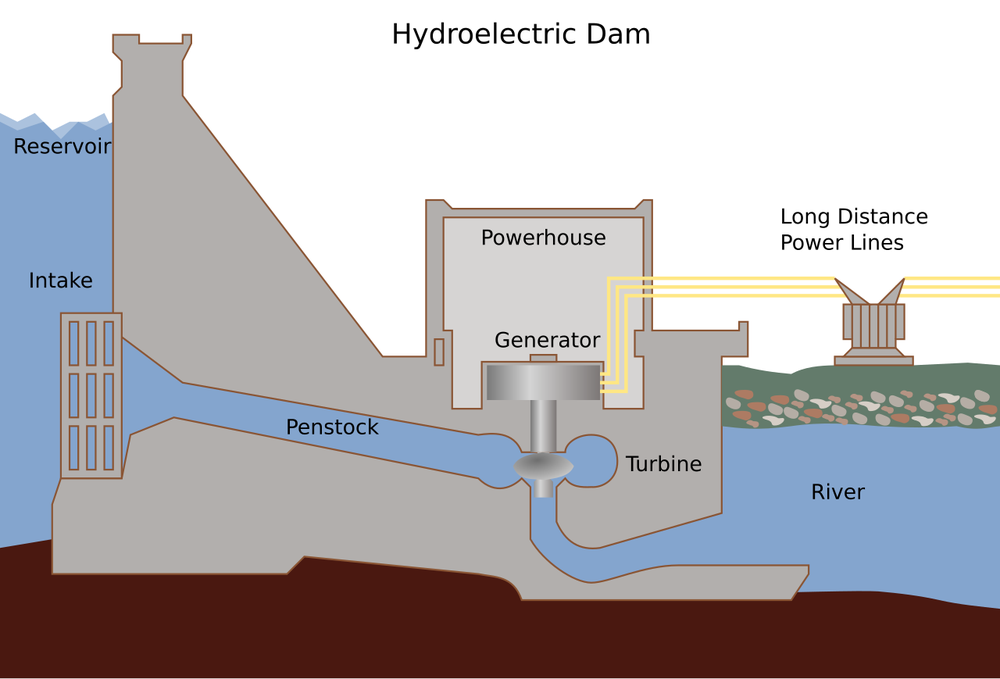
What is the correct energy chain in a hydroelectric dam?
Thermal energy → kinetic energy → electrical energy
Chemical energy → thermal energy → electrical energy
Gravitational PE → kinetic energy → electrical energy
Nuclear energy → thermal energy → electrical energy
Water high in the reservoir has gravitational PE, gains KE falling through the penstock, and its kinetic energy drives the turbine and generator. The other chains describe fossil-fuel and nuclear stations.
Image: Tennessee Valley Authority; SVG version by Tomia, CC BY 2.5, via Wikimedia Commons.
A machine takes in 500 J and gives out 150 J of useful work. What is its efficiency?
30%
70%
3.3%
350%
Efficiency = useful output ÷ total input = 150/500 = 0.30 = 30%. 70% is the fraction wasted. No machine can exceed 100%.
A hoist lifts a load, doing 1200 J of work in 6 s. What is its power?
7200 W
0.005 W
1200 W
200 W
Power = work ÷ time = 1200/6 = 200 W. Multiplying by time would give energy, not power.
A 1.5 kW kettle runs for 4 minutes. How much energy does it use?
6 kJ
360 kJ
6 kWh
360 J
E = Pt = 1500 W × 240 s = 360,000 J = 360 kJ. Remember to convert the time into seconds.
Where does most of the 'lost' energy in an incandescent light bulb end up?
As sound
As thermal energy (heat)
As chemical energy in the filament
As kinetic energy of the glass
Only a small fraction of the electrical energy becomes light; most becomes heat, which is why bulbs are hot and LEDs are far more efficient.
Which of the following is a nonrenewable energy source?
Geothermal heat
Wind
Biomass grown on a managed farm
Natural gas
Natural gas is a fossil fuel formed over millions of years and cannot be replaced on a human timescale. The other three are renewable (biomass if regrown).
The Sun produces energy mainly by which process?
Nuclear fusion of hydrogen into helium
Nuclear fission of uranium
Burning of hydrogen in oxygen
Chemical reactions of carbon
Fusion in the core turns mass into energy (E = mc²). Fission splits heavy nuclei and is used in nuclear power stations on Earth.
Which method of heat transfer can occur through a vacuum?
Conduction
Convection
Radiation
All three equally
Radiation travels as electromagnetic waves and needs no medium, which is how sunlight reaches Earth. Conduction and convection need matter.
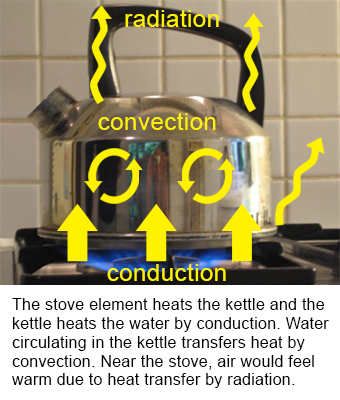
In the photo of a kettle on the hob, the circulation of heated water inside the kettle is an example of which heat transfer method?
Conduction
Radiation
Convection
Insulation
Warmer water is less dense and rises while cooler water sinks, creating a convection current. The bottom is heated by conduction.
Image: P.wormer, CC BY-SA 3.0, via Wikimedia Commons.
You hold your hands to the side of a campfire and feel warmth. Which method carries heat to your hands?
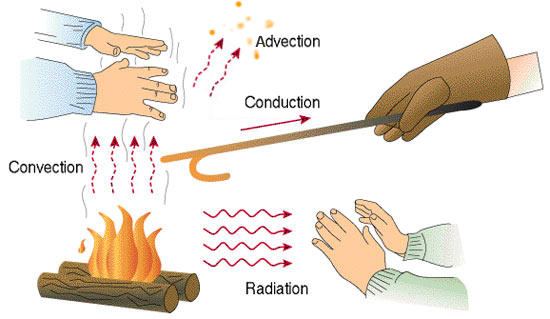
Radiation
Convection
Conduction through the air
Advection of smoke
Warm air rises above the fire (convection) but the sideways heat reaches your hands as infrared radiation. Air is a poor conductor.
Image: Kmecfiunit, cmglee, CC BY-SA 4.0, via Wikimedia Commons.
Why does a metal door handle feel colder than a wooden door on a cold morning, although both are at the same temperature?
Metal is at a lower temperature
Wood is a better conductor of heat
Metal absorbs cold from the air
Metal conducts heat away from your hand faster
They are at the same temperature, but metal's high conductivity takes heat from your skin quickly so it feels colder. Wood is an insulator.
Which has the highest specific heat capacity?
Copper
Water
Sand
Iron
Water's specific heat is about 4186 J/(kg·°C), several times that of metals or sand, so it takes a lot of energy to change its temperature.
How much heat is needed to raise 200 g of water by 5 °C? (c = 4.18 J/g·°C)
209 J
4180 J
836 J
41.8 J
Q = mcΔT = 200 × 4.18 × 5 = 4180 J.
A ball that is thrown upward has the greatest gravitational potential energy at the top of its path.
True
False
At the top the ball is highest, so PE is largest, while KE is momentarily smallest (zero if thrown straight up).
A machine can be more than 100% efficient if it is well designed.
True
False
Energy cannot be created. Some input energy is always dissipated as heat, so efficiency is always below 100%.
Which statement best describes the law of conservation of energy?
Energy is used up when work is done
Energy can be created in nuclear reactions
Kinetic energy always equals potential energy
Energy can be changed from one form to another, but the total amount stays constant
Energy is transformed, not consumed. In nuclear reactions mass is converted into energy, but mass-energy together is still conserved.
