Quiz · Medium
Foundational questions on macromolecules, bonds, water and basic enzyme behavior.
Which structure level is stabilized by hydrogen bonds between backbone atoms?
Tertiary
Secondary
Primary
Quaternary
Alpha helices and beta sheets form by backbone hydrogen bonding. Tertiary involves R groups.
Which pair is correctly matched?
Purine: uracil
Pyrimidine: guanine
Pyrimidine: cytosine
Purine: thymine
Purines (A, G) have two rings; pyrimidines (C, T, U) have one ring.
Which reaction joins two amino acids into a dipeptide?
Oxidation, releasing one electron pair
Phosphorylation, using one ATP
Hydrolysis, using one water
Dehydration synthesis, releasing one water
Peptide bonds form by dehydration synthesis. Hydrolysis is the reverse and splits the bond.
A polysaccharide is built from 100 glucose units. How many water molecules are released when it forms?
101
99
100
50
Joining n monomers in a single chain forms n - 1 bonds, each releasing one water.
Which functional group makes a molecule act as an acid?
Amino
Hydroxyl
Carboxyl
Sulfhydryl
The carboxyl group (-COOH) can release H+. The amino group tends to accept H+ and acts as a base.
Which functional group is shown?
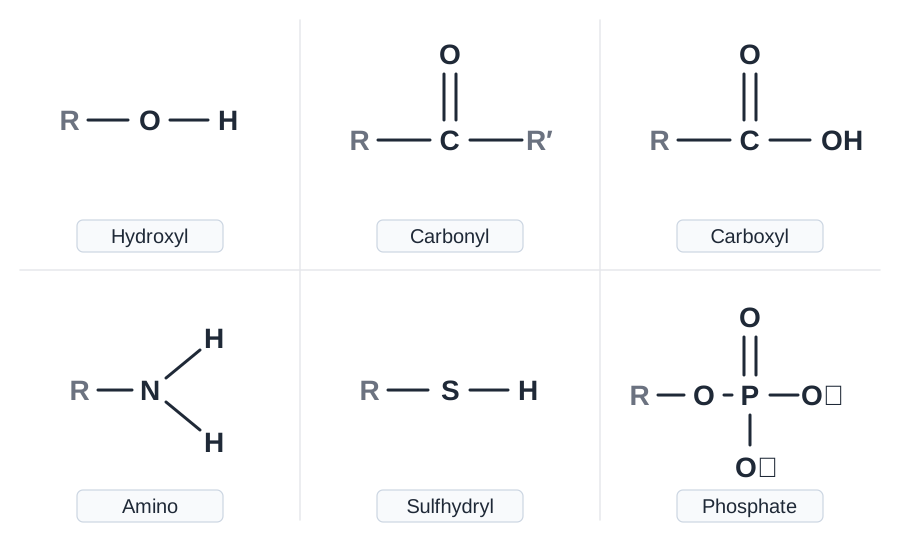
Amino
Sulfhydryl
Carbonyl
Hydroxyl
R-SH is a sulfhydryl; the sulfur distinguishes it from the hydroxyl (R-OH).
Cellulose and starch are both glucose polymers. What is the key difference?
The orientation of the glycosidic linkages (beta vs alpha)
Starch has peptide bonds
Cellulose contains fructose
Cellulose is not a carbohydrate
Humans have enzymes for alpha linkages (starch) but not beta linkages (cellulose).
Which molecule stores glucose in animal cells?
Glycogen
Cellulose
Starch
Chitin
Glycogen is a highly branched glucose polymer in liver and muscle. Starch is the plant version.
What makes a phospholipid amphipathic?
Four fused rings
Three fatty acids on a glycerol
Two identical hydrophobic tails
A hydrophilic head and hydrophobic tails
The head faces water and the tails face away, which creates bilayers.
Compared with saturated fatty acids, unsaturated fatty acids
Have no hydrogens
Are always solid at room temperature
Contain double bonds and have kinks
Are made of amino acids
Double bonds create kinks that prevent tight packing, so unsaturated fats are usually liquid.
Which bond links the amino acids in a protein?
Glycosidic bond
Phosphodiester bond
Peptide bond
Ester bond
Phosphodiester bonds are in nucleic acids, glycosidic bonds in carbohydrates, ester bonds in triglycerides.
The R groups of amino acids
Form the peptide bond
Are always hydrophobic
Determine each amino acid's chemical properties
Are identical in all amino acids
All amino acids share the same backbone; the R group is the only difference.
Which bond is broken when a protein is denatured by heat?
Weak bonds such as hydrogen bonds, but not the peptide bonds
Peptide bonds
Covalent bonds in the amino acids
Phosphodiester bonds
Denaturation changes shape without breaking the primary structure.
Water has a high specific heat mainly because
Water has covalent bonds that break easily
Water is nonpolar
Hydrogen bonds absorb heat before molecules speed up
Water has low density
Many hydrogen bonds must be broken to raise the temperature, buffering climates and cells.
What does an enzyme change about a reaction?
The free-energy difference between reactants and products
The amount of product at equilibrium
The activation energy
The equilibrium position
Catalysts lower the energy barrier. They do not change ΔG or the equilibrium.
The graph shows enzyme activity at different temperatures. What happens past the peak?
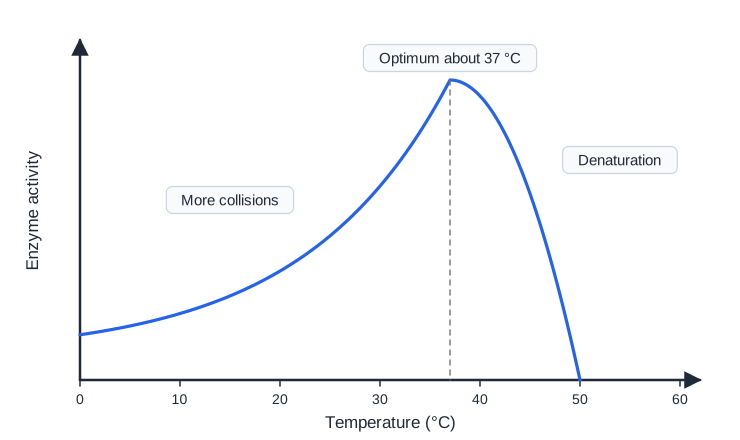
The enzyme denatures
The substrate runs out
The enzyme becomes an inhibitor
Collisions stop
Heat disrupts weak bonds that maintain the active site.
An enzyme works best at pH 2. Where would you most likely find it?
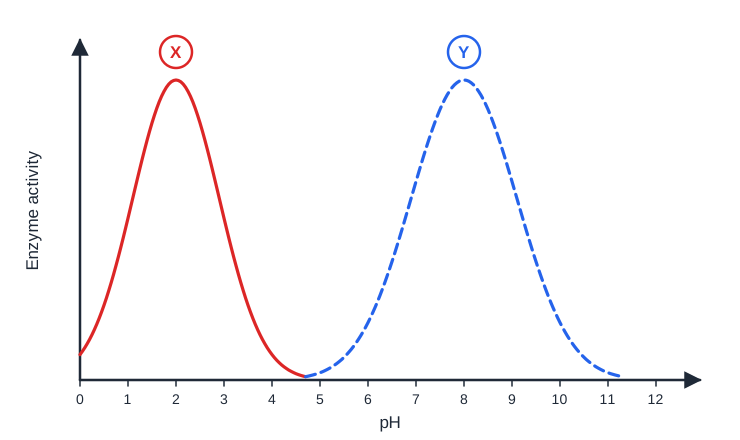
In the small intestine
In the cytoplasm of a muscle cell
In the stomach
In blood plasma
Stomach acid has a pH around 2. Intestinal enzymes work around pH 8 and most cellular enzymes near 7.
In a competitive inhibition experiment, adding much more substrate
Permanently destroys the enzyme
Has no effect at all
Makes the inhibitor allosteric
Can restore the maximum rate
The substrate outcompetes the inhibitor for the active site, so Vmax is reached.
True or false: Lipids are polymers made of identical repeating monomers.
True
False
Lipids are not true polymers; they are grouped by being hydrophobic, such as triglycerides built from glycerol and fatty acids.
True or false: DNA strands are held together by hydrogen bonds between bases.
True
False
A pairs with T (2 hydrogen bonds), G pairs with C (3).
Which test turns from blue to orange-red when heated with a reducing sugar?
Iodine test
Sudan III test
Biuret test
Benedict's test
Iodine detects starch, Biuret detects protein, and Sudan III stains lipids.
