Quiz · Medium
Mixed questions on reform, World War I, the Depression and New Deal, World War II, the Cold War and civil rights, with photographs, posters, and a missile-range map.
In the 1912 election, why did Woodrow Wilson win?
Roosevelt and Taft split the Republican vote
He won more than 60% of the popular vote
Debs withdrew
Taft endorsed Wilson
Roosevelt's Progressive Party split the Republican vote, so Wilson won with about 42% of the popular vote.
Which law, passed after Upton Sinclair's The Jungle, required federal inspection of meatpacking plants?
The Pure Food and Drug Act
The Meat Inspection Act (1906)
The Hepburn Act
The Clayton Antitrust Act
The Meat Inspection Act of 1906. The Pure Food and Drug Act passed the same day but focused on food and drug labeling and adulteration.
The Triangle Shirtwaist Factory fire of 1911 (shown) led most directly to
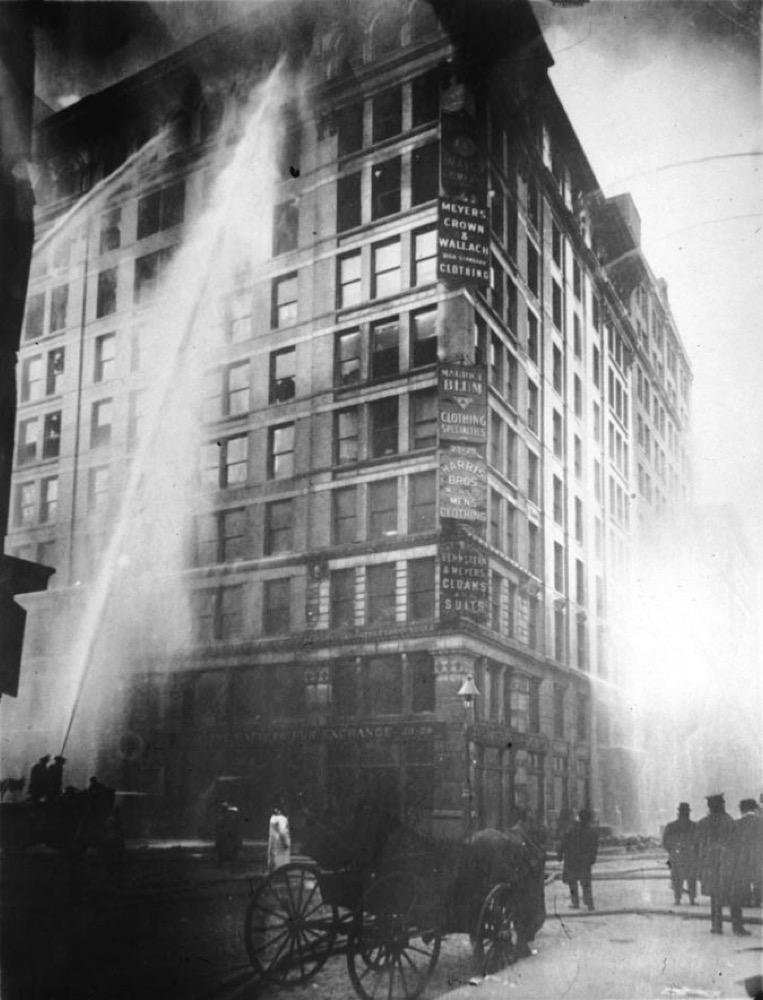
The Sherman Antitrust Act
The creation of the CIO
The end of child labor nationwide
New workplace-safety and fire-code laws
The tragedy, in which 146 workers died, spurred state safety laws and a stronger labor movement. Image: unknown photographer, public domain, via Wikimedia Commons.
Which event most directly led the US to enter World War I in April 1917?
The sinking of the Maine
The attack on Pearl Harbor
The Zimmermann Telegram and unrestricted German submarine warfare
The Treaty of Versailles
Germany's resumption of unrestricted submarine warfare and the Zimmermann Telegram pushed Wilson to ask for war. The Maine (1898) was the Spanish-American War; Pearl Harbor was 1941.
What was the purpose of this 1917 poster?
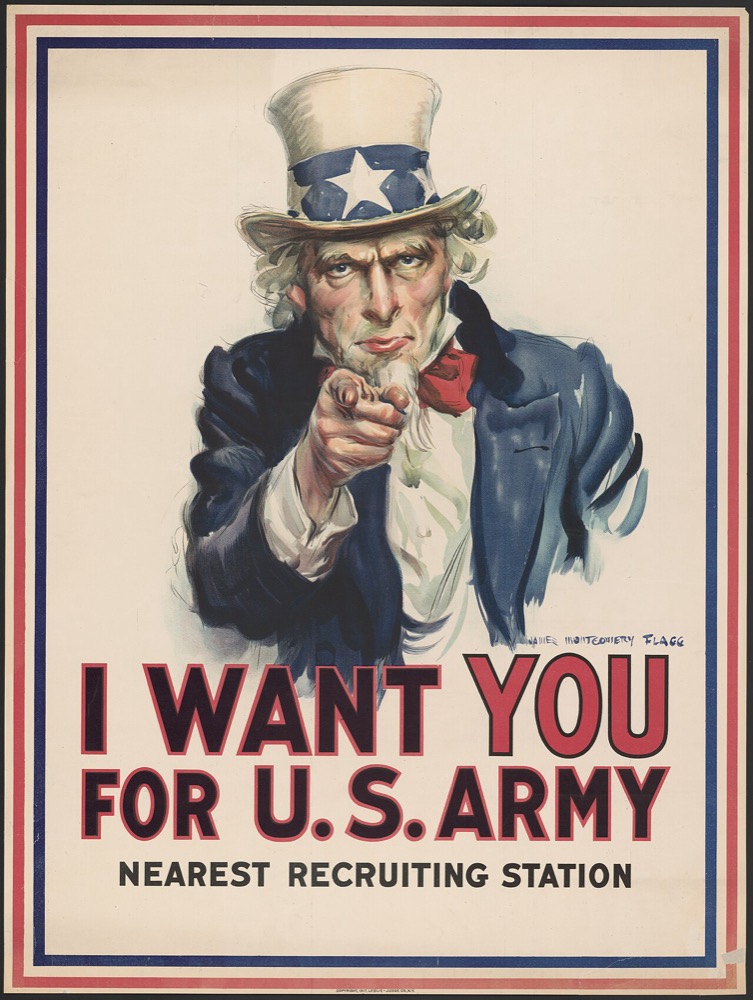
Encouraging immigration
Selling war bonds in World War II
Recruiting soldiers for World War I
Promoting Prohibition
James Montgomery Flagg's "I Want YOU for U.S. Army" recruited soldiers for World War I. Image: public domain, via Wikimedia Commons.
Why did the US Senate refuse to ratify the Treaty of Versailles?
Opponents feared the League of Nations would limit Congress's power to declare war
Wilson refused to sign it
The treaty did not include the League
Britain rejected it first
Lodge and the reservationists objected to Article 10; Wilson refused to compromise, and the treaty failed in 1919-1920.
Which 1924 law reflected the nativism of the 1920s?
Fordney-McCumber Tariff
Volstead Act
Hepburn Act
National Origins Act (Immigration Act of 1924)
The Immigration Act of 1924 set quotas that favored Northern and Western Europeans and barred most Asians. The Volstead Act enforced Prohibition.
Which was a cause of the Great Depression?
Excessive government spending on social programs
Unequal distribution of wealth, heavy margin buying, bank failures, and the Smoot-Hawley Tariff
The cost of World War II
A huge decline in imports
Weak demand from unequal income, speculative credit, bank failures, and the tariff all contributed. Government spending was low in the 1920s, and WWII came after the Depression.
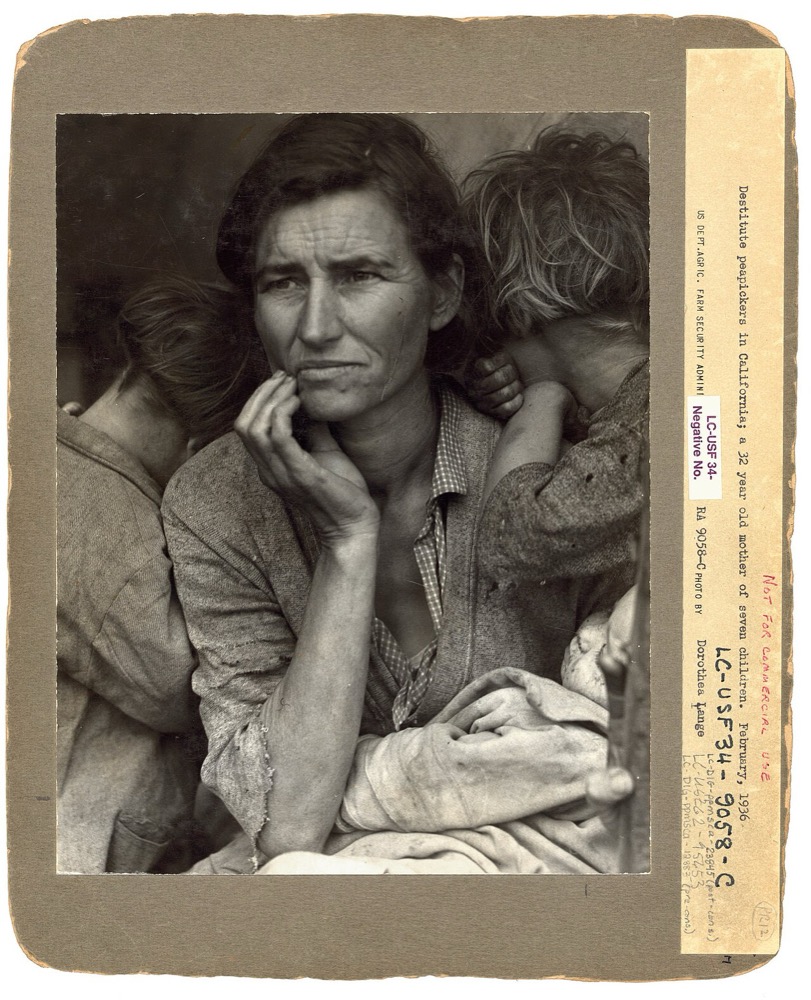
This 1936 photograph by Dorothea Lange is most associated with which topic?
The Spanish-American War
Poverty and migration during the Great Depression
The Gilded Age
Postwar suburbs
"Migrant Mother" became an icon of Depression-era poverty and migrant farm workers, made for the Farm Security Administration. Image: Dorothea Lange, public domain, via Wikimedia Commons.
Which New Deal program insured bank deposits?
The WPA
The SEC
The TVA
The FDIC, created by the Glass-Steagall Act
The FDIC. The SEC regulates the stock market, the TVA built dams, and the WPA employed people on public works.
Which Supreme Court case struck down the National Industrial Recovery Act in 1935?
Schechter Poultry Corp. v. United States
United States v. Butler
Korematsu v. United States
Brown v. Board of Education
Schechter. Butler (1936) struck down the AAA, so it's a tempting but wrong answer.
FDR's 1937 court-packing plan was
An amendment limiting the Court's term
Passed by Congress but later ruled invalid
An attempt to add justices to the Supreme Court that failed
A plan to impeach Justice Hughes
Congress rejected it. It cost FDR political capital even though the Court began upholding New Deal laws.
What was the main significance of the Battle of Midway (1942)?
It forced Germany to surrender
It opened the Western Front in Europe
It turned the tide in the Pacific by destroying four Japanese carriers
It was the first use of the atomic bomb
Midway ended Japan's offensive power in the Pacific. D-Day (1944) opened the Western Front.
This photograph by Ansel Adams shows a camp for which group in World War II?
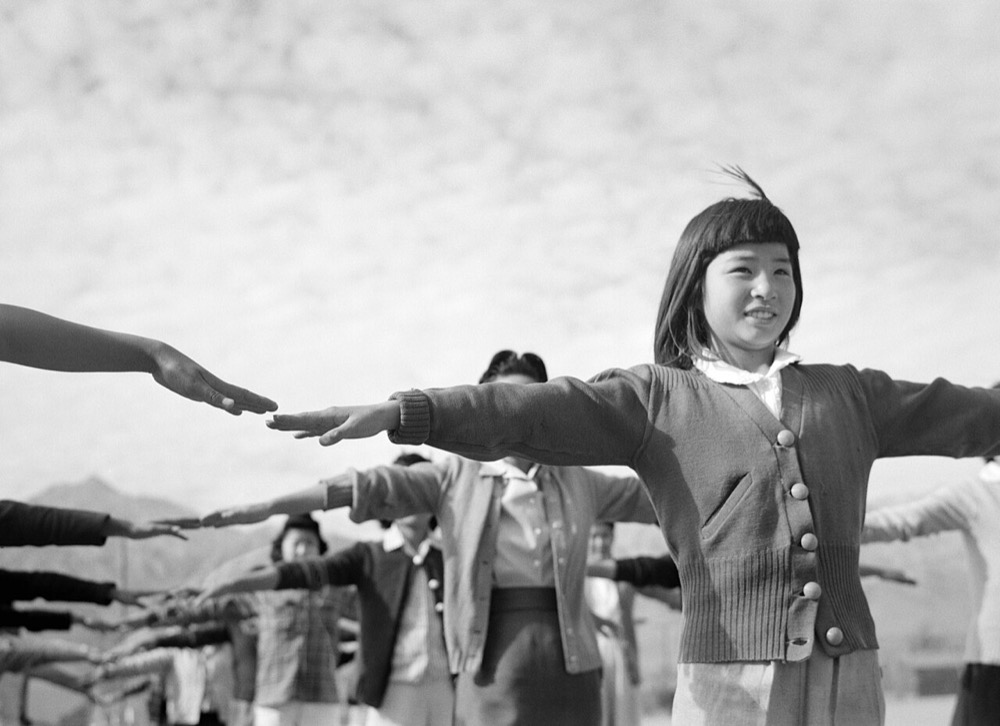
Japanese Americans held after Executive Order 9066
German prisoners of war
Conscientious objectors
Italian immigrants
Manzanar was one of ten War Relocation Authority camps where about 120,000 people of Japanese ancestry were held. Image: Ansel Adams, public domain, via Wikimedia Commons.
Which Supreme Court case upheld the internment of Japanese Americans?
Gideon v. Wainwright
Plessy v. Ferguson
Schenck v. United States
Korematsu v. United States
Korematsu (1944). Schenck (1919) concerned speech in wartime; Plessy (1896) upheld segregation.
This map shows the reach of Soviet missiles and bombers from Cuba. The crisis it relates to was resolved when
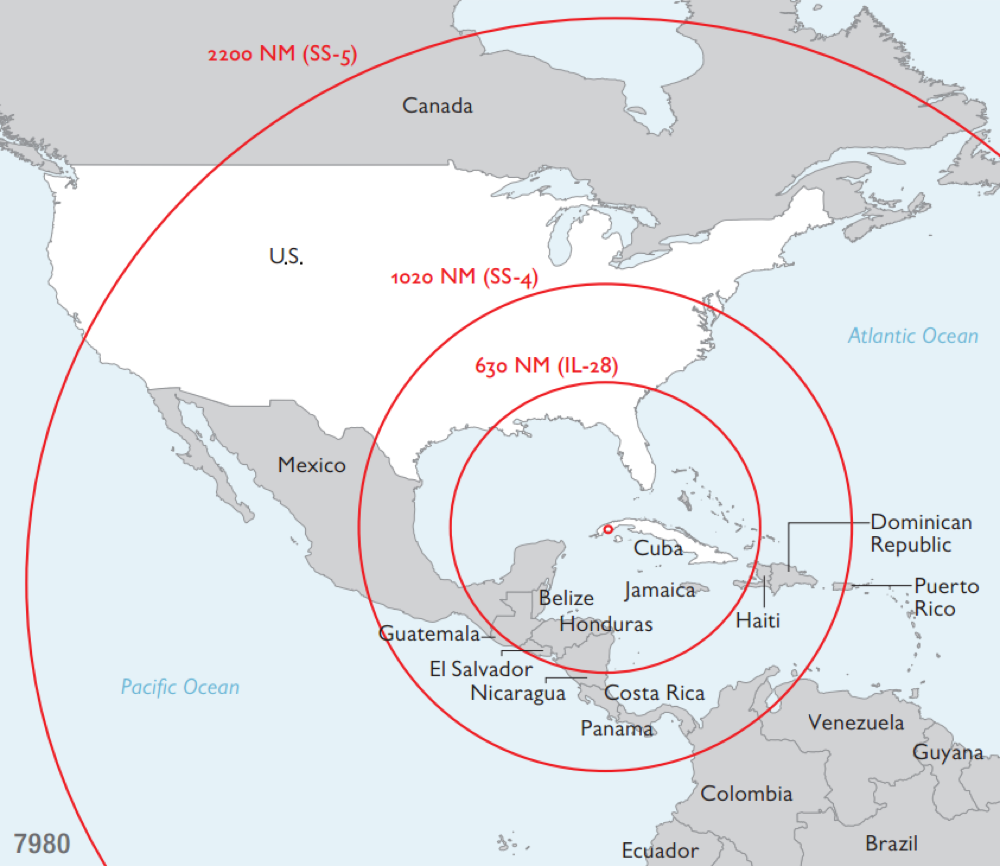
The US invaded Cuba
The Soviets removed their missiles in exchange for a US promise not to invade Cuba
Castro surrendered
The United Nations imposed sanctions
Khrushchev withdrew the missiles; Kennedy pledged not to invade Cuba and secretly agreed to remove missiles from Turkey. Image: US Defense Intelligence Agency, public domain, via Wikimedia Commons.
The policy of containment was first outlined in
The Marshall Plan speech
George Kennan's Long Telegram
Eisenhower's farewell address
The Monroe Doctrine
Kennan's 1946 telegram and 1947 "X" article laid out containment. The Truman Doctrine and Marshall Plan put it into practice.
What did the Supreme Court decide in Brown v. Board of Education (1954)?
Private schools must integrate
Racial segregation in transportation is legal
States must integrate within one year
Segregated public schools are inherently unequal
Brown overturned "separate but equal" in public education. It did not set a deadline (Brown II said "all deliberate speed").
This photograph from 1957 shows a student walking toward which school?
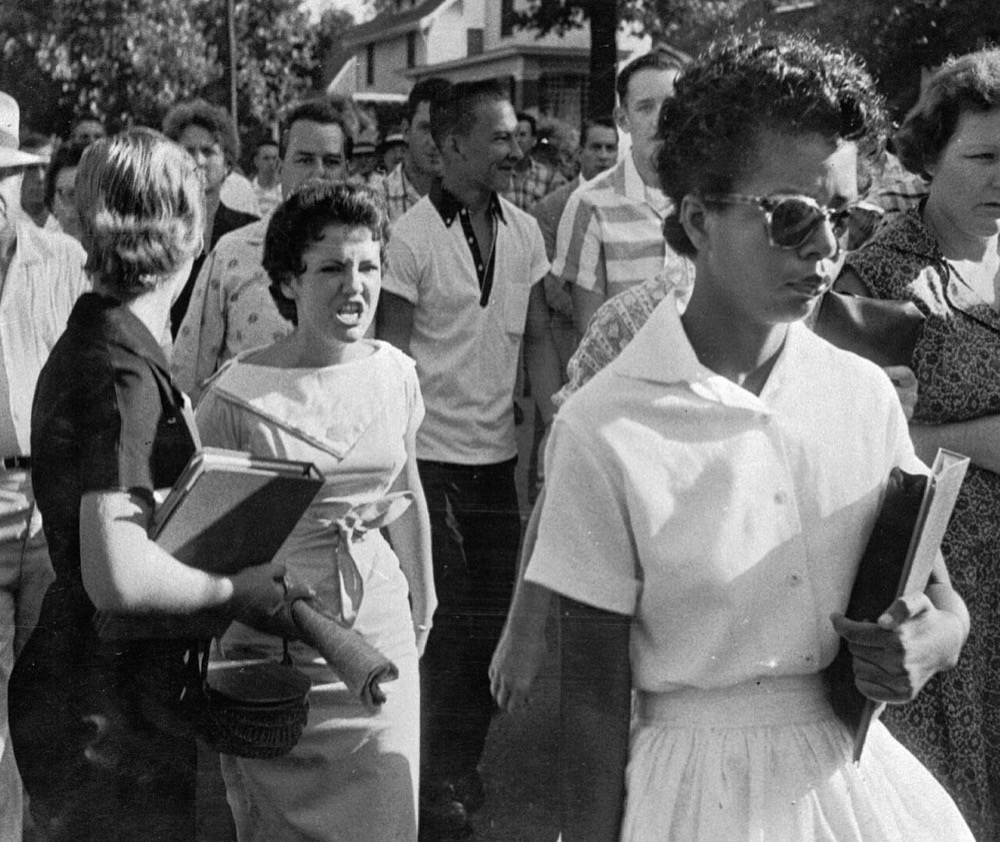
Little Rock Central High School
Selma High School
Birmingham Municipal School
Greensboro Elementary
Elizabeth Eckford was blocked from entering Little Rock Central High by the Arkansas National Guard. Image: Will Counts, public domain, via Wikimedia Commons.
Which event directly led to passage of the Voting Rights Act of 1965?
The Montgomery Bus Boycott
The March on Washington
The Selma to Montgomery march and Bloody Sunday
The Watts riots
The violence at Selma convinced Johnson to ask for voting rights legislation. The March on Washington (1963) helped pass the Civil Rights Act of 1964.
The War Powers Resolution (1973) was passed in reaction to
Watergate break-in
The Cuban Missile Crisis
The Vietnam War
The Iran hostage crisis
It limited presidential war-making after Vietnam. Watergate was a related but separate scandal.
Which event in 1989 symbolized the end of the Cold War in Europe?
The fall of the Berlin Wall
The Cuban Missile Crisis
The Soviet launch of Sputnik
The Korean armistice
The Berlin Wall fell on November 9, 1989; the USSR dissolved in 1991.
True or false: Franklin Roosevelt's New Deal ended the Great Depression on its own before World War II began.
True
False
False. The New Deal brought relief and reform, but unemployment was still high in 1939; wartime production ended the Depression.
