Quiz · Hard
Fifteen applied questions: gravimetric and titrimetric calculations, calibration, statistical tests, resolution and method choice.
A 0.5000 g sample of an impure NaCl is dissolved and excess AgNO3 gives 0.9840 g AgCl (M = 143.32 g/mol). What is the mass percent Cl in the sample?
97.4%
68.7%
48.7%
24.3%
n(AgCl) = 0.9840/143.32 = 6.866 × 10⁻³ mol = n(Cl⁻). Mass Cl = 6.866 × 10⁻³ × 35.45 = 0.2434 g; 0.2434/0.5000 = 48.7%. (24.3% would come from halving the result, 97.4% from doubling it.)
25.00 mL of vinegar is titrated with 0.1000 M NaOH; the end point is at 31.20 mL. What is the molarity of acetic acid (1:1)?
0.1248 M
0.0801 M
0.3120 M
1.248 M
n(NaOH) = 0.03120 × 0.1000 = 3.120 × 10⁻³ mol = n(HAc); M = 3.120 × 10⁻³ / 0.02500 = 0.1248 M. 0.0801 M comes from inverting the volume ratio.
A calibration of absorbance against concentration (mg/L) gives A = 0.0450c + 0.010. A sample absorbs 0.505. What is c?
12.3 mg/L
0.0225 mg/L
11.2 mg/L
11.0 mg/L
c = (A − b)/m = (0.505 − 0.010)/0.0450 = 11.0 mg/L. Forgetting the intercept would give 11.2 mg/L.
A 5.00 mL aliquot of a stock is diluted to 250.0 mL and measured at 0.84 mg/L. What is the stock concentration?
0.017 mg/L
4.2 mg/L
42 mg/L
16.8 mg/L
Dilution factor = 250.0/5.00 = 50. 0.84 × 50 = 42 mg/L.
Replicate results: 10.1, 10.3, 10.2, 10.2. Which is the sample standard deviation (n − 1)?
0.20
0.082
0.071
0.10
Mean = 10.20. Deviations: −0.1, 0.1, 0, 0 → squares sum 0.02. s = √(0.02/3) = 0.0816 ≈ 0.082. Dividing by n would give 0.071, which is the population SD.
A new method is checked against a certified reference material. Which test is used to see whether the mean differs significantly from the certified value?
F-test
Q-test
Chi-square on variances
One-sample t-test
Compare the sample mean with the known value using t = |x̄ − μ|√n / s. The F-test compares two variances; the Q-test flags outliers.
An F-test is used to:
Compare two means directly
Reject an outlier
Find the detection limit
Compare the precision (variances) of two methods
F = s1²/s2² (larger over smaller). It is usually done before choosing between pooled and unpooled t-tests.
Four values: 12.1, 12.3, 12.2, 13.5. For the Q-test, Q_calc for 13.5 is:
0.60
1.2
0.86
0.14
Q = gap/range = (13.5 − 12.3)/(13.5 − 12.1) = 1.2/1.4 = 0.857 ≈ 0.86. At n = 4 and 95% confidence Qcrit is 0.829, so it would be rejected.
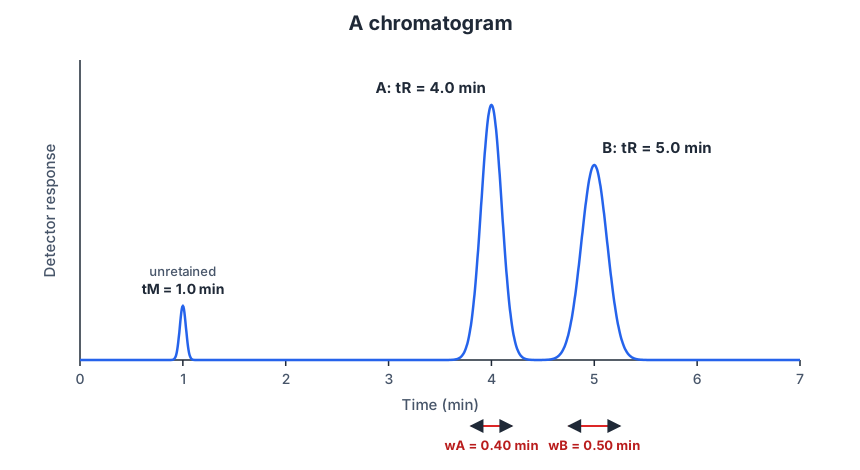
Chromatographic peaks A and B have retention times 4.0 and 5.0 min and baseline widths 0.40 and 0.50 min. Resolution is closest to:
4.4
2.2
1.1
0.9
Rs = 2(5.0 − 4.0)/(0.40 + 0.50) = 2.0/0.90 = 2.2. A value ≥ 1.5 means baseline separation.
Which change improves resolution in HPLC most directly?
Higher plate number (longer or more efficient column)
Injecting more sample
Using a colder detector
Using a shorter wavelength
Resolution depends on efficiency (N), selectivity (α) and retention (k). Overloading the column broadens peaks and worsens resolution.
In reversed-phase HPLC with a C18 column, increasing the percentage of methanol in the mobile phase will:
Decrease retention times
Increase retention times
Have no effect
Reverse the elution order of all peaks
A more organic (less polar) mobile phase competes better with the nonpolar stationary phase, so analytes elute sooner.
A 0.2500 g sample requiring 22.50 mL of 0.1000 M EDTA (1:1) for a metal ion M (M = 65.38 g/mol) has what mass percent of the metal?
0.588%
29.4%
58.8%
5.88%
n = 0.02250 × 0.1000 = 2.250 × 10⁻³ mol; mass = 2.250 × 10⁻³ × 65.38 = 0.1471 g; 0.1471/0.2500 = 58.8%.
A back titration is most appropriate when:
The reaction is instantaneous
The analyte reacts slowly or is insoluble
The analyte is a strong acid
A primary standard is unavailable
An excess of reagent reacts completely with the analyte; the leftover reagent is then titrated. This helps with slow reactions, insoluble solids such as CaCO3, or poor indicators.
The relative standard deviation is 1.5% for a mean of 40.0 mg. What is s?
0.60 mg
2.7 mg
0.015 mg
1.5 mg
%RSD = (s/mean) × 100, so s = 0.015 × 40.0 = 0.60 mg.
In atomic absorption spectroscopy, a hollow cathode lamp is made of the element being analyzed because:
It gives broad white light
It heats the sample
It removes interferences
Atoms absorb light at the same narrow wavelengths they emit
Atomic lines are very narrow, so a source emitting the element's own lines gives selective, sensitive absorption.
A standard addition method is preferred over an external calibration when:
No standards are available
There are matrix effects that change the signal
The sample is very pure
The detector is perfectly linear
Spiking the sample itself means the standards experience the same matrix, so the response slope is correct.
