Quiz · Hard
Exam-level problems: phase shifts, sum and double-angle formulas, trig equations, inverse trig compositions and the ambiguous case.
A triangle has sides 5, 6 and 7. What is its area?
15
21
Heron: s = 9; area = √(9·4·3·2) = √216 = 6√6 ≈ 14.7.
Which equation matches this graph?
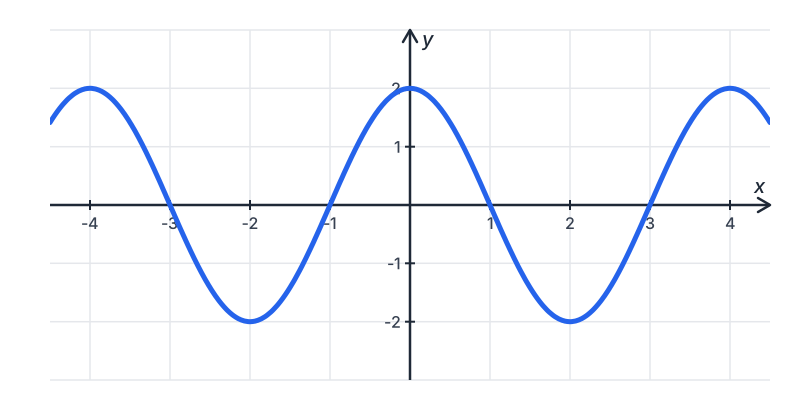
Maximum 2 at x = 0 means cosine with amplitude 2. The period is 4, so B = 2π/4 = π/2. cos(2x) would have period π.
What is the phase shift of ?
to the left
to the left
to the right
to the left
Factor: 4 sin(3(x + π/3)) − 2, a shift of π/3 left. Reading π straight from the equation forgets to divide by B.
Find the exact value of .
cos(60° + 45°) = cos60 cos45 − sin60 sin45 = √2/4 − √6/4. It must be negative because 105° is in QII.
If and θ is in Quadrant III, what is ?
sin θ = −12/13 in QIII. sin 2θ = 2(−12/13)(−5/13) = 120/169, positive because both factors are negative.
How many solutions does have on ?
2
3
4
1
(2 sin x + 1)(sin x − 1) = 0. sin x = 1 gives π/2; sin x = −1/2 gives 7π/6 and 11π/6. Three solutions.
Solve on .
2cos²x − 1 = cos x ⇒ (2cos x + 1)(cos x − 1) = 0 ⇒ cos x = 1 or −1/2.
Evaluate .
arccos(2/3) is an angle in QI with adjacent 2 and hypotenuse 3, so opposite √5. Sine is positive there.
Evaluate .
tan(3π/4) = −1 and arctan(−1) = −π/4, since arctan only returns angles in (−π/2, π/2).
In triangle ABC, A = 40°, a = 6 and b = 8. How many triangles are possible?
None
One
Two
Infinitely many
h = b sin A = 8 sin 40° ≈ 5.14. Since h < a < b (5.14 < 6 < 8), two triangles fit (the SSA ambiguous case).
Two sides of a triangle are 10 and 14 with an included angle of 50°. Which is closest to the third side?
8.2
10.8
12.9
17.2
c² = 100 + 196 − 280 cos 50° ≈ 296 − 180.0 = 116.0, so c ≈ 10.8.
Simplify .
0
1
Multiply the first fraction by (1 + cos θ)/(1 + cos θ): sin θ(1 + cos θ)/sin²θ = (1 + cos θ)/sin θ, which equals the second fraction.
A Ferris wheel's height is h(t) = 30 − 25 cos(πt/4), t in minutes. How long is one revolution?
4 min
8 min
π/4 min
25 min
Period = 2π ÷ (π/4) = 8 minutes. 4 would come from forgetting the 2 in 2π/B.
Which is an identity?
This is the power-reducing formula. sin 2θ = 2 sin θ cos θ; tangent does not distribute; sine is odd.
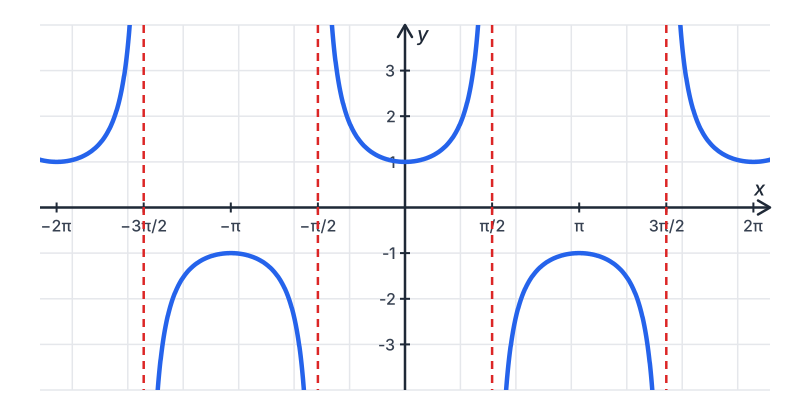
Read the graph: what is sec x at x = π, and where are its asymptotes?
1; at multiples of π
−1; at odd multiples of π/2
0; at multiples of π
Undefined; at odd multiples of π/2
sec π = 1/cos π = −1, the top of a downward U. Asymptotes are where cos x = 0: x = π/2 + kπ.
For , what is the maximum value and where does the first maximum after occur?
4, at
4, at
−2, at
3, at
Max = 1 + 3 = 4. The reflected cosine starts at its minimum at x = π/6, and the maximum comes half a period (π/2) later, at 2π/3.
