Quiz · Medium
Twenty foundation-level questions on vital signs, isolation, PPE, injections, catheters, positioning, pressure injuries and delegation.
Which finding should the nurse report immediately after taking an adult's vital signs?
Blood pressure 82/50 mmHg with HR 124
Pulse 72, regular
Respirations 18
Temperature 37.0 °C
A low BP with tachycardia suggests shock or hypovolemia and needs immediate action. The other values are within normal adult ranges.
When counting the apical pulse for an adult patient, where do you place the stethoscope?
Second intercostal space, right sternal border
Third intercostal space, left sternal border
Fifth intercostal space, left midclavicular line
Fifth intercostal space, right midclavicular line
The apex of the heart (point of maximal impulse) is at the left 5th intercostal space in the midclavicular line. The right 2nd space is the aortic area.
A manual blood pressure cuff that is too small for the patient's arm will cause which result?
A falsely high reading
No change in the reading
A falsely narrow pulse pressure only
A falsely low reading
A cuff that is too small does not compress the artery fully, so more pressure is needed to occlude it and the reading is falsely high. Too large gives falsely low.
The nurse is preparing to remove personal protective equipment after caring for a patient on contact precautions. Which item is removed first?
Gown
Face shield
Gloves
Mask
CDC doffing: gloves first (most contaminated), then goggles or face shield, then gown, then mask last, followed by hand hygiene.
Which patient requires an N95 respirator and a negative-pressure room?
A patient with C. difficile
A patient with measles
A patient with influenza
A patient with MRSA wound infection
Measles, TB and varicella are airborne. Influenza is droplet; MRSA and C. difficile are contact (and C. diff needs soap and water, not alcohol rub).
When should the nurse use soap and water instead of alcohol-based hand rub?
After applying lotion
After touching intact skin
Before entering the room of any patient
When caring for a patient with C. difficile
Alcohol does not kill C. difficile spores. Soap and water physically remove them. Alcohol rub is otherwise preferred if the hands are not visibly soiled.
Which statement about confirming nasogastric tube placement is correct?
Listen over the stomach while injecting air
Gastric pH of 5.5 or less and x-ray are used to confirm placement
Placing the end of the tube in water and looking for bubbles confirms placement
A patient who can speak has a correctly placed tube
X-ray is the gold standard and gastric aspirate pH of 5.5 or less supports it. The air-whoosh test is unreliable, bubbling can mean the tube is in the lungs, and a tube can be in the airway even if the patient speaks.
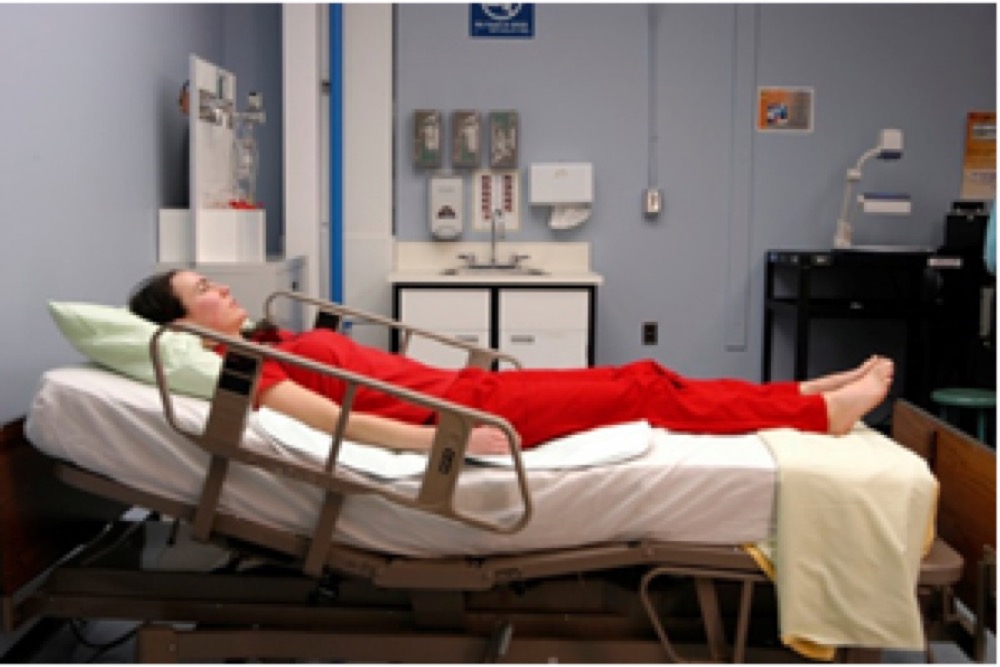
The picture shows a patient with the head of the bed raised about 30 to 45 degrees. Which position is this?
Trendelenburg
Sims'
Supine
Semi-Fowler's
Semi-Fowler's is 30 to 45 degrees. Trendelenburg is head-down, Sims' is lateral semi-prone, supine is flat on the back.
Image: Glynda Rees Doyle and Jodie Anita McCutcheon, CC BY 4.0, via Wikimedia Commons.
Which image shows the Trendelenburg position?
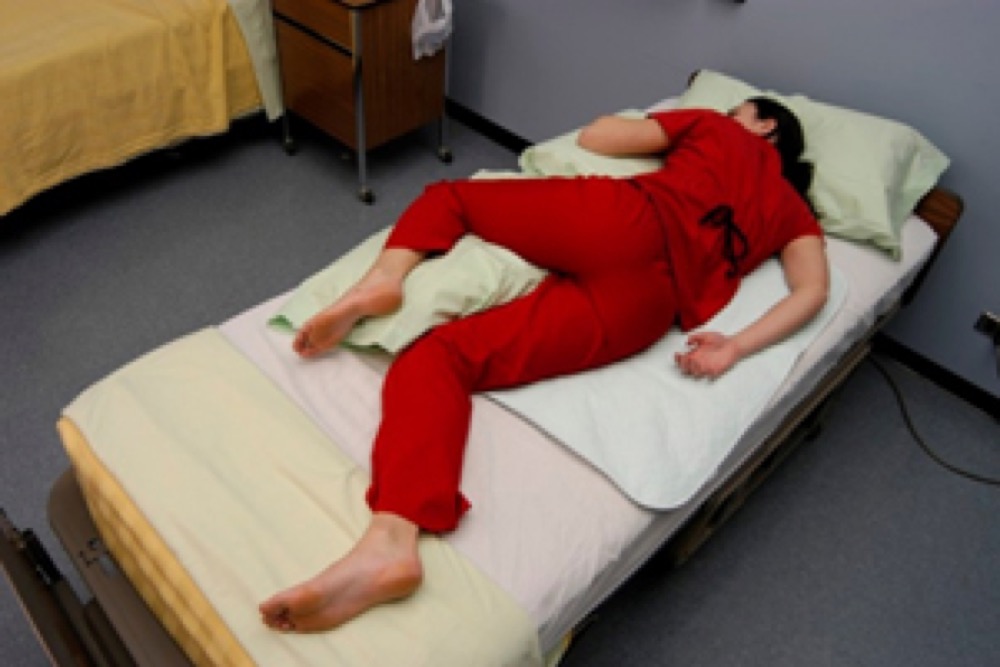
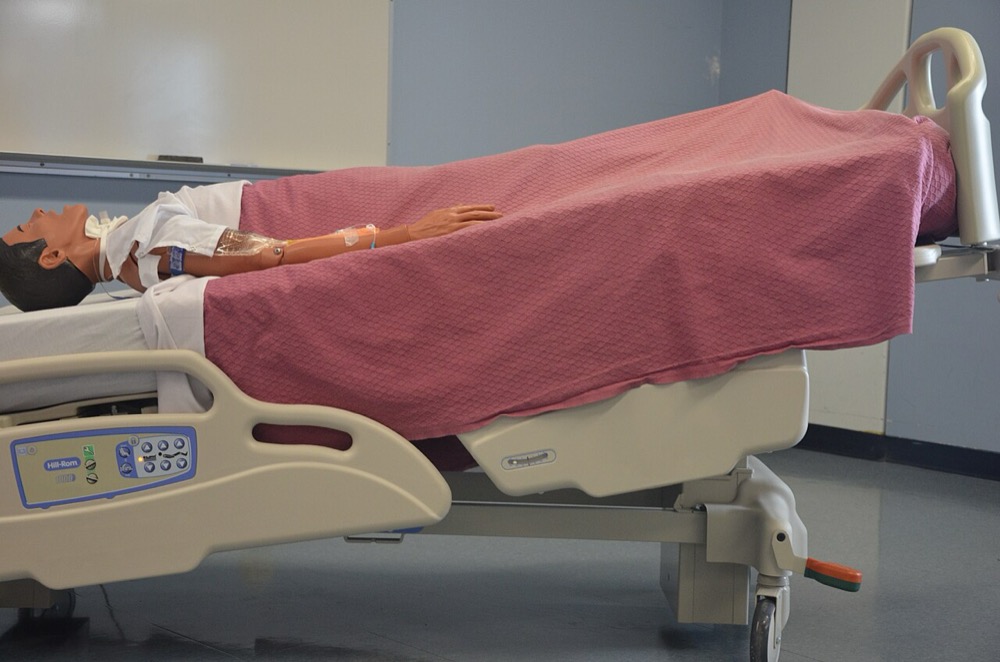
Trendelenburg tilts the head down with feet higher. The first image is semi-Fowler's and the second is Sims' position.
Images: Glynda Rees Doyle and Jodie Anita McCutcheon, CC BY 4.0, via Wikimedia Commons.
A nurse is giving an intramuscular injection into an adult. Which angle is correct?
90 degrees
45 degrees
10 degrees
15 degrees
IM injections go in at 90 degrees. 5 to 15 degrees is intradermal and 45 to 90 degrees is subcutaneous.
In which order should the nurse draw up regular insulin and NPH insulin in the same syringe?
Never mix them
NPH first, then regular
Regular first, then NPH
Either order is acceptable
Clear before cloudy: regular insulin first, then NPH, to avoid contaminating the regular vial with NPH.
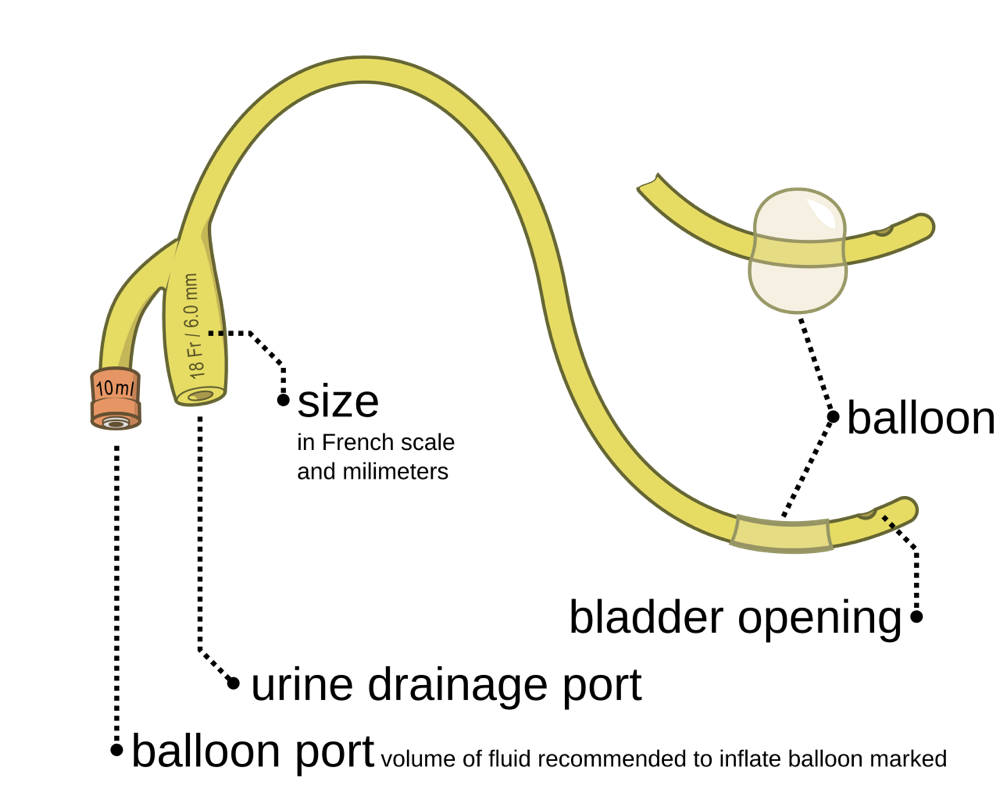
What should be used to inflate the balloon of an indwelling urinary catheter?
Sterile water
Tap water
0.9% sodium chloride
Air
Use sterile water: saline can crystallize and block the balloon channel so it will not deflate. Never air, never tap water.
Image: Olek Remesz (wiki-pl: Orem, commons: Orem), CC BY-SA 3.0, via Wikimedia Commons.
Which abbreviation is on The Joint Commission's 'Do Not Use' list?
mg
mL
prn
U
U for unit can be mistaken for 0 or 4. Write 'unit'. Other examples: IU, QD, QOD, trailing zeros, lack of leading zeros, MS, MSO4, MgSO4.
Which patient is at highest risk for pressure injury according to the Braden Scale?
Score 22
Score 9
Score 19
Score 16
Lower Braden scores mean higher risk. 18 or less is at risk, 9 or less is very high risk.
A nurse notes non-blanchable redness over the patient's sacrum with intact skin. What stage is this?
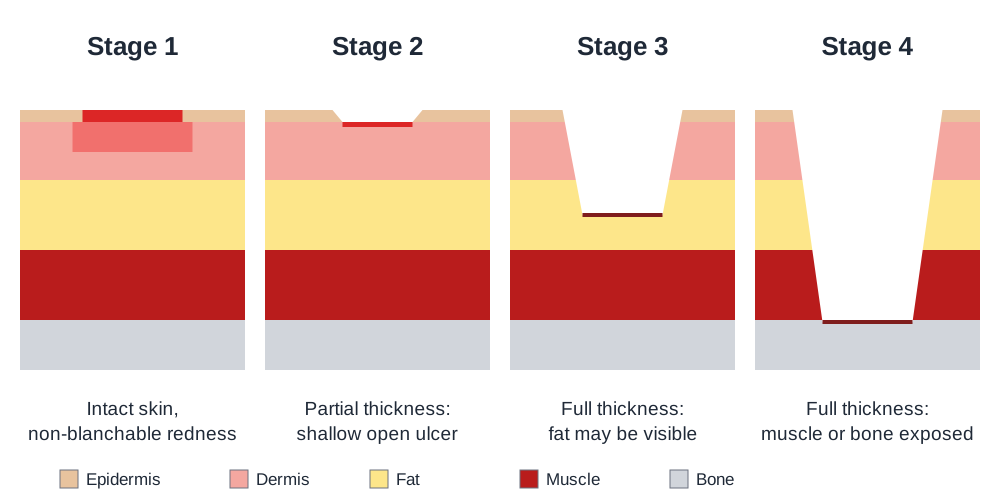
Stage 3
Unstageable
Stage 2
Stage 1
Stage 1 is intact skin with non-blanchable redness. Stage 2 has partial-thickness skin loss (dermis exposed).
Which task can the RN delegate to a nursing assistant?
Teaching a new insulin regimen
Taking vital signs on a stable patient
Evaluating the response to pain medication
Initial admission assessment
Vital signs on a stable patient are routine. Assessment, teaching and evaluation are RN responsibilities.
Which patient should the nurse assess first?
A patient with a new onset of wheezing and a respiratory rate of 32
A patient with chronic back pain rated 4/10
A patient due for a scheduled dressing change
A patient who needs help with a bath
Airway and breathing are the priority (ABCs). New acute respiratory distress outranks the scheduled, stable, or chronic problems.
Which is the best way to evaluate a patient's understanding of discharge teaching?
Ask the family if they understood
Ask 'Do you understand?'
Ask the patient to explain the plan in their own words (teach-back)
Give the patient a pamphlet
Teach-back shows actual understanding. A yes/no question or a pamphlet does not verify learning.
A nurse is giving a drug that requires a Z-track technique. What should the nurse do?
Pull the skin to one side, inject, wait about 10 seconds, then release the skin
Massage the site afterward
Inject at a 15 degree angle
Inject into the deltoid only
Z-track seals the drug in the muscle and prevents tracking into the subcutaneous tissue. Do not massage the site.
The pulse oximeter reads 99% on a patient who was exposed to smoke in a fire. What should the nurse do?
Document the finding and reassess in 4 hours
Decrease the oxygen
Recognize that carbon monoxide can give a falsely normal reading and obtain an arterial or venous co-oximetry
Remove the oximeter
Standard pulse oximeters cannot tell carboxyhemoglobin from oxyhemoglobin, so SpO2 can look normal in CO poisoning. Give 100% oxygen and get a co-oximetry level.
