Quiz · Hard
Identify the right model, check conditions and compute probabilities, means and standard deviations.
Which is NOT a requirement of a binomial setting?
Each trial has two outcomes
The trials continue until the first success
Trials are independent
Probability of success is constant
Continuing until the first success describes the geometric distribution, not the binomial.
A fair coin is flipped 10 times. The mean number of heads is...
5
10
2.5
0.5
np = 10(0.5) = 5.
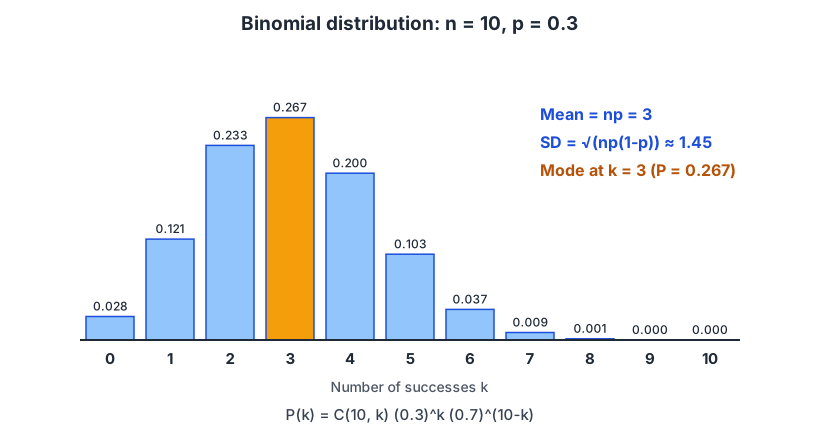
For n = 10, p = 0.3 the most likely number of successes is...
0
5
7
3
The distribution peaks at k = 3 with P = 0.267.
The standard deviation for the binomial with n = 10, p = 0.3 is about...
2.1
3
1.45
0.21
sqrt(10 x 0.3 x 0.7) = sqrt(2.1) ≈ 1.45.
The probability of at least one success in 5 trials with p = 0.2 is...
0.328
0.672
0.2
1.0
1 - 0.8^5 = 0.672.
A multiple-choice quiz has 5 questions with 4 options each. A student guesses all. P(all 5 correct) is...
(1/4)^5 ≈ 0.001
5/4
1/20
0.25
Independent guesses: 0.25^5 = 0.000977.
Sampling 30 cards without replacement from a deck to count hearts violates which binomial condition?
Binary outcomes
A fixed number of trials
Counts being whole numbers
Independence
Without replacement the probabilities change and the trials are dependent (30 is far more than 10% of 52).
Which situation is geometric?
Counting 6s in 20 rolls
Counting how many items out of 50 are defective
Counting rolls of a die until the first 6
Measuring the height of a student
A geometric variable counts trials until the first success.
For p = 0.2, the expected number of trials until the first success is...
0.2
5
4
10
The mean of the geometric distribution is 1/p = 5.
Which situation best fits a Poisson model?
The number of typos on a randomly chosen page, averaging 2 per page
The number of heads in 10 flips
The height of a randomly chosen adult
The time until the next bus
Rare independent events in a fixed interval with a constant rate.
For a Poisson random variable with lambda = 4, the standard deviation is...
4
16
sqrt(2)
2
Variance = lambda = 4, so sd = 2.
Calls arrive at an average of 3 per hour. P(no calls in an hour) =
3e^-3
0.333
e^-3 ≈ 0.050
1 - e^-3
Poisson P(0) = e^(-lambda) = 0.0498.
X is uniform on [0, 10]. What is P(2 < X < 6)?
0.2
0.4
0.6
0.04
Width 4 times density 1/10 = 0.4.
The waiting time between calls in a Poisson process (rate 0.5 per minute) follows which distribution?
Exponential with mean 2 minutes
Poisson with mean 0.5
Uniform
Normal with mean 0.5
Exponential with lambda = 0.5 has mean 1/lambda = 2.
The memoryless property of the exponential distribution means...
The mean equals the variance
The distribution is symmetric
Values must be integers
The remaining wait does not depend on how long you have already waited
P(X > s + t | X > s) = P(X > t).
In 100 flips of a fair coin, which model best approximates the number of heads?
Normal with mean 50 and sd 25
Uniform from 0 to 100
Normal with mean 50 and sd 5
Poisson with mean 100
np = 50 and sqrt(np(1-p)) = 5; both np and n(1-p) exceed 10.
Which pair of mean and variance identifies a Poisson distribution?
Variance is the square of the mean
Mean equals variance
Variance is 1/mean
Mean is 0
For Poisson both equal lambda.
A pdf curve has height 0.4 at one point. What does this tell you?
Nothing is wrong: height is a density, and only area gives probability
The probability of that single point is 0.4
The distribution is discrete
The total area exceeds 1
Height is density, not probability. Only areas count.
The mean of a chi-square distribution with 7 degrees of freedom is...
3.5
14
49
7
The mean of a chi-square equals its degrees of freedom.
