Quiz · Medium
Read limits and discontinuities from graphs, evaluate basic limits and check the conditions for continuity.
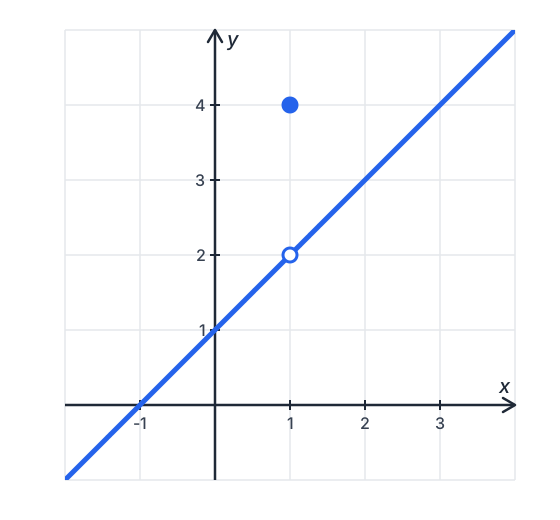
Here f(x) = x + 1 for x ≠ 1 and f(1) = 4. What are lim x→1 f(x) and f(1)?
Limit 4, f(1) = 2
Limit 2, f(1) = 4
Limit 2, f(1) = 2
The limit does not exist
The graph approaches the open circle at (1, 2) from both sides, so the limit is 2. The filled dot is f(1) = 4. The limit ignores the value at the point.
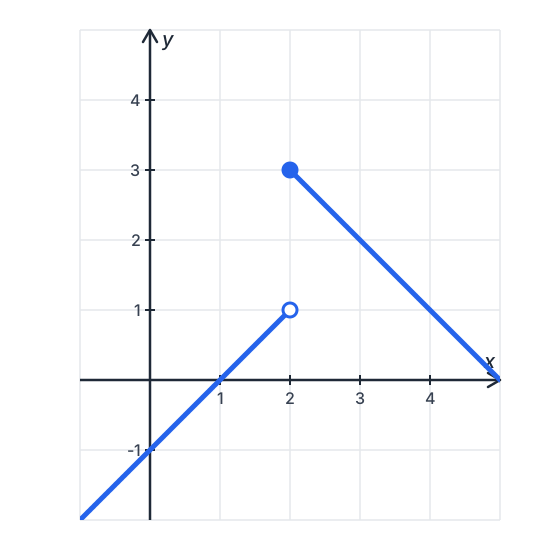
Using the graph, what is the limit as x approaches 2 from the left?
3
2
1
Does not exist
The left piece y = x − 1 approaches 1 at x = 2 (open circle). The filled dot at 3 belongs to the right piece.
Does the two-sided limit at x = 2 exist for the graph shown?
Yes, it equals 3 because f(2) = 3
Yes, it equals 1
Yes, it equals 2 (the average)
No, the one-sided limits are different
Left limit 1, right limit 3. The two-sided limit exists only if they agree. f(2) = 3 does not matter.
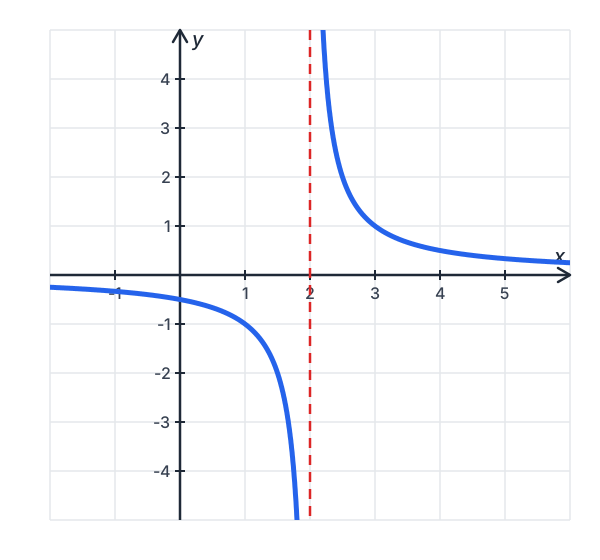
For f(x) = 1/(x − 2), what is the limit as x approaches 2 from the right?
+∞
−∞
0
2
For x slightly bigger than 2, x − 2 is a small positive number, so 1/(x − 2) is huge and positive.
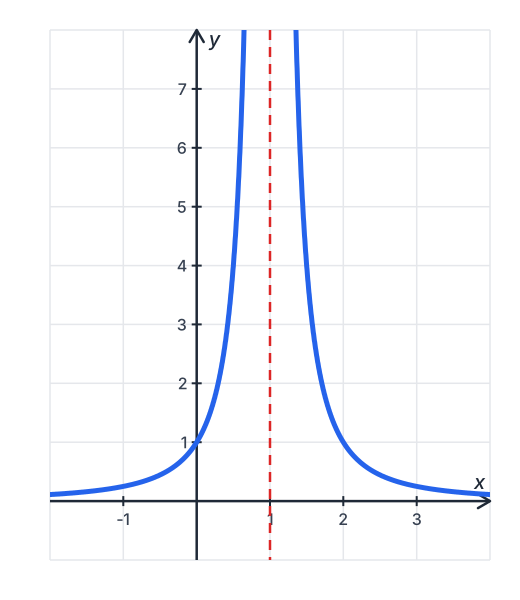
For f(x) = 1/(x − 1)², what is lim x→1 f(x)?
−∞
∞
0
1
The square makes the denominator positive from both sides, so f grows without bound upward. The limit is ∞ (a vertical asymptote at x = 1).
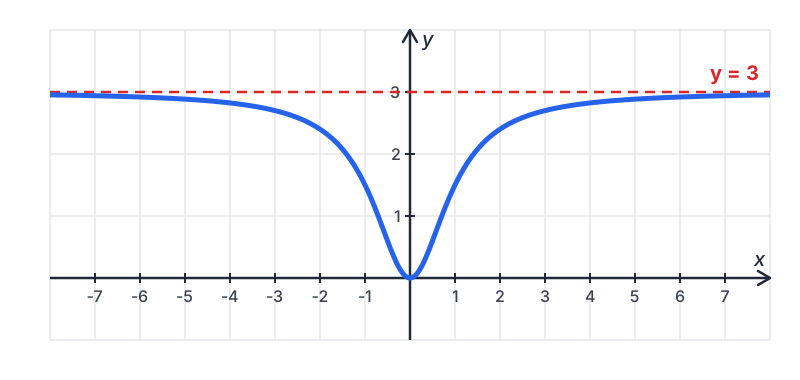
What is lim x→∞ of the plotted function f(x) = 3x²/(x² + 1)?
0
1
3
∞
Equal degrees give the ratio of leading coefficients, 3/1 = 3. The graph flattens along y = 3.
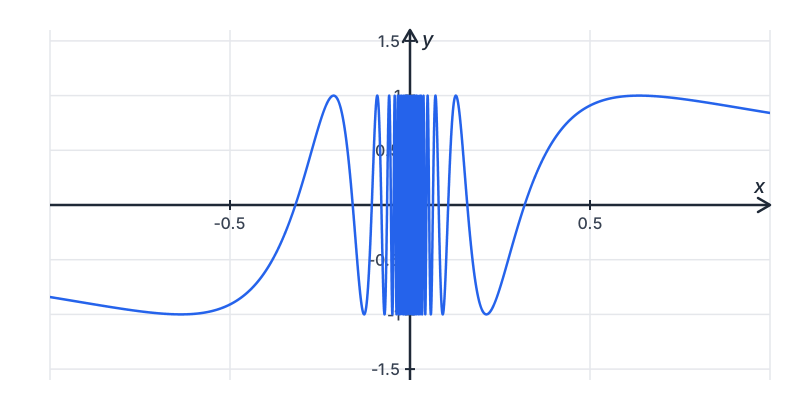
What is lim x→0 sin(1/x)?
0
1
Does not exist
−1
As x → 0 the function oscillates between −1 and 1 infinitely often, so it never approaches a single number.
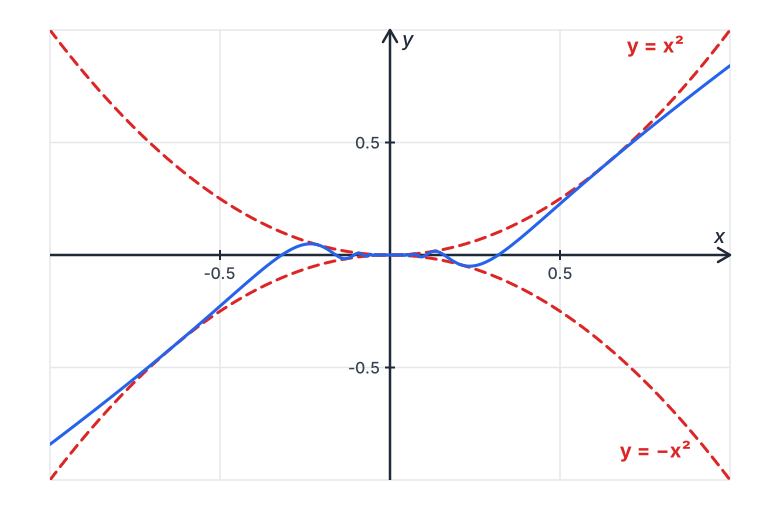
The red curves are y = ±x². Using the Squeeze Theorem, what is lim x→0 x² sin(1/x)?
1
0
Does not exist
1/2
−x² ≤ x² sin(1/x) ≤ x² and both bounds tend to 0, so the blue curve is squeezed to 0.
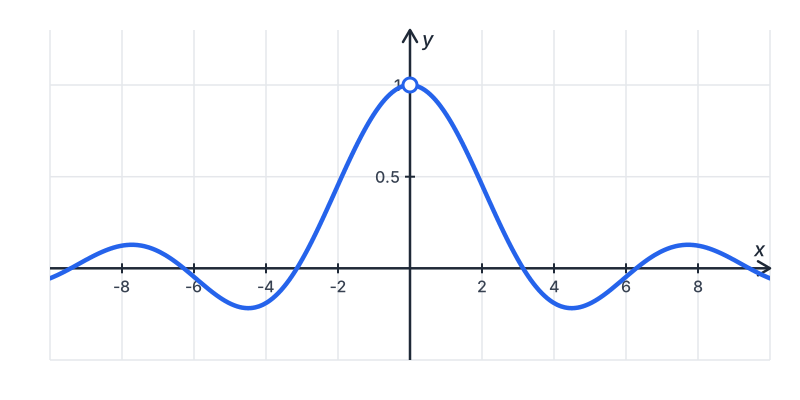
The graph of sin x / x has an open circle at (0, 1). Which statement is correct?
The limit at 0 is 1 although f(0) is undefined
The limit at 0 does not exist because f(0) is undefined
The limit at 0 is 0
The limit at 0 is infinite
The limit only depends on nearby values, which approach 1.
Evaluate .
11
12
9
Does not exist
A polynomial is continuous, so just substitute: 12 − 2 + 1 = 11.
Evaluate .
0
Does not exist
3
6
Substitution gives 0/0, which is indeterminate, so factor: (x − 3)(x + 3)/(x − 3) = x + 3 → 6. Answering 0 stops at the 0 in the numerator.
Evaluate .
−1
1
0
Does not exist
x² − 5x + 6 = (x − 2)(x − 3). After cancelling, x − 3 → −1.
Evaluate .
0
1/4
1/2
Does not exist
Multiply by the conjugate: (x − 4)/((x − 4)(√x + 2)) = 1/(√x + 2) → 1/4.
Evaluate .
1
0
∞
3
Same degree, so the limit is the ratio of the leading coefficients, 3.
Evaluate .
2
0
∞
1
The denominator has the higher degree, so the fraction tends to 0.
True or false: if f(a) is undefined then lim x→a f(x) cannot exist.
True
False
False. The limit ignores f(a). For example (x² − 4)/(x − 2) is undefined at 2 but has limit 4.
Evaluate .
1
3
0
1/3
sin(3x)/x = 3·sin(3x)/(3x) → 3·1 = 3. The limit 1 only applies when the angle in the sine matches the denominator.
Which of these is NOT required for f to be continuous at x = a?
f(a) is defined
lim x→a f(x) exists
lim x→a f(x) = f(a)
f is differentiable at a
Continuity needs only the first three. Differentiability is a stronger property: |x| is continuous at 0 but not differentiable there.
Of the three discontinuity types shown, which one can be repaired by redefining the function at a single point?
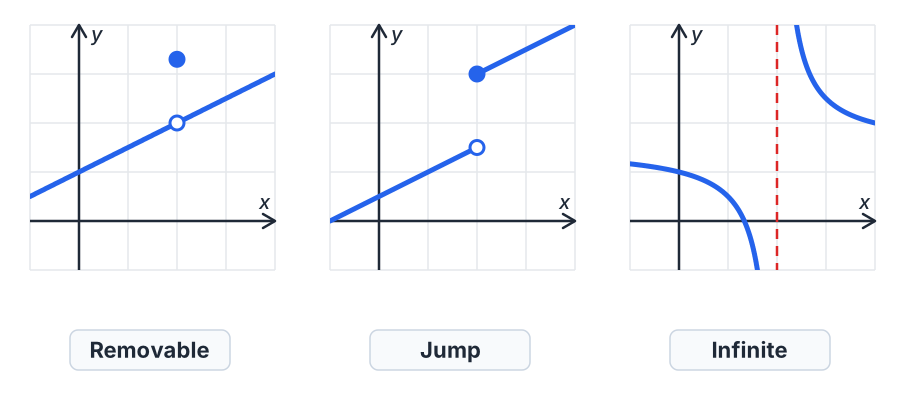
Removable
Jump
Infinite
All three
A removable discontinuity (a hole) has a limit, so defining f(a) equal to it fixes the function. Jumps and asymptotes have no such single value.
What is ?
∞
−∞
0
Does not exist
From the right it is +∞ and from the left −∞, so the two-sided limit does not exist. Contrast with 1/x², which is +∞ from both sides.
Using the graph, what is lim x→−1 f(x)?
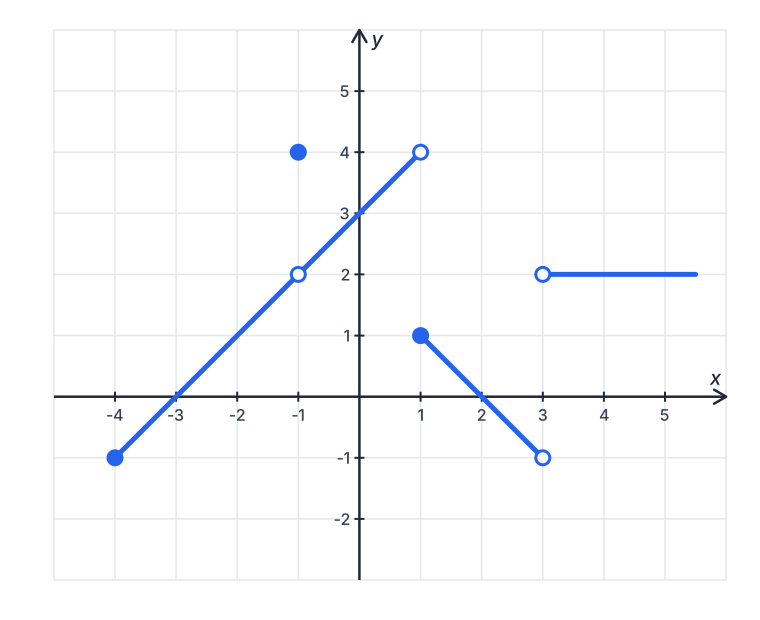
2
4
3
Does not exist
Both sides approach the open circle at (−1, 2). The filled dot at (−1, 4) is f(−1), which is not the limit.
Using the graph, what is lim x→1⁺ f(x)?
4
1
2
Does not exist
To the right of 1 the graph is the piece starting at the filled dot (1, 1). The left side approaches 4.
