Quiz · Medium
Supports, shear and moment diagrams, stress and strain, buckling and the basics of concrete and LRFD.
A roller support provides how many reaction components in a plane?
Two: horizontal and vertical
Three: horizontal, vertical and moment
One, perpendicular to the supporting surface
One, along the supporting surface
A roller can only push or pull perpendicular to its surface. It cannot resist sliding along the surface (so not 'along'), and it provides no moment.
Which condition describes a stable, statically determinate plane truss?
m + r = 2j
m + r = j
m + r = 3j
m = 2j + r
m members plus r reaction components must equal two equilibrium equations per joint (2j). More unknowns than 2j is indeterminate; fewer is unstable.
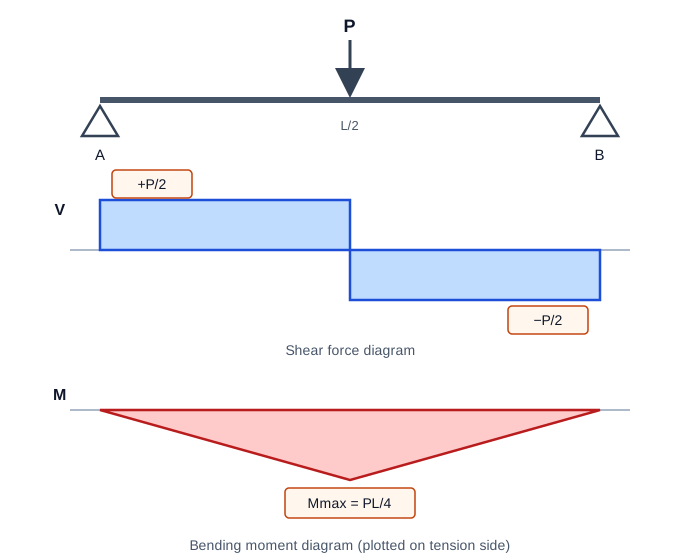
Using the diagram, what is the maximum bending moment for the simply supported beam with a central load P?
PL/2
PL/8
P/2
PL/4
Each reaction is P/2, so M at midspan = (P/2)(L/2) = PL/4. PL/8 is the fixed-end moment, not the midspan moment of this beam.
Where does the maximum bending moment in a beam occur?
Always at midspan
Where the shear force is zero or changes sign
Always at the supports
Where the load is largest
dM/dx = V, so M has a peak where V = 0. It is at midspan only for symmetric loading.
A cantilever of length 4 m carries a uniform load of 5 kN/m. The maximum moment is
20 kN·m at the fixed end
40 kN·m at the fixed end
40 kN·m at the free end
10 kN·m at midspan
M = wL²/2 = 5(16)/2 = 40 kN·m at the support. 20 kN is the maximum shear (wL), not a moment.
A simply supported beam has L = 6 m and w = 10 kN/m. What is the maximum bending moment?
30 kN·m
60 kN·m
90 kN·m
45 kN·m
wL²/8 = 10(36)/8 = 45 kN·m. 30 kN is the reaction wL/2, and 90 would come from wL²/4.
In the flexure formula σ = My/I, y is
the distance from the neutral axis to the point
the beam deflection
the distance from the top of the section
the yield strength
Stress varies linearly from zero at the neutral axis to a maximum at the extreme fiber.
Doubling the depth of a rectangular beam (same width) increases its bending strength (section modulus) by a factor of
2
6
4
8
S = bh²/6, so doubling h gives four times S. A factor of 8 applies to the moment of inertia I, which controls deflection.
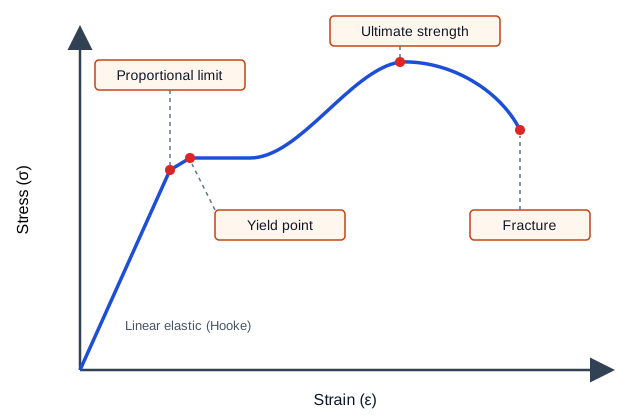
Which point on a ductile steel stress-strain curve marks the highest engineering stress?
Yield point
Proportional limit
Fracture
Ultimate strength
After the ultimate strength, necking reduces the area and engineering stress falls, so fracture occurs at a lower stress.
A 100 kN tension force acts on a bar with A = 500 mm², L = 2 m and E = 200 GPa. The elongation is
0.2 mm
2 mm
20 mm
1 mm
δ = PL/AE = (100,000 × 2000)/(500 × 200,000) = 2 mm. Watch units: use N, mm and MPa consistently.
Euler's formula for the critical load of a column depends on
Yield strength and area
Compressive strength of the material only
E, I, length and end conditions
Cross-sectional area and length only
P_cr = π²EI/(KL)². Yield strength does not appear, which is why Euler only applies to slender columns.
The theoretical effective length factor K for a fixed-free (flagpole) column is
2.0
0.5
0.7
1.0
A free end doubles the effective length. 0.5 is fixed-fixed, 0.7 fixed-pinned and 1.0 pinned-pinned.
Which change reduces a column's buckling load the most?
Doubling its length
Doubling its yield strength
Increasing its cross-section area by 10%
Using a stiffer end support
P_cr is proportional to 1/L², so doubling the length cuts the load to one quarter. Yield strength is not in Euler's formula.
Hoop stress in a thin-walled pressurized cylinder compared with longitudinal stress is
equal
half as large
twice as large
four times as large
Hoop σ = pr/t and longitudinal σ = pr/(2t), so cylinders split along their length first.
Concrete is reinforced with steel mainly because
concrete is weak in compression
concrete is weak in tension
steel reduces concrete's weight
steel prevents shrinkage entirely
Concrete's tensile strength is roughly a tenth of its compressive strength. Reinforcement carries tension; it does not eliminate shrinkage.
An under-reinforced concrete beam is preferred because it
has the highest possible strength
never cracks
fails suddenly by concrete crushing
fails in a ductile way, with steel yielding first
Steel yield gives large deflections and cracks as a warning. Over-reinforced beams crush in a brittle way.
In LRFD, which gravity load combination is commonly used?
1.0D + 1.0L
1.6D + 1.2L
1.2D + 1.6L
1.4L only
Live load carries the larger factor because it is less predictable than dead load.
Fixed-end moment for a fixed-fixed beam with a uniform load w over span L is
wL²/12
wL²/8
wL²/2
PL/8
wL²/8 is the simply supported midspan moment; wL²/2 is the cantilever moment; PL/8 is for a central point load.
A pin support can resist an applied moment.
True
False
A pin allows rotation, so it provides only horizontal and vertical force reactions.
A statically indeterminate structure cannot be solved without considering deformations.
True
False
Statics provides too few equations, so compatibility conditions (deformation, material stiffness) are needed.
In a simply supported beam under gravity load, which fibers are in tension at midspan?
The top fibers
The neutral axis
Both top and bottom equally
The bottom fibers
Sagging bending compresses the top and stretches the bottom, which is why main reinforcement goes near the bottom.
The Müller-Breslau principle is used to
compute buckling loads
sketch influence lines
design prestressed beams
find principal stresses
The influence line for a response has the shape of the deflected structure after releasing the corresponding restraint and applying a unit displacement.
Which relationship is correct for a beam with distributed load w(x)?
dM/dx = −w and dV/dx = V
dV/dx = −w and dM/dx = V
dV/dx = M and dM/dx = w
dV/dx = w and dM/dx = −V
Shear changes by the (negative) load, and moment changes by the shear. Differentiating twice gives d²M/dx² = −w.
