Quiz · Medium
Twenty-two NCLEX-style questions on therapeutic communication, defense mechanisms, anxiety, schizophrenia, bipolar disorder and psychotropic medication safety.
During the orientation phase of the nurse-client relationship, which task is the priority?
Exploring the client's childhood trauma
Evaluating the client's progress and planning discharge
Confronting the client's defense mechanisms
Establishing trust and a contract that outlines roles, time and purpose
Orientation focuses on trust, boundaries and agreement on goals. Problem exploration belongs to the working phase and evaluation to termination.
A client says, 'I feel like nobody listens to me.' Which response is most therapeutic?
'I am sure your family listens to you.'
'Why do you feel that way?'
'You feel that nobody is listening. Tell me more about that.'
'You should tell them how you feel.'
Reflecting and an open invitation encourage expression. Disagreeing or reassuring dismisses the feeling; 'why' questions are defensive; advice limits independence.
A client who was just told she needs a mastectomy says, 'The lab must have mixed up my results.' Which defense mechanism is this?
Projection
Rationalization
Denial
Displacement
Denial refuses to accept a threatening reality. Rationalization offers an excuse; projection attributes feelings to others; displacement redirects feelings to a safer target.
A man scolded by his supervisor yells at his wife when he gets home. Which defense mechanism is he using?
Reaction formation
Displacement
Regression
Sublimation
Displacement redirects feelings from the threatening source (supervisor) to a safe target (wife). Sublimation channels the feeling into an acceptable activity such as sports.
A child hospitalized for surgery begins sucking his thumb and asking for a bottle. Which defense mechanism is demonstrated?
Repression
Suppression
Compensation
Regression
Regression is a retreat to an earlier developmental stage under stress. It is common and expected in hospitalized children.
According to Maslow's hierarchy, which need should the nurse address first for a client who is agitated, hasn't eaten in 2 days and wants to talk about his anger?
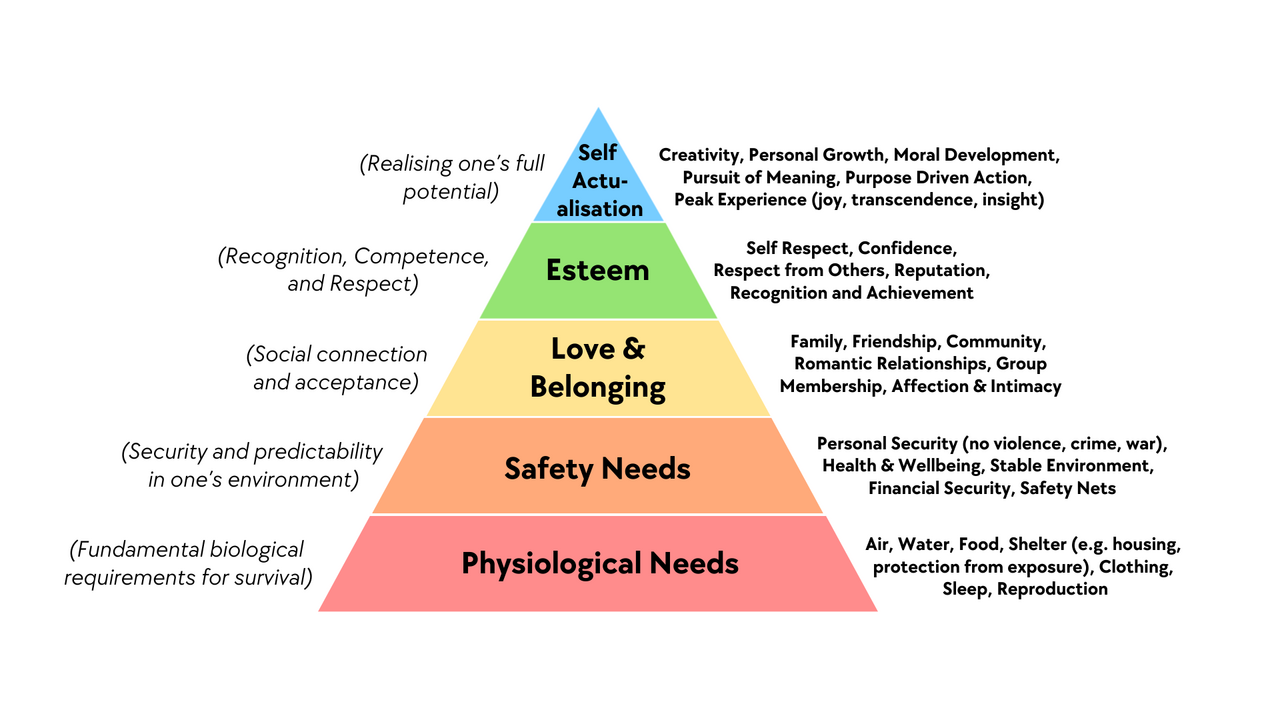
Physiologic needs such as food and fluids
Esteem needs
Love and belonging
Self-actualization
Basic physiologic needs take priority over psychosocial needs. Address food and hydration, then safety, before exploring emotions. Image: Hamish.croker, CC BY-SA 4.0, via Wikimedia Commons.
The nurse is caring for a client in the severe level of anxiety. Which intervention is best?
Teach relaxation techniques using a pamphlet
Ask the client to explain the cause of the anxiety
Stay with the client and use short, simple, calm sentences
Leave the client alone to calm down
Severe anxiety narrows perception so that learning is impossible. Stay with the client, reduce stimulation and use brief directions; teaching occurs when anxiety is mild.
A client with schizophrenia says, 'The voices are telling me to hurt my roommate.' What should the nurse do first?
Tell the client the voices are not real and change the subject
Ask the client to ignore the voices
Document the finding and continue routine rounds
Assess the content and intensity of the command hallucination, and ensure safety
Command hallucinations can lead to harm. Assess for intent and plan, ensure safety of the roommate and the client, notify the provider and give PRN medication as ordered.
A client with a delusion of persecution says, 'The staff are poisoning my food.' Which response is best?
'You're right, I will bring you food from home.'
'That is ridiculous. No one is poisoning you.'
'I know you are afraid, but I don't think the food is poisoned. I'll sit with you while you eat.'
'Why do you believe the staff want to hurt you?'
Acknowledge the feeling, present reality without arguing, and offer support. Agreeing reinforces the delusion; arguing breaks trust.
Which statement by a client describes a negative symptom of schizophrenia?
'The TV is sending me secret messages.'
'I hear someone whispering my name.'
'The CIA is following me.'
'I have no energy to do anything and I don't care about seeing friends.'
Negative symptoms are the loss of normal functions: avolition, anhedonia, asociality, flat affect and alogia. Hallucinations and delusions are positive symptoms.
A client in the manic phase of bipolar disorder is pacing, has not slept for three days and refuses to sit for meals. Which intervention is the best for nutrition?
Insist the client sit at the table for all meals
Provide high-calorie finger foods that can be eaten while moving
Wait until the client asks for food
Give a liquid supplement only
Clients in mania cannot sit still. Finger foods that are portable and high in calories maintain nutrition. Decreasing stimulation and consistent limits are also important.
A client has been taking lithium for 2 weeks. Which finding indicates the need to hold the dose and notify the provider?
Coarse hand tremor, vomiting and diarrhea
Fine hand tremor
Increased thirst and urination
Mild nausea at the start of therapy
Coarse tremor with GI symptoms signals lithium toxicity. A fine tremor, thirst and mild nausea are expected side effects early in therapy.
Which statement by a client taking lithium indicates understanding?
'I will reduce the salt in my diet to help my blood pressure.'
'I will drink 2 to 3 liters of water daily and keep my salt intake steady.'
'I can take ibuprofen for headaches.'
'I will stop the medication when I feel better.'
Sodium depletion makes the kidneys retain lithium, raising levels. NSAIDs also increase lithium levels. Never stop abruptly.
A client taking phenelzine (an MAOI) is eating a pizza with pepperoni and aged cheese. What is the nurse's priority?
Document the client's food choices
Teach the client to take the medication with food
Administer a PRN antiemetic
Check the client's blood pressure and assess for headache, because a hypertensive crisis is possible
Tyramine-rich foods can trigger a hypertensive crisis in clients on MAOIs. Measure BP and report severe occipital headache, stiff neck or palpitations.
A client who started paroxetine 10 days ago says, 'I feel better and I am thinking about stopping because I don't need it.' What is the best response?
Agree that the medication can be stopped if the symptoms are better
Tell the client to double the dose for faster effect
Explain that full effect takes weeks and the drug should not be stopped abruptly without the provider
Suggest an herbal supplement
SSRIs take 2 to 6 weeks, and sudden discontinuation can cause withdrawal-like symptoms. Encourage the client to discuss changes with the provider.
A client taking haloperidol develops muscle spasms of the neck, a protruding tongue and an oculogyric (upward) eye deviation. Which medication does the nurse anticipate?
Lorazepam
Benztropine
Propranolol
Dantrolene
This is an acute dystonic reaction treated with an anticholinergic (benztropine) or diphenhydramine. Propranolol treats akathisia; dantrolene treats NMS.
Which assessment finding in a client taking an antipsychotic requires immediate intervention?
Dry mouth and constipation
Weight gain of 1 kg
Temperature 40 C, severe muscle rigidity and confusion
Mild drowsiness
Fever, rigidity and altered mental status suggest neuroleptic malignant syndrome, a medical emergency. The other effects are common and managed less urgently.
A client with alcohol use disorder is admitted. When will delirium tremens most likely occur?
6 to 12 hours after the last drink
48 to 96 hours after the last drink
Immediately after the last drink
7 to 10 days after the last drink
Withdrawal begins with tremor and anxiety at 6 to 12 hours; seizures at 12 to 48 hours; DTs 48 to 96 hours. DTs are a life-threatening emergency requiring benzodiazepines.
A client is being treated for alcohol withdrawal. Which vitamin should be given?
Thiamine
Vitamin K
Vitamin C
Vitamin A
Thiamine prevents or treats Wernicke encephalopathy in clients with alcohol use disorder. Give it before or with glucose.
The nurse is caring for a client with anorexia nervosa. Which intervention is most appropriate after meals?
Allow the client to go to the bathroom right away
Stay with the client for an hour after meals and observe bathroom use
Discuss the client's body weight and calories
Weigh the client in the afternoon with clothing on
Observation after meals prevents purging. Discussions about food and weight can reinforce the disorder; weigh at the same time each morning.
A depressed client who has been on an antidepressant for 2 weeks suddenly appears calm and has given away her belongings. What is the nurse's priority?
Assess suicide risk with direct questions and implement safety measures
Document that the depression is improving
Reduce the observation level
Encourage the client to join group therapy
Sudden calm, giving away possessions and increased energy early in antidepressant therapy are warning signs of a suicide plan. Ask directly and protect.
Which finding is most consistent with the DSM criteria for major depressive disorder?
Elevated mood for 3 days
Fear of leaving the house for 1 week
Depressed mood for most of the day for at least 2 weeks with weight loss and insomnia
Hallucinations lasting 1 day
MDD requires at least 5 symptoms for 2 weeks, including depressed mood or anhedonia. Elevated mood suggests mania or hypomania; fear of leaving home suggests agoraphobia.
