Quiz · Medium
Homology, fossils, cladograms, species concepts and reproductive isolation.
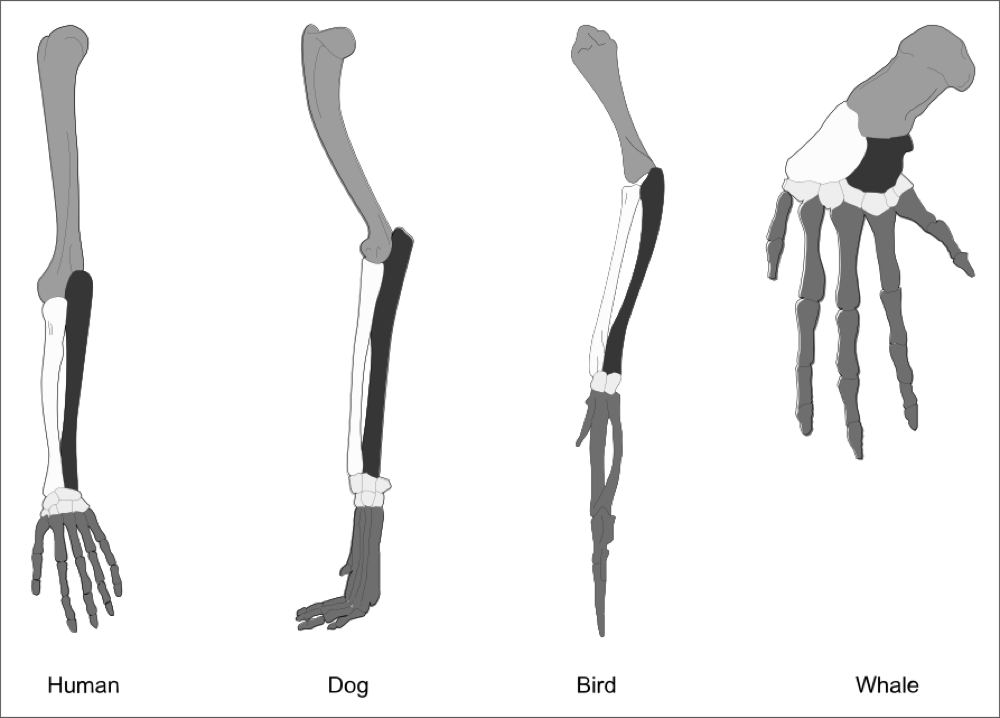
The forelimbs of humans, dogs, birds and whales share the same bone pattern. This is evidence of
Analogous structures
Common ancestry (homology)
Use and disuse
Convergent evolution
Same bones with different functions show modification of a shared ancestral limb. Analogous structures share function but not origin. Image: Волков Владислав Петрович, CC BY-SA 4.0, via Wikimedia Commons.
Which pair is an example of analogous structures?
Human arm and bat wing
Bird wing and insect wing
Human and chimp hand
Whale flipper and dog leg
Bird and insect wings evolved independently for flight.
Which fossil is a transitional form between fish and tetrapods?
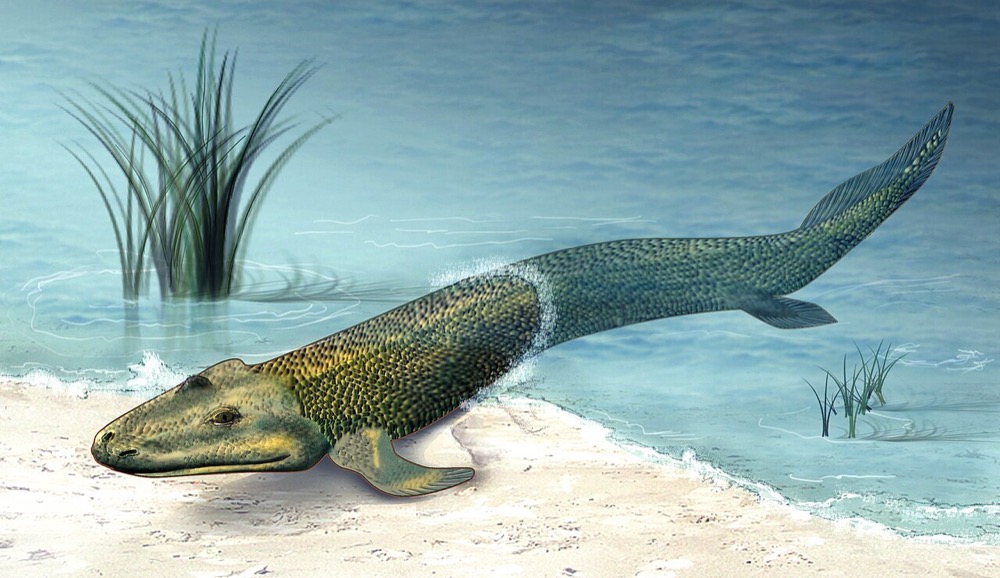
Tiktaalik
Trilobite
Archaeopteryx
Australopithecus
Tiktaalik had fins with limb-like bones and a neck.
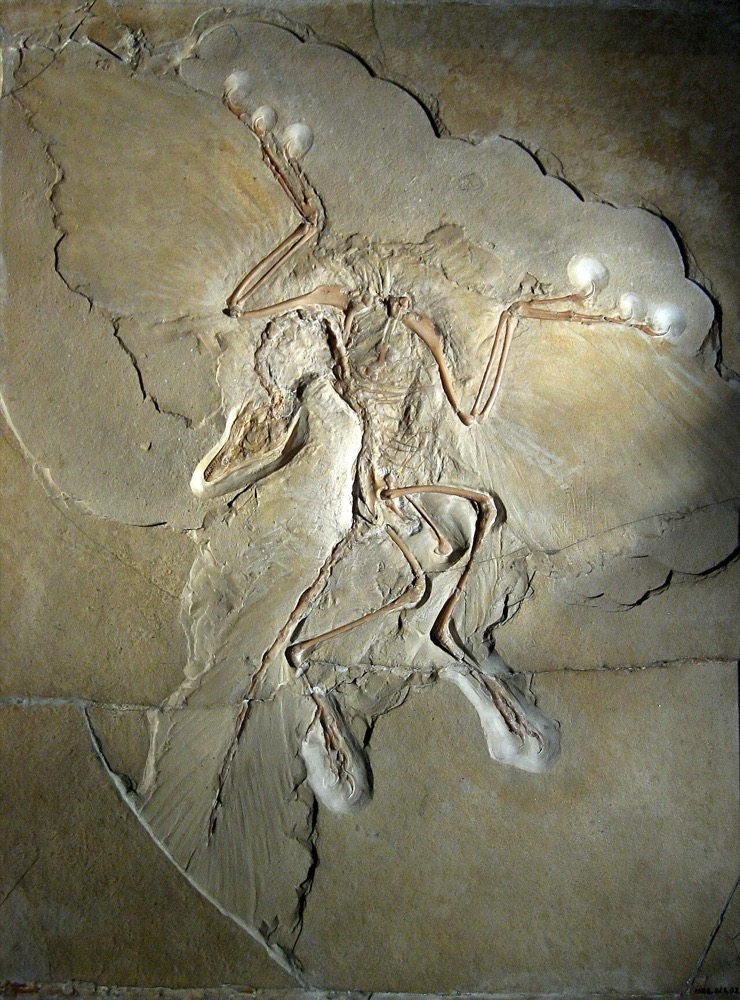
Archaeopteryx is considered a transitional form because it
Was a flightless dinosaur without feathers
Had hair and mammary glands
Had feathers and reptile-like teeth and a bony tail
Was a fish with legs
Combining traits of dinosaurs and birds supports their shared ancestry. Image: H. Raab (User: Vesta), CC BY-SA 3.0, via Wikimedia Commons.
In this tree, which node is the common ancestor of A, B and C but not D?
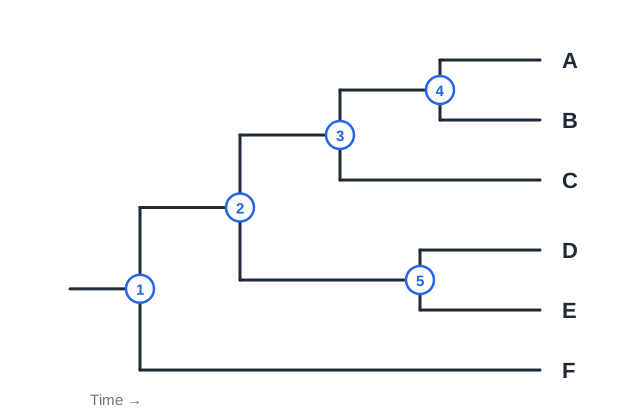
Node 3
Node 1
Node 4
Node 5
Node 4 includes only A and B; node 2 includes A, B, C, D and E.
In this tree, which taxon is the outgroup?
C
F
E
A
F diverged first and is used to root the tree.
In this tree, D and E are
Analogous
Sister taxa
Paraphyletic
Outgroups
They share a most recent common ancestor (node 5) not shared with any other taxon.
Which character is a shared derived character for turtles and leopards but not salamanders?
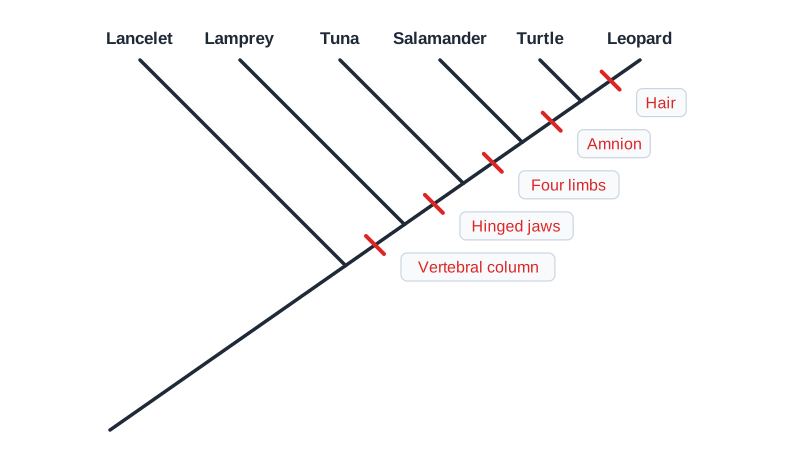
Four limbs
Vertebral column
Amnion
Hinged jaws
The amniotic egg arose in the ancestor of reptiles and mammals.
A clade is
A group sharing only similar appearance
An ancestor and all of its descendants
Any group of related species
Only living species
This is what monophyletic means.
The biological species concept defines a species as
Organisms with the same DNA
Organisms that look alike
Organisms in the same habitat
A group of populations that can interbreed and produce fertile offspring
It cannot be applied to asexual species or fossils.
Two closely related plants flower at different times of year. This is
Postzygotic hybrid sterility
Temporal isolation, a prezygotic barrier
Behavioral isolation
Gametic isolation
They never get a chance to mate.
A mule is sterile. This is an example of
Hybrid sterility, a postzygotic barrier
Temporal isolation
Behavioral isolation
Habitat isolation
Postzygotic barriers act after zygote formation.
A river changes course and splits a population of squirrels; over time two species arise. This is
Gene flow
Polyploidy
Sympatric speciation
Allopatric speciation
Geographic separation stops gene flow, allowing divergence.
A new plant species forms in a single generation by chromosome doubling. This is
Convergent evolution
Sympatric speciation by polyploidy
Allopatric speciation
The founder effect
The tetraploid cannot produce fertile offspring with the diploid parent.
Finches on the Galapagos with many beak types from one ancestor illustrate
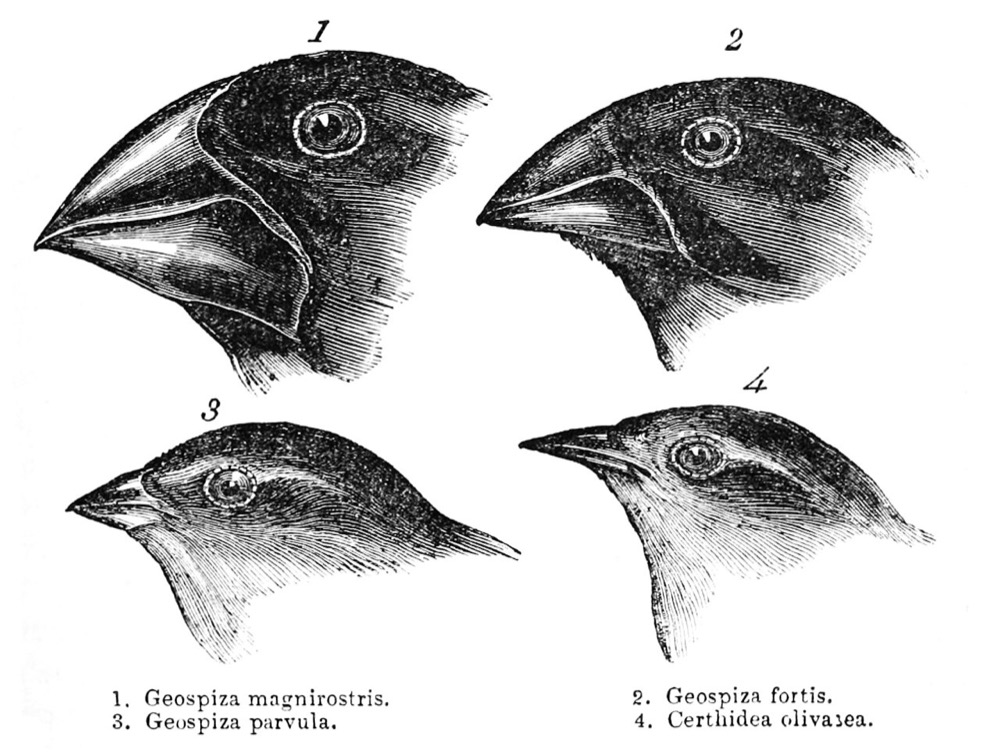
Coevolution
Adaptive radiation
Convergent evolution
Genetic drift
One ancestral lineage diversified to fill several niches.
Which mass extinction is thought to be the largest?
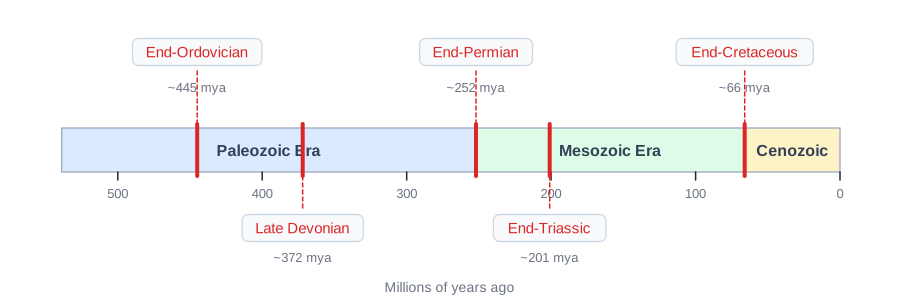
End-Permian
End-Cretaceous
End-Triassic
Late Devonian
About 90% of marine species vanished about 252 million years ago.
Sharks and dolphins have similar body shapes but are not closely related. This is
Convergent evolution
Genetic drift
Homology
Divergent evolution
Similar environments select similar solutions.
True or false: Punctuated equilibrium proposes that species change at a constant slow rate.
True
False
It proposes long stasis broken by relatively rapid change.
The molecular clock assumes that
DNA never changes
Neutral mutations accumulate at a roughly constant rate
All genes evolve at the same speed
Mutations occur only at speciation
Calibrating with fossils lets us estimate divergence time.
Which is NOT evidence for evolution?
Fossil sequences
Vestigial structures
DNA similarity
The need of organisms to adapt causes beneficial mutations
Mutations arise randomly; need does not direct them.
