Quiz · Medium
Core leadership theories in exam style: grid styles, Fiedler, path-goal, SLII, transformational and servant leadership, power, conflict, feedback and change.
In Blake and Mouton's Managerial Grid, a leader with high concern for production and high concern for people (9,9) is practicing:
Country club management
Team management
Middle-of-the-road management
Authority-compliance management
(9,9) is team management. Country club is (1,9), authority-compliance is (9,1) and middle-of-the-road is (5,5).
Which of these identifies the grid style shown in the diagram's top-left corner?
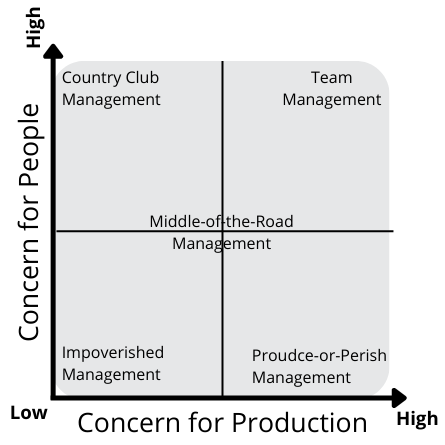
Country Club Management
Team Management
Impoverished Management
Middle-of-the-Road Management
Top-left is high concern for people and low concern for production: country club management.
The Ohio State leadership studies identified which two independent dimensions?
Task focus and production focus
Initiating structure and consideration
Power and affiliation
Autocratic and democratic style
Initiating structure is task-oriented, consideration is people-oriented. Autocratic/democratic is Lewin. Production/employee-centered is Michigan.
According to Fiedler, a leader who rates their least preferred coworker (LPC) very harshly is:
Relationship-oriented
Task-oriented
Transformational
Laissez-faire
Low LPC means a harsh rating, which signals a task-oriented leader. High LPC (rates the coworker favorably) signals relationship orientation.
Fiedler's contingency model recommends what when a leader's style does not fit the situation?
Train the leader to change style
Change the situation to fit the leader
Remove the leader
Use a participative style
Fiedler treated LPC as a stable trait, so he advised changing the situation (task structure, position power, relations) rather than the leader.
In path-goal theory, a manager supervising stressful, monotonous work should most likely use which style?
Directive
Achievement-oriented
Supportive
Participative
Supportive leadership raises morale when the task itself is unpleasant. Directive would add little because the task is already routine.
A newly hired employee is excited but has no experience. In SLII, which leadership style matches this D1 level?
Delegating
Supporting
Coaching
Directing
D1 (enthusiastic beginner) needs high direction and low support: directing. Coaching suits D2, who has lost some commitment.
Which element of transformational leadership involves challenging followers to question assumptions and think creatively?
Idealized influence
Inspirational motivation
Intellectual stimulation
Individualized consideration
Intellectual stimulation encourages innovation and rethinking. Individualized consideration treats followers as individuals and coaches them.
Passive management by exception is part of which leadership category in the full-range model?
Transformational leadership
Transactional leadership
Servant leadership
Adaptive leadership
Management by exception (active or passive) and contingent reward are the two transactional components. (Passive MBE is sometimes grouped with passive-avoidant behavior in later versions of the model.)
Greenleaf's servant leadership places the leader's primary focus on:
Achieving shareholder returns
Followers' growth and wellbeing
Controlling costs
Defining the vision alone
Servant leaders put followers' needs and growth first, expecting performance to follow. Transformational leaders put organizational goals first.
According to Jim Collins, Level 5 leaders combine:
Charisma and ambition
Personal humility and professional will
Technical skill and political skill
Autocratic control and vision
Humble about themselves, fiercely determined about the organization's results. Collins found charismatic celebrity leaders were less common among good-to-great companies.
Heifetz describes a problem that needs people to change their values or habits as:
A technical problem
An adaptive challenge
A transactional exchange
A contingency factor
Technical problems have known solutions. Adaptive challenges require learning and change in the people involved.
Kotter argues that management and leadership differ mainly because management:
Copes with complexity while leadership copes with change
Sets direction while leadership controls budgets
Inspires people while leadership organizes them
Is for lower levels while leadership is only for CEOs
Kotter: management is planning, budgeting, organizing and controlling. Leadership is setting direction, aligning people and motivating.
In leader-member exchange (LMX) theory, the 'in-group' typically receives:
Formal, contract-based treatment
More trust, responsibility and support
Less autonomy
Only coercive rewards
In-group members have high-quality exchanges. Out-group members get more formal, transactional treatment.
A leader who holds back from deciding or giving direction and avoids responsibility is displaying:
Delegation
Management by exception (active)
Laissez-faire leadership
Participative leadership
Laissez-faire is the absence of leadership. True delegation is deliberate, with clear expectations and support.
Which French and Raven power base depends on followers admiring and identifying with the leader?
Legitimate
Referent
Expert
Reward
Referent power comes from admiration and identification. Expert comes from knowledge, legitimate from position.
A manager repeatedly says 'Do as I do, now' and sets very high standards, but the team has started to burn out. Goleman would call this style:
Authoritative
Coaching
Pacesetting
Affiliative
Pacesetting works with a skilled, motivated team in short bursts. Overused, it hurts climate.
In the Thomas-Kilmann model, 'avoiding' is low in:
Assertiveness only
Cooperativeness only
Both assertiveness and cooperativeness
Neither
Avoiding sidesteps the conflict, so it is low on both. Accommodating is low assertiveness, high cooperativeness.
The 'S' in SBI feedback stands for:
Strengths
Situation
Standards
Solution
Situation, Behavior, Impact: describe the specific situation, the observable behavior and its impact.
Which of the following CAN'T a manager fully delegate to a subordinate?
Authority to make purchases
Responsibility for doing a task
Accountability for the final outcome
Access to resources
Authority and responsibility can be delegated. Ultimate accountability stays with the delegator.
Which symptom is a classic sign of groupthink?
Members openly argue alternatives
Self-censorship and an illusion of unanimity
A formal devil's advocate is appointed
Outside experts are consulted
Self-censorship and illusion of unanimity are Janis's symptoms. The other options are remedies or signs of healthy debate.
Kotter's eight-step model for leading change begins with:
Forming a strategic vision
Creating a sense of urgency
Generating short-term wins
Anchoring changes in culture
Establishing urgency comes first. Anchoring changes in culture is the final step.
Taylor's scientific management primarily sought to improve:
Employee morale through group norms
Efficiency by studying and standardizing tasks
Organizational culture
Strategic planning at the top
Taylor used time-and-motion study to find 'one best way' to perform tasks. Group norms are the human-relations tradition.
Barnard's acceptance theory of authority holds that authority ultimately depends on:
The manager's position in the hierarchy
The subordinate's willingness to accept the order
Written rules
The leader's charisma
Barnard said orders have authority only if subordinates accept them. Weber's rational-legal authority is based on rules and office.
