Quiz · Hard
Harder multi-step problems in the style of AP Calculus BC free-response and Calculus II exams: borderline tests, intervals of convergence, series manipulation and error bounds.
Which series converges?
Integral test: is finite. The others diverge (, comparison with 1/n, limit comparison with 1/n).
Determine the behavior of and the reason.
Converges: ratio test gives
Diverges: grows faster than
Converges: p-series with p = 2
Inconclusive: ratio test gives 1
Exponentials beat polynomials, so and the ratio L = 1/2 < 1. The p-series is a different type.
What is the interval of convergence of ?
R = 4, center 3. At x = 7: harmonic, diverges. At x = −1: alternating harmonic, converges.
The interval of convergence of has radius
1
1/e
∞
e
Ratio: , so converges when |x| < e.
If has radius 3, the radius of is
2
3
∞
It cannot be determined
Term-by-term differentiation preserves the radius.
Which is the beginning of the Maclaurin series of ?
; multiplying by gives .
Using Maclaurin series, equals
0
1
. The sign is negative, a common slip.
Find .
This is at : . It lies in the interval (−1, 1].
Which gives the Taylor polynomial of degree 2 of at 0?
Substitute 2x into : .
How many terms of guarantee an error of at most 0.001?
99 terms
9 terms
3 terms
1000 terms
The error after N terms is at most . We need , so N = 9 (bound exactly 0.001). Using N = 10 is also safe, but 9 is enough; 99 and 1000 are far too many.
converges conditionally. Which statement is correct?
must converge
does not approach 0
Any rearrangement has the same sum
diverges
Conditional means convergent but not absolutely so. Rearranging can change the sum (Riemann), and is still required.
is
absolutely convergent
divergent by the nth-term test
divergent by the ratio test
conditionally convergent
AST: decreases (for n ≥ 1) to 0, so it converges. Absolute series compares with , so diverges.
The series behaves like
, so it converges
, so it diverges
, so it converges
a geometric series with r = 1
Leading behavior . Limit comparison with gives limit 1.
Find the radius of convergence of the series for at 0.
∞
0
1
2
is geometric with ratio , converging for , even though the function is smooth for all real x (the singularities are at ±i).
Write as a series.
; integrating raises the exponent to 4n + 3 and divides by it.
What does the interval-of-convergence picture say about the test to use at the endpoints?
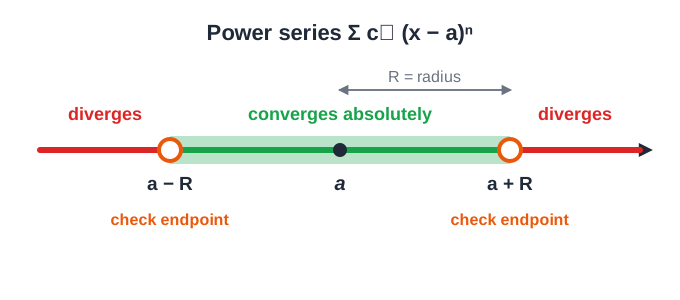
Use the ratio test again
Test each endpoint separately with an ordinary series test
Both endpoints always converge
Both endpoints always diverge
At the ratio test gives L = 1, so it is inconclusive; use p-series, AST, nth-term, and so on.
