Quiz · Medium
Mixed concept and calculation questions on von Mises stress, fatigue diagrams, bolted joints, gears, shafts, bearing life and springs.
A thin-walled cylinder has p = 2 MPa, r = 0.5 m, t = 10 mm. The hoop stress is:
25 MPa
50 MPa
100 MPa
200 MPa
sigma = pr/t = 2 x 500/10 = 100 MPa; the axial stress is half that.
A part sees stress cycling between 100 MPa and 300 MPa. What are the mean and alternating stresses?
150 and 150
100 and 200
300 and 100
200 and 100
sigma_m = (300 + 100)/2 = 200 MPa; sigma_a = (300 - 100)/2 = 100 MPa.
A steel part has Sy = 400 MPa. At a critical point σx = 80 MPa and τxy = 40 MPa. By distortion energy, the factor of safety against yielding is about:
3.8
1.9
5.0
0.4
σ' = sqrt(80^2 + 3 x 40^2) = 105.8 MPa; n = 400/105.8 = 3.8. Using Tresca would give a smaller n (more conservative).
Which theory is the most conservative for yielding of ductile metals?
Distortion energy (von Mises)
Maximum shear stress (Tresca)
Maximum normal stress
Coulomb-Mohr
Tresca predicts yield slightly earlier than von Mises (Ssy = 0.5Sy vs 0.577Sy). Maximum normal stress and Coulomb-Mohr are for brittle materials.
A gear module is 3 mm and it has 24 teeth. Its pitch diameter is:
8 mm
27 mm
72 mm
75.4 mm
d = mN = 3 x 24 = 72 mm. 75.4 mm is the circumference divided by... actually pi x 24 = 75.4, a confusion with circular pitch.
A 20-tooth pinion at 1800 rpm drives a 60-tooth gear. The gear speed is:
5400 rpm
900 rpm
3600 rpm
600 rpm
Speed ratio = 60/20 = 3, so the gear turns at 1800/3 = 600 rpm. 5400 rpm would be a multiplier, not a reducer.
Standard full-depth 20 degree teeth have an addendum and dedendum of:
m and m
1.25 m and m
m and 1.25 m
2.25 m and 1.25 m
Addendum = m, dedendum = 1.25 m, leaving 0.25 m clearance. The whole depth is 2.25 m.
Which is the main disadvantage of helical gears compared to spur gears?
Louder operation
Axial thrust
Lower load capacity
Cannot be used at high speed
Angled teeth produce an axial force that thrust bearings must carry. They are quieter and stronger than spur gears.
In the Goodman diagram shown, what bounds the safe region on the mean-stress axis?
Sut on the Goodman line, Sy on the yield line
Se on both lines
Sy on the Goodman line
Sut on the yield line
Goodman runs to Sut, but the yield line limits the safe region to Sy on that axis. The safe region is enclosed by both lines.
Which factor increases the fatigue notch factor Kf toward Kt?
Low notch sensitivity
Larger fillet radius
Shot peening
High notch sensitivity q approaching 1
Kf = 1 + q(Kt - 1). When q = 1 the material is fully notch sensitive and Kf = Kt; q = 0 gives Kf = 1.
A bolt joint has members much stiffer than the bolt. When an external tensile load is applied, the bolt:
Carries almost all of it
Carries only a small fraction, because the preload in the members is just relieved
Carries none
Always yields
The bolt sees C = kb/(kb + km), which is small when members are stiff. This is why preload is so important for fatigue.
Recommended preload for a reusable bolted connection is about:
75% of proof load
50% of proof load
25% of proof load
100% of yield
About 75% of proof strength x stress area for reusable joints (about 90% for permanent joints).
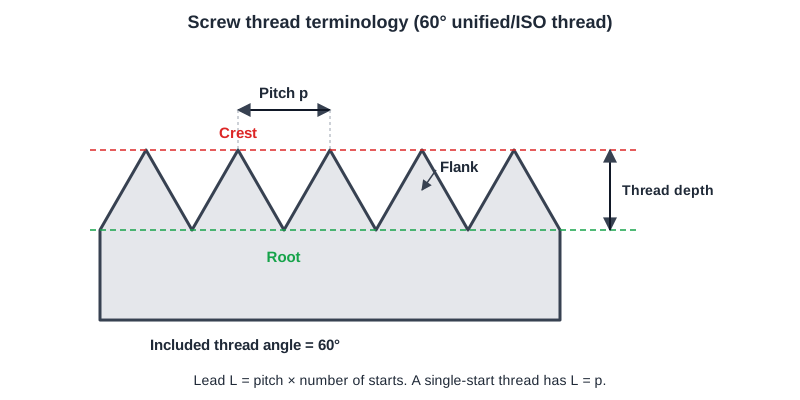
M10 x 1.5 refers to:
10 threads per inch
Length 10 mm, lead 1.5 mm
Diameter 1.5 mm, 10 threads
Diameter 10 mm, pitch 1.5 mm
Metric threads are specified by nominal diameter and pitch (mm).
A power screw is self-locking if:
tan(lead angle) > friction coefficient
Lead = pitch
friction coefficient > tan(lead angle)
It is a ball screw
With mu > tan(lambda), friction holds the load and it will not back-drive. Ball screws are low-friction and are not self-locking.
A steel rod (E = 200 GPa), 20 mm diameter, 1 m long and pinned at both ends. Its Euler critical load is closest to:
15.5 kN
1.55 kN
155 kN
1550 kN
I = pi d^4/64 = 7.85e-9 m^4; Pcr = pi^2 E I / L^2 = 15.5 kN.
The effective length factor K for a fixed-free (cantilever) column is:
0.5
2.0
1.0
0.7
Fixed-free columns buckle like half a pinned column, so Le = 2L. Fixed-fixed has K = 0.5.
A ball bearing with a dynamic load rating C = 20 kN carries an equivalent load of 5 kN. L10 life is:
64 million revs
20 million revs
4 million revs
400 million revs
L10 = (C/P)^3 = 4^3 = 64 million revolutions. For roller bearings the exponent is 10/3.
What does L10 mean?
The mean life of the bearings
The life of 10% of the bearings
The life that 90% of identical bearings reach or exceed
The life at 10 kN
L10 is the 10th-percentile life: 10% fail earlier, 90% last at least that long.
On the Stribeck curve shown, which regime has the lowest friction coefficient?
Near the minimum, at the mixed-to-hydrodynamic transition
Mixed, well before the minimum
Boundary
Far right, at very high ZN/P
Friction is lowest near the transition from mixed to full-film lubrication, then rises gradually with viscous drag as speed increases.
True or false: A journal bearing runs in the hydrodynamic regime only when a converging wedge forms between journal and bearing.
True
False
The eccentric journal drags oil into a converging gap, generating pressure that carries the load. Without motion or viscosity, no film forms.
A shaft carries 10 kW at 1500 rpm. The torque is about:
6.7 N·m
1500 N·m
637 N·m
63.7 N·m
omega = 2 pi x 1500/60 = 157 rad/s; T = P/omega = 10,000/157 = 63.7 N·m.
A 10 mm wide, 40 mm long key transmits a torque of 200 N·m on a 40 mm shaft. Shear stress in the key is:
5 MPa
25 MPa
250 MPa
10 MPa
F = 2T/d = 2(200)/0.04 = 10 kN; tau = F/(w l) = 10,000/(10 x 40) = 25 MPa.
Two springs of 10 N/mm and 10 N/mm are connected in series. The combined rate is:
20 N/mm
10 N/mm
5 N/mm
100 N/mm
1/k = 1/10 + 1/10, so k = 5 N/mm. Parallel would give 20.
