Quiz · Medium
Conceptual questions on rate laws, reactor types, selectivity, catalysis and RTD.
For an elementary reaction 2A → B, the rate law is:
-r_A = k C_A
-r_A = k C_A C_B
Cannot be known without experiments
-r_A = k C_A²
Elementary reactions have orders equal to their stoichiometric coefficients. For non-elementary reactions you need data.
The units of k are 1/s. The reaction is:
Half order
Zero order
First order
Second order
First-order rate constants have units of 1/time. Second order would be L/(mol·s); zero order mol/(L·s).
The half-life of a first-order reaction:
Is independent of C_A0
Doubles when C_A0 doubles
Is halved when C_A0 doubles
Equals 1/(k C_A0)
t_1/2 = ln2/k. The 1/(kC_A0) formula is for second order.
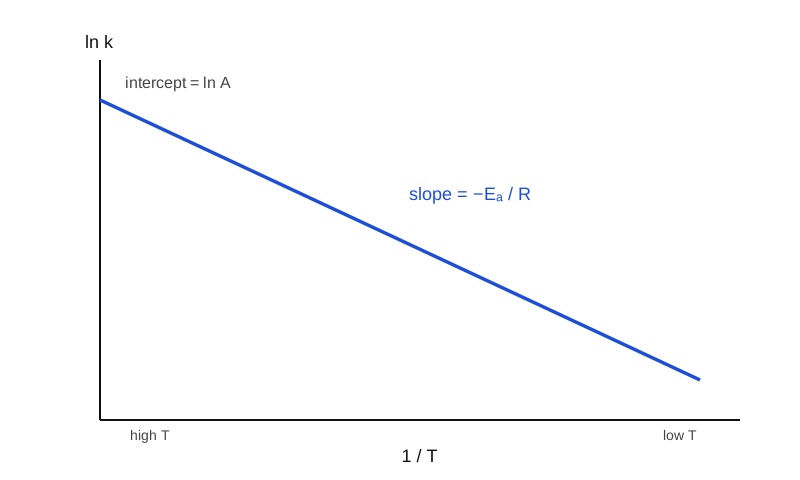
What does the slope of this plot (ln k vs 1/T) equal?
-R/Ea
ln A
Ea
-Ea/R
ln k = ln A - Ea/(R T); the slope is -Ea/R, negative, and the intercept is ln A.
Which statement about a catalyst is correct?
It increases equilibrium conversion
It lowers activation energy and speeds both forward and reverse reactions
It changes the heat of reaction
It is consumed in the reaction
A catalyst opens a lower-Ea path; equilibrium and ΔH are unchanged, so it speeds both directions equally.
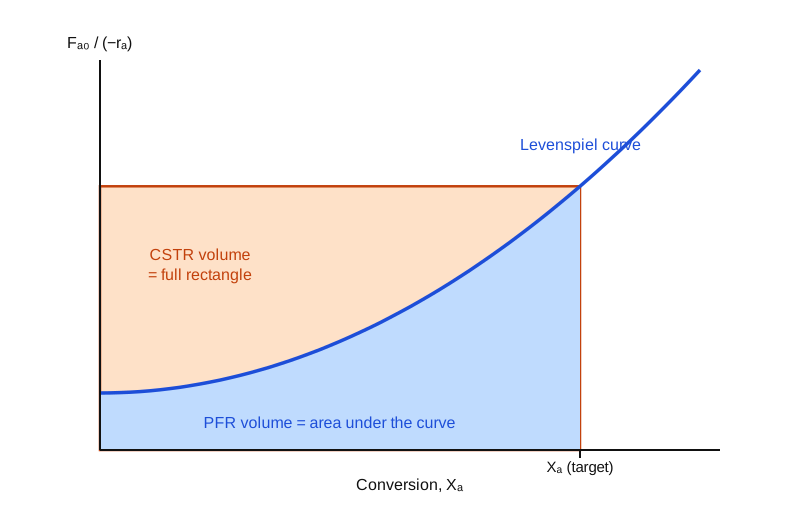
In the Levenspiel plot, what does the area under the curve from 0 to X represent?
PFR volume
Space time
Residence time distribution
CSTR volume
V_PFR = F_A0 ∫dX/(-r_A) is the area under F_A0/(-r_A) vs X. The CSTR volume is the rectangle.
For a positive-order, isothermal reaction at the same conversion, which reactor volume is larger?
Depends only on feed rate
PFR
They are the same
CSTR
The CSTR operates at the low exit concentration, so the rate is lowest everywhere in the tank and volume is larger. For zero order they are equal.
A series of many equal CSTRs approaches the behavior of:
A batch reactor with no mixing
A PFR
A single CSTR
A dead zone
As the number of tanks increases with fixed total volume, back-mixing is gradually eliminated and plug-flow performance is approached.
Which reactor is best for the autocatalytic reaction A → R with rate k C_A C_R?
CSTR first, then PFR
CSTR only
PFR only
Batch with no initial product
The CSTR operates at the maximum-rate composition (a product is available), then a PFR completes the conversion. A PFR with no R in the feed does not start.
In series reactions A → B → C with B desired, you want:
A PFR or batch stopped at the optimal time
A CSTR with a long space time
The highest possible temperature with no control
A high conversion of A at any cost
B is an intermediate: it rises and then falls. Plug-flow/batch stopped at t_opt gives the maximum B; back-mixing in a CSTR lowers it, and going to full conversion converts B to C.
Parallel reactions: desired path is order 2, undesired is order 1 in A. To maximize selectivity:
Keep C_A high
Concentration does not matter
Keep C_A low
Use a very dilute CSTR
S ∝ C_A^(2-1): higher C_A favors the higher-order desired reaction (PFR or batch, undiluted feed).
An exothermic reversible reaction: as the temperature rises, the equilibrium conversion:
Decreases
Is unchanged
Becomes 100%
Increases
By Van't Hoff, K falls with T for exothermic reactions, so equilibrium conversion falls even though the rate rises.
The RTD of an ideal PFR is:
A Gaussian of infinite width
A delta function at τ
An exponential decay
Uniform
All fluid elements spend exactly τ in an ideal PFR. The exponential E(t) = e^(-t/τ)/τ describes a CSTR.
In an effectiveness-factor analysis, η close to 1 means:
External transfer controls
Strong internal diffusion limitation
Negligible internal diffusion limitation
The catalyst is deactivated
η = actual rate / rate with no gradients. φ small means reaction-limited and η near 1; large φ gives η ≈ 1/φ.
Under strong pore-diffusion limitation, the observed activation energy is about:
Zero
Twice the true Ea
Half the true Ea
Equal to the true Ea
Rate ∝ √k in this regime, so E_obs = E_a/2.
True or False: For a first-order reaction, the CSTR and PFR RTDs make no difference to conversion if the mean residence times are the same.
True
False
The PFR gives X = 1 - e^(-kτ), the CSTR gives kτ/(1+kτ), and the CSTR is lower. The RTD matters even for first-order reactions in different ideal reactors; only for a given RTD do segregated and maximum-mixedness models coincide.
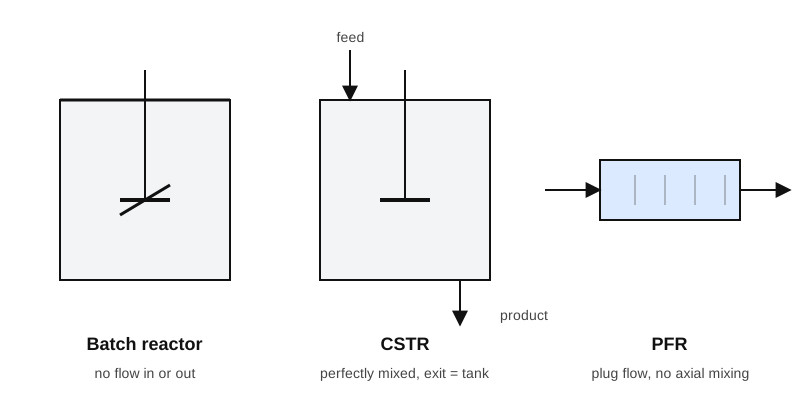
Which diagram is the CSTR?
The second (stirrer with feed in and product out)
The third (tube)
The first (stirrer, closed tank)
None of them
The CSTR has continuous feed and product streams and a stirrer so the contents are uniform. The batch tank has no flow; the tube is a PFR.
Multiple steady states in an exothermic CSTR occur because:
The feed is too cold only
The reactor volume is too small
Rate is zero-order
The heat generation curve is S-shaped versus T while removal is nearly linear
The sigmoid G(T) can cross the linear R(T) three times: low, unstable middle and high steady states.
