Quiz · Hard
Harder problems on R/P, capacity factor, efficiency, soil and water management, mining impacts, Hubbert peak and overfishing.
A wind farm has a rated capacity of 50 MW and generates 140,160 MWh in a year (8,760 hours). What is its capacity factor?
64%
100%
32%
16%
Maximum possible = 50 x 8,760 = 438,000 MWh. 140,160 / 438,000 = 0.32.
A town uses 2 million MWh of electricity a year. A solar farm of 200 MW has a capacity factor of 25%. About what fraction of the town's use could one such farm supply?
22%
50%
12.5%
100%
Output = 200 x 8,760 x 0.25 = 438,000 MWh. 438,000 / 2,000,000 = 0.219, about 22%.
The proven reserves of a fuel are 240 billion barrels. World use is 30 billion barrels per year and rising 2% per year. Which statement is correct?
It will last exactly 8 years
R/P cannot be calculated
It will last more than 8 years because use will fall
The 8-year simple R/P estimate overstates how long it will last if use keeps rising
R/P = 240 / 30 = 8 years at a constant rate. Rising consumption shortens the time, while new discoveries lengthen it.
A coal plant is 33% efficient. A combined-heat-and-power plant uses the waste heat for district heating and reaches 75% overall efficiency. For the same fuel energy of 1,000 MWh, how much more useful energy does the CHP plant deliver?
330 MWh
420 MWh
75 MWh
750 MWh
Coal plant: 330 MWh. CHP: 750 MWh. Difference = 420 MWh.
A hillside field loses topsoil faster than the soil forms. Which combination of changes would reduce erosion the MOST?
Planting corn in the same rows each year
Terracing, no-till planting and winter cover crops
Removing hedgerows and plowing downhill
Flood irrigation of bare soil
Terraces slow water, no-till keeps residue on the surface and cover crops protect the soil in winter.
A farmer in a dry region irrigates with river water for decades and finds yields falling and white crusts on the soil. The best long-term solution is:
Adding more salty water
Stopping all irrigation and plowing deeper
More flood irrigation with no drainage
Drip irrigation with good drainage and periodic flushing
White crusts are salts. Drip irrigation limits the water applied and drainage removes salts.
Wells in a farming region have to be drilled deeper every few years and land is sinking. Which is the MOST likely cause?
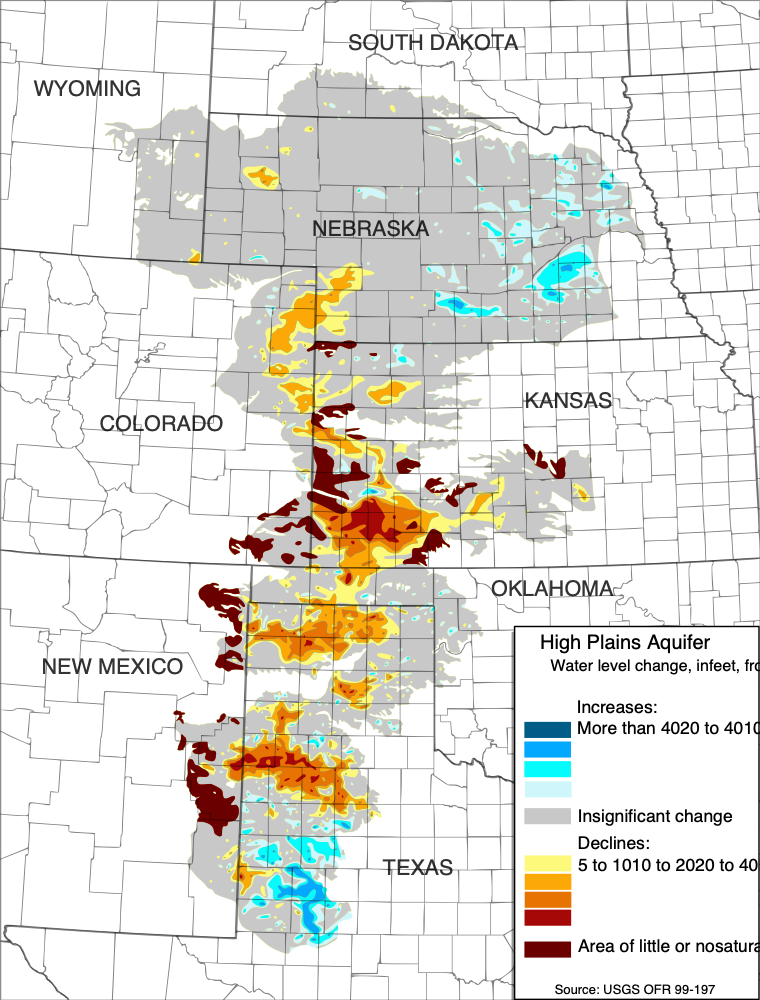
Groundwater withdrawal exceeding recharge
Salt accumulation in the topsoil only
Wetland restoration
Increased rainfall
Overdraft lowers the water table and compacts aquifer sediments (subsidence). Image: Kbh3rd, CC BY-SA 3.0.
Compared with surface mining, underground mining is generally:
Less hazardous for workers
Cheaper and disturbs more land
More expensive and dangerous but disturbs less surface land
Not used for coal
Deep deposits can only be reached by tunnels and shafts, which costs more but leaves a smaller surface footprint.
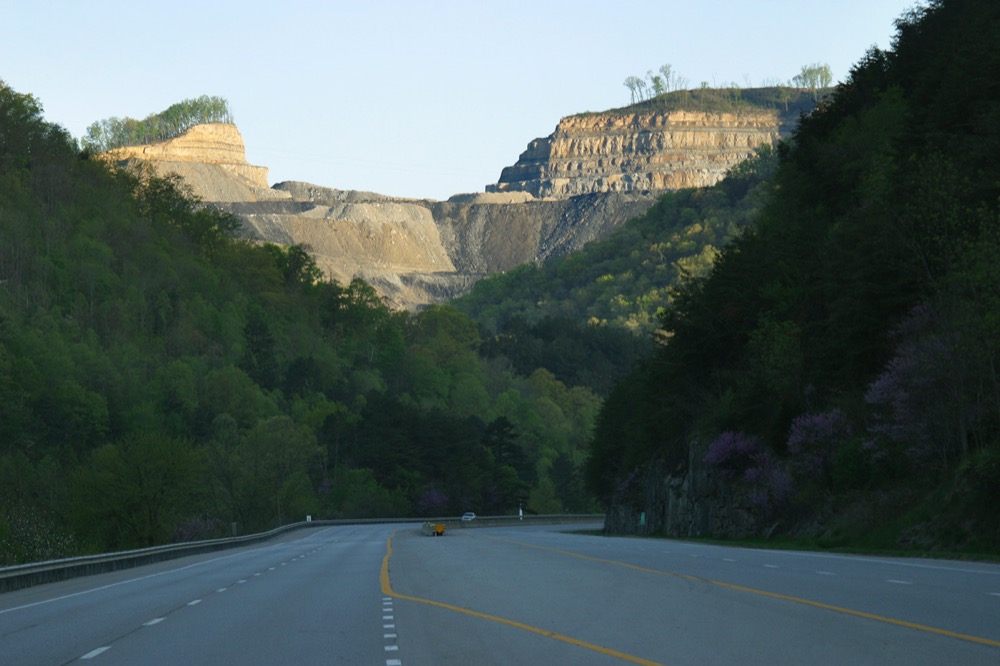
Which pair correctly matches a mining method with a distinctive environmental impact?
Underground mining: loss of soil. Quarrying: ocean acidification
Placer mining: radioactive fallout. Strip mining: acid rain from the dragline
Mountaintop removal: valley fills burying headwater streams. Oil sands: toxic tailings ponds and boreal forest loss
Open-pit mining: nuclear waste. Oil sands: ozone depletion
The other pairs mix up unrelated impacts. Image: iLoveMountains.org, CC BY 2.0.
A rancher increases her herd beyond what the pasture can sustain for several years. Which sequence of effects is MOST likely?
Loss of plant cover, soil compaction and erosion, then desertification
Higher soil organic matter and more grass
More wildlife habitat
Reduced soil erosion
Overgrazing removes the vegetation that protects soil and ultimately reduces productivity.
A fishery's yearly catch has risen steadily for decades, but the catch per boat is dropping and the fish are smaller. What does this suggest?
The population is growing
The fishery is at its optimum
Climate change has not affected it
Overfishing: more effort is needed to catch fewer, smaller fish
Falling catch per unit effort and shrinking fish size are warning signs, as seen before the Grand Banks cod collapse.
Which statement about the difference between a mineral resource and a mineral reserve is correct?
They are the same thing
Reserves are the part of the resource that is economically and technically recoverable now
Resources are only counted when mined
Reserves are always larger than the total resource
A price increase or new technology can turn a resource into a reserve.
Which pair of changes would increase the Hubbert peak resource of a country?
Higher domestic demand only
Discovery of new reserves and technology to access previously unrecoverable oil
A decrease in the oil price only
Removal of all drilling permits
Technology and discoveries enlarge what is recoverable and can delay or raise the peak, but the total is still finite.
A nuclear plant and a coal plant each generate 1,000 MW. Which statement is correct about CO2 emissions and waste?
Only coal produces waste
The nuclear plant emits more CO2 than the coal plant
Both produce the same waste
The nuclear plant emits almost no CO2 in operation but produces radioactive waste; the coal plant emits much CO2, SO2 and ash
Nuclear fission produces no combustion emissions, while coal combustion produces large amounts of CO2, SO2, particulates and mercury.
A dam is built to supply hydropower and irrigation. Which downstream consequence is MOST likely?
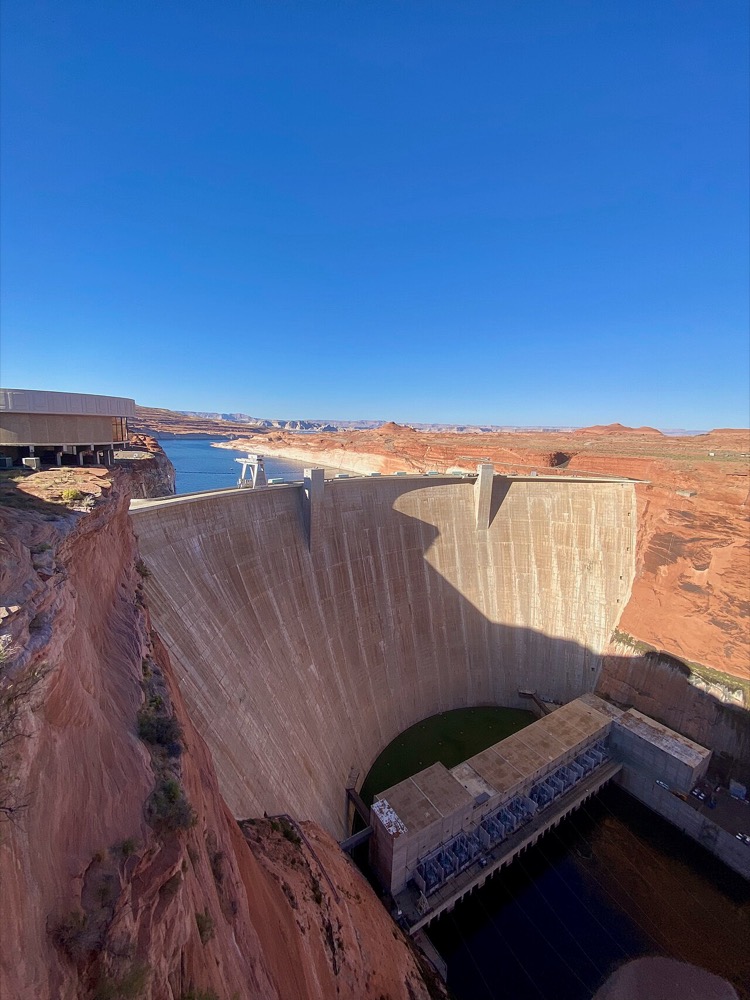
Reduced sediment delivery, causing erosion of the delta and loss of nutrients
Higher sediment loads
No change to river ecology
Increased fish migration
Reservoirs trap sediment, starving deltas and beaches downstream. Image: YosemiteYamper, CC BY-SA 4.0.
