Quiz · Medium
Mixed logistics questions on flows, modes, Incoterms 2020, chargeable weight and distribution network design.
Which statement best describes how logistics relates to supply chain management?
The two terms mean exactly the same thing
Logistics is wider than SCM and includes product design
Logistics is one part of supply chain management, focused on moving and storing goods and information
Logistics covers only transport, while SCM covers only warehousing
SCM also covers sourcing, production planning and partner collaboration. Logistics is the flow and storage component. It covers more than transport alone, so the 'only transport' option is wrong.
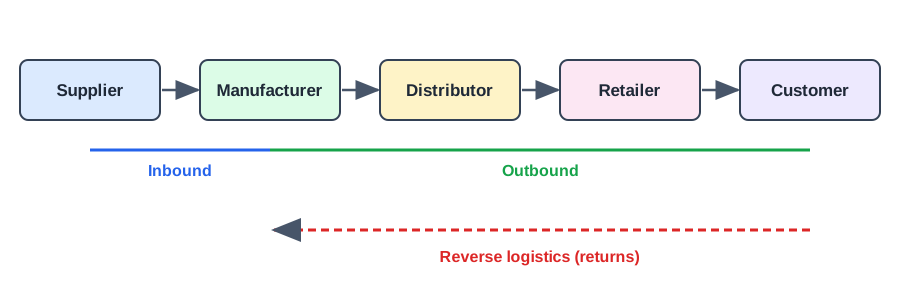
In the diagram, the dashed red arrow running back from the customer represents which flow?
Reverse logistics
Outbound logistics
Inbound logistics
Cross-docking
Flows from customers back toward the seller (returns, repair, recycling) are reverse logistics. Outbound flows run toward the customer.
Which Incoterms 2020 rule places the most obligation on the seller?
EXW
FOB
CIF
DDP
Under DDP the seller delivers cleared for import and pays duties. EXW is the other extreme with minimum seller obligation. CIF sounds generous (seller pays freight and insurance) but risk still passes at origin.
Under FOB (Incoterms 2020), risk passes from seller to buyer when
the goods reach the destination port
the goods are on board the vessel at the port of shipment
the goods leave the seller's factory gate
the buyer pays the invoice
FOB is sea/inland waterway only and risk passes on board at origin. Passing at the destination port would describe a D-term; the factory gate is EXW.
A shipment of 8 cartons, each 60 x 50 x 40 cm and 15 kg, goes by air using /6000. What is the chargeable weight?
120 kg
160 kg
20 kg
140 kg
Volumetric weight per carton = 120,000 / 6000 = 20 kg, so 160 kg total, against actual weight 120 kg. Chargeable weight is the greater, 160 kg.
Which situation favors rail over road?
Delivering a single parcel to a home address
Moving a small urgent medical shipment
Delivering to a customer with no rail siding, same day
Hauling heavy bulk cargo such as grain over a long inland distance
Rail has low cost per tonne-km for heavy bulk over long distances. It is inflexible for door-to-door small loads, which favors road.
What does a negotiable (order) bill of lading do that a sea waybill does not?
It acts as a document of title that must be presented to collect the goods
It proves the goods are insured
It sets the Incoterm used
It fixes the import duty rate
A negotiable bill of lading is a document of title, so control of the paper means control of the goods. A sea waybill only names the consignee.
Incoterms rules decide when ownership (title) of the goods passes to the buyer.
True
False
Incoterms deal with costs, risk and delivery tasks. Title passes as set by the sales contract and applicable law.
A company replaces 12 regional warehouses with 3. According to the square root law, safety stock across the network falls by about
25%
75%
50%
12%
Safety stock scales with the square root of the number of locations: sqrt(3)/sqrt(12) = 0.5. It does not fall in direct proportion to the count (that would be 75%).
A distribution center filled 940 of 1,000 order lines completely and on time. A customer measures it on OTIF. What is the OTIF?
60%
6%
94%
99%
OTIF = orders delivered on time and in full divided by orders: 940/1000 = 94%.
Which pair is correctly matched?
Demurrage: a container held at the terminal beyond free time
Demurrage: fee for a late-delivered air shipment
Detention: fee for goods stored in a bonded warehouse
Detention: fee for an unpaid freight invoice
Demurrage applies at the terminal; detention applies when the carrier's equipment is held outside the terminal beyond the free time.
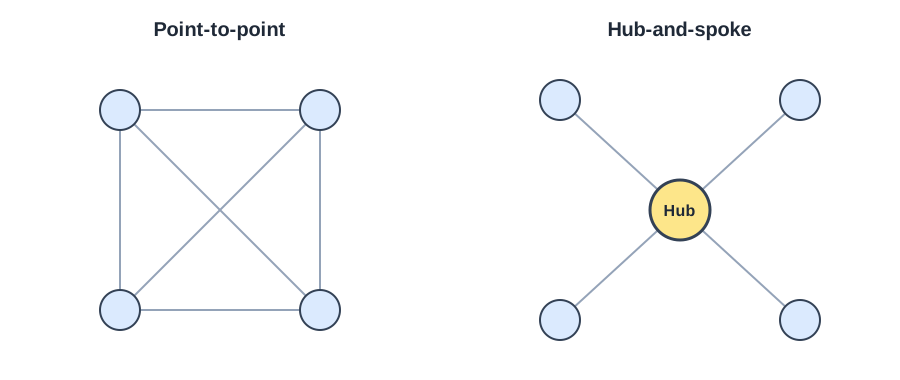
The image shows two network designs. What is the main advantage of the right-hand design?
It always has shorter transit times
It removes the need for any warehouse
It avoids handling goods more than once
It consolidates flows at a central point, requiring fewer links and giving better vehicle utilization
Hub-and-spoke needs n links versus n(n-1)/2 and consolidates loads, but goods are handled at the hub and some routes get longer, so it does not always reduce transit time.
What is the difference between a 3PL and a 4PL?
A 4PL owns more trucks than a 3PL
A 4PL integrates and manages the whole supply chain and several providers, while a 3PL performs operational services
A 3PL manages other 3PLs while a 4PL moves freight
They are the same, 4PL is only a newer name
A 3PL provides services such as transport or warehousing; a 4PL is a strategic integrator that designs and runs the solution and manages 3PLs.
Which is the best example of cross-docking?
Storing pallets in racking for three months
Unloading inbound pallets and loading them straight onto outbound trucks with minimal storage
Re-packing returned goods into new boxes
Shipping goods directly from a supplier to the end customer
Cross-docking removes storage and picking. The last option describes drop shipping.
CIF and CIP differ in that
CIF is for any mode and CIP is sea only
CIP does not require insurance at all
CIF puts import duty on the seller
CIP is for any transport mode and needs higher insurance cover (Clauses A), CIF is sea only with minimum cover (Clauses C)
In Incoterms 2020 CIP requires all-risks cover; CIF still requires minimum cover. Neither makes the seller pay import duty.
Which action most directly reduces last-mile cost per parcel?
Increasing drop density by consolidating deliveries in the same area
Shipping parcels one by one on separate routes
Using faster vehicles on each route
Delivering only at the customer's chosen minute
Last-mile cost depends heavily on stops per route. Higher density spreads vehicle and driver cost over more parcels.
An air waybill is a negotiable document of title.
True
False
The air waybill is a contract and receipt but is non-negotiable. A negotiable bill of lading (sea) can be a document of title.
A truck covers 600 km, of which 150 km is driven empty. What percentage of the distance is empty running?
15%
75%
25%
40%
150 / 600 = 25%. The loaded share is 75%.
A buyer wants to avoid import clearance duties and tasks. Which term fits best?
DAP
FCA
DDP
FOB
Under DDP the seller clears the goods for import and pays duties. Under DAP the buyer still handles import clearance.
A manager chooses the cheapest freight rate but transit is slow and erratic. What is the likely effect on total logistics cost?
Higher inventory and safety stock may raise total cost despite the low freight rate
Total cost always falls with freight cost
Safety stock falls because the transit is slower
Only the freight bill changes
Slow and unreliable transport raises pipeline inventory and safety stock requirements, and can lose sales. Total-cost thinking compares all of these.
A cold chain for vaccines usually requires which temperature range for chilled products?
-18 to -10 °C
8 to 15 °C
15 to 25 °C
2 to 8 °C
Chilled pharmaceuticals and many vaccines are kept at 2 to 8 °C. Frozen food is about -18 °C or colder.
