Quiz · Hard
Scenario-based questions comparing developmental theories, research designs, Kohlberg, Marcia, theory of mind and a teacher's duty to report.
Two preschoolers play next to each other with similar toys but do not interact. Using Parten's categories, this is:
Associative play
Parallel play
Cooperative play
Onlooker play
Parallel play means side by side with no joint activity. Associative play involves interaction without a shared goal.
A student argues that rules should be obeyed to keep society functioning, even if one dislikes them. Which Kohlberg stage?
Stage 4: law and order
Stage 2: self-interest
Stage 3: interpersonal accord
Stage 6: universal principles
Rule following for the sake of social order is conventional, Stage 4. Stage 3 is about approval from others.
A teen has explored many careers and is still deciding. According to Marcia, her status is:
Foreclosure
Achievement
Diffusion
Moratorium
Active exploration without commitment is moratorium. Foreclosure is commitment without exploration.
A 4-year-old watches a puppet put a ball in a basket and leave; another puppet moves it to a box. The child predicts the first puppet will look in the box. Which concept is not yet developed?
Object permanence
Conservation
Theory of mind (false belief)
Seriation
Passing the false-belief task means understanding that others can hold beliefs different from reality, typically by age 4 to 5.
Which is the best contrast between Piaget and Vygotsky?
Piaget stressed culture; Vygotsky stressed stages
Piaget stressed independent discovery and stages; Vygotsky stressed social interaction and cultural tools
Both said language has no role
Both said development is fixed by genes
For Vygotsky, learning leads development through social interaction with more knowledgeable others.
A kindergarten teacher uses sentence frames and gradually removes them as students write independently. This best reflects:
Scaffolding in the ZPD
Assimilation
Operant extinction
Centration
Temporary supports that fade as competence grows are scaffolding.
A study compares reading skills of 6-, 9- and 12-year-olds tested in one month. Which problem could confound it?
Attrition
Practice effects
Retest bias
Cohort effects
Cross-sectional studies can confuse age differences with differences between generations.
A child with a disorganized attachment pattern most likely:
Always seeks comfort and is soothed
Ignores the caregiver completely
Shows contradictory behavior, such as approaching and then freezing or fearing the caregiver
Plays happily regardless of the caregiver
Disorganized attachment, often associated with maltreatment or frightening caregiving, shows no coherent strategy.
Which statement about sensitive periods for language is best supported?
No age effects exist
Language acquisition is easiest in early childhood but not impossible later
Language can only be learned before age 2
Adult learners always outperform children
Evidence suggests a sensitive, not strictly critical, period (for example, accents are easier to acquire early).
A teacher notices a student with frequent unexplained bruises who flinches at adults' movements. What is her legal obligation?
Report reasonable suspicion to child protective services or law enforcement
Wait until she has proof
Ask the parents first
Only report if the child discloses abuse
Teachers are mandated reporters and need only reasonable suspicion, not proof.
A parent tells a toddler, 'I will tell you what to do and no arguments.' She rarely praises. Which outcome is most associated with this authoritarian style?
Highest school achievement and self-reliance
Very impulsive and low in self-control
High self-confidence
Obedient but lower self-esteem and social skills
Authoritarian parenting is associated with lower self-esteem and sometimes anxiety or rebellion. Authoritative is linked with best outcomes.
What is the best reason to screen early for developmental delays?
Delays always resolve on their own
Early labeling lowers expectations
Brain plasticity is greatest early, so interventions are more effective
Screening is only needed for school-age children
Early intervention takes advantage of plasticity and prevents gaps from widening.
Which pair of Erikson stages is correctly matched to ages?
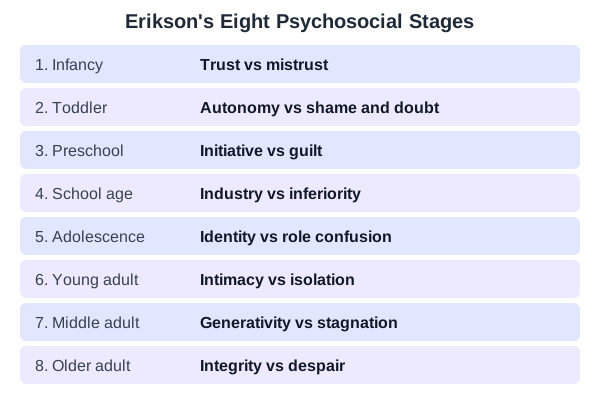
Intimacy vs isolation: adolescence; Identity vs role confusion: young adulthood
Intimacy vs isolation: young adulthood; Generativity vs stagnation: middle adulthood
Industry vs inferiority: toddler; Autonomy vs shame: school age
Integrity vs despair: infancy; Trust vs mistrust: late adulthood
Erikson's stages run from infancy to late adulthood in the order shown in the first option.
A 7-year-old can sort objects by size and color but fails when asked about 'What would happen if gravity were doubled?' Which stage explains this?
Concrete operational
Preoperational
Sensorimotor
Formal operational
Concrete operational children reason logically about real objects, but hypothetical, abstract reasoning develops later.
Which feature would indicate a possible need for an autism evaluation in a 2-year-old?
Prefers some foods
Cries when parents leave
Has temper tantrums
No response to name, little eye contact and no pointing
Social communication differences, such as limited eye contact and lack of joint attention, are early signs. Tantrums and separation distress are typical at this age.
