Quiz · Hard
Sixteen harder questions: balanced budget multipliers, leakage-adjusted multipliers, Ricardian equivalence, open-economy crowding out and debt dynamics.
With MPC = 0.8, a proportional income tax of 20% and imports equal to 10% of added income, the multiplier is closest to:
5.0
4.0
1.5
2.2
Multiplier = 1/(1 − MPC(1 − t) + m) = 1/(1 − 0.64 + 0.10) = 1/0.46 ≈ 2.2. Leakages shrink the simple multiplier of 5.
According to Ricardian equivalence, a deficit-financed tax cut will:
Leave private consumption unchanged as households save to pay future taxes
Raise consumption by the full amount of the cut
Lower interest rates immediately
Raise net exports
Households foresee higher future taxes and save the extra income. Evidence suggests this holds only partly.
In an open economy, expansionary fiscal policy that raises domestic interest rates tends to:
Appreciate the currency and reduce net exports
Depreciate the currency and raise net exports
Appreciate the currency and raise net exports
Have no effect on the currency
Higher rates attract foreign capital, appreciating the currency. Exports fall and imports rise, partly offsetting the stimulus.
MPC = 0.75. The government raises spending and taxes by $40 billion each. The change in GDP is:
+$160 billion
+$120 billion
+$40 billion
$0
+160 from spending and −120 from taxes net to +40 (balanced budget multiplier of 1).
A recessionary gap is $90 billion and the MPC is 0.9. How large an increase in G closes the gap?
$9 billion
$10 billion
$90 billion
$81 billion
Multiplier = 1/(1 − 0.9) = 10, so ΔG = 90/10 = $9 billion. The tax-multiplier answer would be $10 billion.
In the diagram, expansionary fiscal policy moves the economy from Y1 to Yf. What happens to the price level?
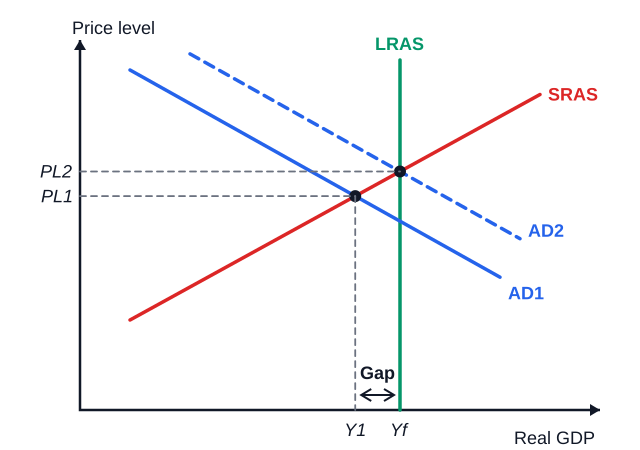
It falls from PL2 to PL1
It rises from PL1 to PL2
It stays at PL1
It becomes undefined
AD shifts right along SRAS, so both output and the price level rise.
Which condition makes crowding out least likely?
Full employment and a tight central bank
Strong private investment demand and rising rates
A deep recession with interest rates near zero and abundant idle resources
A large trade surplus
When there is slack and the central bank holds rates low, government borrowing does not push up rates much and can even raise private investment.
The public debt-to-GDP ratio is more likely to rise when:
GDP grows faster than the interest rate
The government runs large primary surpluses
The interest rate exceeds the growth rate and the primary budget is balanced
Inflation falls to zero
If r > g, debt grows faster than GDP unless offset by primary surpluses.
Which $50 billion policy likely has the largest effect on GDP?
Infrastructure spending that begins immediately
A tax cut for high-income households who save most of it
An increase in the discount rate
Additional interest paid on existing debt
Direct purchases enter AD in full; tax cuts for those with low MPC have smaller multipliers.
A deficit that increases during a recession because tax receipts fall and transfers rise is called:
A cyclical deficit
A structural deficit
A primary deficit
A trade deficit
The change is caused by the business cycle, not by new policy.
The Social Security trust fund buys additional Treasury securities. What happens?
Both gross debt and public debt fall
Gross federal debt rises but debt held by the public does not rise
Debt held by the public rises
Only debt held by foreigners rises
Securities held by government trust funds are intragovernmental debt, included in gross debt but not in debt held by the public.
A chart's total deficit and primary deficit differ by:
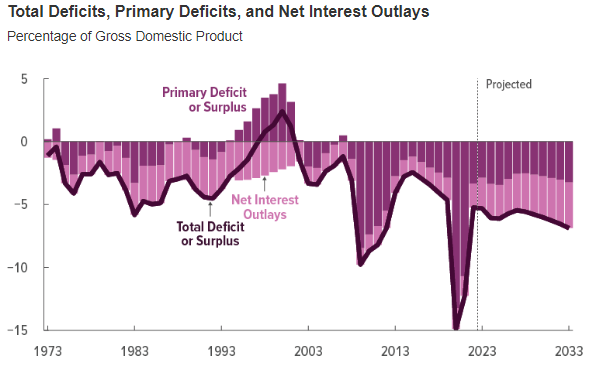
Net interest outlays
Defense spending
Discretionary spending
Tax revenue
Primary deficit excludes interest. Total deficit = primary deficit + net interest. Image: CBO, public domain.
The economy is at full employment. The government raises spending without raising taxes, and the central bank holds interest rates steady. In the short run:
Unemployment rises above the natural rate
Real GDP falls below potential
The price level falls
Inflationary pressure builds as AD shifts right of potential output
With no slack, extra demand pushes output above potential, raising wages and prices until SRAS shifts left.
A $100 billion recessionary gap, MPC = 0.8. Which pair is correct?
ΔG = $25B or ΔT = −$20B
ΔG = $20B or ΔT = −$25B
ΔG = $20B or ΔT = −$20B
ΔG = $5B or ΔT = −$4B
Spending multiplier 5 → ΔG = 20. Tax multiplier −4 → ΔT = −25. Tax cuts must be larger than spending increases.
Which feature of supply-side policy distinguishes it from Keynesian policy?
It works mainly by shifting LRAS through incentives, not by shifting AD
It relies on the multiplier
It increases government spending
It targets the money supply
Supply-side cuts in marginal tax rates aim to increase work, saving and investment, expanding potential output.
Which of these best explains why discretionary fiscal policy may destabilize the economy?
Taxes are not collected in recessions
Lags can cause stimulus to arrive after the recovery has begun
Government spending cannot affect AD
Interest rates never respond
With recognition, legislative and implementation lags, stimulus may arrive in a later expansion, adding to inflation pressure.
